






























India has issued a strong diplomatic protest following an attack on a commercial vessel carrying Indian crew members off the coast of Oman. The incident has raised concerns about maritime security in the Gulf region and the safety of Indian seafarers working on international shipping routes.
India Condemns Attack on Commercial Vessel
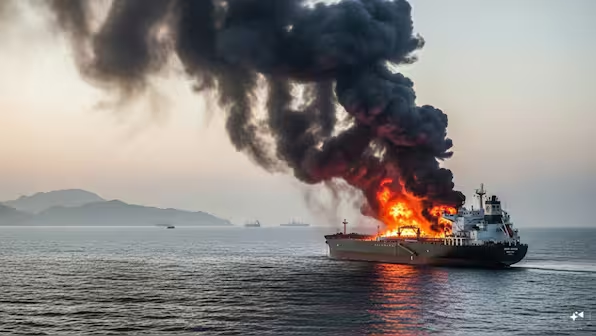
India’s diplomatic protest came after the commercial vessel Settebello was attacked in the Gulf of Oman while carrying 24 Indian crew members. According to official statements, 21 Indian nationals were rescued, while three crew members were initially reported missing following the incident.
The Ministry of External Affairs (MEA) strongly condemned the attack and stated that Indian authorities were working closely with Omani officials to monitor rescue and recovery efforts. The government also summoned the United States Chargé d’Affaires in New Delhi to formally convey India’s concerns regarding the incident.
The diplomatic response reflects India’s growing focus on protecting its citizens working in high-risk maritime zones. Thousands of Indian seafarers serve aboard commercial vessels operating across international waters, making maritime safety a key foreign policy concern.
What Happened Near the Coast of Oman?
The attack occurred off the coast of Oman in the strategically important Gulf of Oman, a region that serves as a critical gateway to the Strait of Hormuz. The area is one of the world’s busiest maritime corridors, handling a significant portion of global oil and energy shipments.
Reports indicate that the vessel was struck while transiting the region. The incident immediately triggered search and rescue operations involving Omani authorities and maritime agencies. India’s embassy in Oman coordinated with local officials to track the status of the crew members and support rescue efforts.
The attack has attracted international attention because any disruption in the Gulf of Oman can affect global shipping routes, energy markets, and regional stability. Commercial vessels operating in the region often face heightened security risks during periods of geopolitical tension.
Diplomatic Protest Signals Serious Concern
India’s decision to summon a senior American diplomat demonstrates the seriousness with which New Delhi views the incident. In diplomatic practice, issuing a formal protest, often referred to as a demarche, is a significant step used to express strong objections over actions affecting national interests or citizens abroad.
Officials emphasized that the safety of civilian mariners and commercial shipping must remain a priority. India has consistently advocated for freedom of navigation and secure maritime trade routes in the Indian Ocean and surrounding waters.
The government also reiterated that attacks on commercial vessels place innocent crew members at risk and can have broader consequences for international commerce. The incident has renewed discussions about protecting merchant shipping in conflict-prone regions.
Why Indian Seafarers Are Important to Global Shipping
India is one of the world’s largest suppliers of skilled maritime professionals. Indian seafarers serve on cargo ships, oil tankers, container vessels, and other commercial fleets operating across global trade routes.
According to industry estimates, hundreds of thousands of Indian maritime workers contribute to international shipping operations each year. Their role is vital to maintaining global supply chains and energy transportation networks.
Incidents such as the Oman vessel attack highlight the challenges faced by these professionals. Unlike military personnel, commercial crew members are civilians whose primary responsibility is operating and maintaining ships involved in international trade.
When attacks occur in major shipping corridors, Indian authorities often work through diplomatic channels to ensure crew safety, secure rescue operations, and seek accountability where necessary.
Maritime Security Remains a Global Challenge
The Gulf of Oman and nearby Strait of Hormuz remain strategically important waterways connecting the Middle East with global markets. Any security incident in the region attracts attention from governments, shipping companies, insurers, and energy traders worldwide.
In recent years, concerns over attacks on commercial vessels, maritime disruptions, and regional conflicts have prompted countries to strengthen monitoring and security measures. India has also maintained a strong focus on maritime awareness and the protection of Indian citizens working in international waters.
As investigations and rescue efforts continue, the incident serves as a reminder of the risks faced by commercial shipping crews in sensitive maritime zones. The outcome of ongoing diplomatic engagement and search operations will likely remain under close observation in the coming days.
Key Takeaways
• India formally protested the attack on the commercial vessel Settebello near Oman.
• The ship carried 24 Indian crew members, with 21 rescued and rescue efforts continuing for missing personnel.
• New Delhi summoned the US Chargé d’Affaires to convey its concerns over the incident.
• The attack has renewed focus on maritime security and the protection of Indian seafarers.
FAQ
Why did India issue a diplomatic protest?
India issued a protest after a commercial vessel carrying Indian crew members was attacked near Oman, putting the lives of Indian citizens at risk.
How many Indian crew members were on board?
Official statements said the vessel had 24 Indian crew members on board at the time of the attack.
Where did the incident occur?
The attack took place off the coast of Oman in the Gulf of Oman, an important international shipping route.
Why is the Gulf of Oman strategically important?
The Gulf of Oman connects to the Strait of Hormuz, a key maritime passage used for transporting oil, gas, and commercial goods worldwide.
(India diplomatic protest, Oman vessel attack, Indian crew Oman, Gulf of Oman news, maritime security, Indian seafarers, Settebello vessel, India foreign policy, shipping route security, Oman maritime incident)