






















“Look at the way Rahat dresses, he’s definitely gay”
A comment posted online about Rahat Achanta’s wardrobe. Not one outfit. All of them.
So, is Rahat gay? For the record, he is straight. But the record is not the point. The better question is why a man in colour and ornament gets asked at all: why do we treat fashion as a declaration of sexuality?
Where the rule came from
In 1930 the psychologist J.C. Flügel named the Great Male Renunciation, the late-18th-century moment when Western men gave up lace, silk and colour, handed decoration to women, and aimed only to be useful. The idea that a “real man” doesn’t adorn himself is a historical costume, not a law of nature.
India inherited it with a twist. The historian Mrinalini Sinha shows how colonial politics built the “manly Englishman” against the “effeminate Bengali”, and the fear of looking soft stuck. Yet Hyderabad remembers otherwise. The Nizams wore turban ornaments, necklaces, armbands and pearls. Nobody asked a Nizam about his orientation. They called him Your Highness.
The Controversial Look
Via @rahatachanta
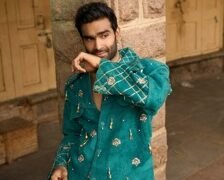
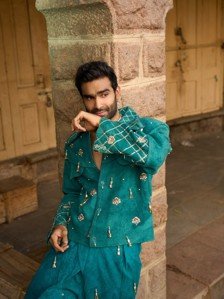
This is Rahat’s most expressive, most refined look, and our favourite to date. The Shehzaada set by Farak is structured and cropped, with clean tailored lines, then lit up by hand embroidery: gold motifs blooming across deep teal, tassel charms swinging on tiny loops, a lattice of gold thread down the sleeves, draped trousers finishing the thought. It is a homage to the artisan, where embroidery is the point and not the trim.
It is royalty, worn lightly. Shehzaada means prince, and the set carries the opulence of the court in a cut made for now. Homegrown described the jacket as quilted and hand-embroidered, a nod to royal grandeur in a structured, current tone, and it sits in a collection that carries Indian folk heritage into streetwear, alongside kantha-embroidered shirts and handmade jackets.
Farak is a Jaipur label founded in 2021 by Rishabh Kumar. The name means difference, and its tagline, #BeTheFarak, is an invitation to be exactly that. The label works with artisans on handwoven, block-printed and handmade garments, released in limited runs, which makes each piece feel like a collaboration between maker and wearer. For a man answering a stereotype, it is the right label to answer in: a homegrown brand that treats individuality as the whole point and Indian craft as the way to express it.
And Rahat wears it beautifully.
The Telugu script of what looks good
Telugu cinema’s public script of manhood prizes swagger. Critics such as Film Companion describe mass-hero films as steeped in excess masculinity, and fan associations are a largely masculine space, so the screen sets the standard the street copies. Style is allowed inside that script as long as it reads as potency. Allu Arjun became the “Stylish Star” in suits, trench coats and silk shirts, then reinvented himself in a beard and lungi for Pushpa. Both looks are a flex.
Rahat’s version is different: style as play, and as pleasure in craft, with no fight attached. That falls outside the script, and the script answers with its oldest question. Stars also have armour. A hero’s fan club and cultural capital turn his ornament into swagger, while a man without them is simply read. Rahat has no such shield, so his jacket cost him a little more, which is part of why it is brave. Judith Butler called gender a “stylized repetition of acts”, and each “is he gay?” is the norm pushing back.
The reply
Rahat didn’t explain himself. He got dressed. He posted another flamboyant suit, this one, a beautiful pink with stunning detailing that’s impossible to look away from by Varun Chakkilam, with a caption:
It takes bigger balls to break stereotypes than to fit into them.
Flamboyant by choice. Confident in my masculinity. Unapologetic by nature.
It never answers the question. It refuses it, claiming beauty and masculinity together, the pairing Flügel said men had to give up. The internet, meanwhile, was inconsistent. In one corner it called him gay for his clothes. In another, the chatter paired him with Varsha D’Souza. Same wardrobe, opposite conclusions. A suit offered as proof of both is proof of neither.
So, what does this mean for us?
It began with one careless sentence, a stranger deciding that the way a man dresses is proof of who he is, and it opens onto a very old quarrel about who is allowed to be beautiful. Flügel called it a renunciation, but it was really a bargain: men laid down their pearls and silks and were handed seriousness in return, and ever since, any man who picks them back up has been accused of breaking the deal. Sinha showed how an empire turned that bargain into a weapon in India, making softness a charge a man had to answer, and the Telugu screen kept the weapon polished, rewarding the hero whose style reads as swagger and quietly punishing the one whose style reads as play. Butler explains how it survives. If gender is a stylized repetition of acts, then a wardrobe is a daily argument, and each “is he gay?” is a crowd reaching out to straighten a performance it did not expect. The question never reveals the man. It reveals the script the crowd is afraid to leave. Yet the Nizams wore their pearls and were called Your Highness, which tells us the rule was never written in nature, only in fear, and that what we call tradition is often just the habit of a single century. Rahat stepped out of that script with grace. When the internet handed him two opposite verdicts at once, he did not argue the point, he refused its terms: flamboyant by choice, confident in his masculinity, unapologetic by nature. That is the quiet generosity of what he did. He made a freer kind of manhood visible to the next young man watching from the edge of the room, and he showed that courage is not the art of fitting in but the willingness to be looked at. For in the end every garment is a small philosophy, a way of saying this is what moves me, this is the beauty I chose to carry into the world, and a philosophy of taste is not a confession of desire. To read a man’s heart in his sleeve is to mistake the surface for the soul and the performance for the person. Fashion is not a confession, a man in embroidery is simply a man who loves beauty, and Rahat Achanta, flamboyant by choice, has made that plain.
And if you’re looking to find more of Rahat, follow him on Instagram at https://www.instagram.com/rahatachanta/ . We’re all definitely hoping to see more of his experimentation!