































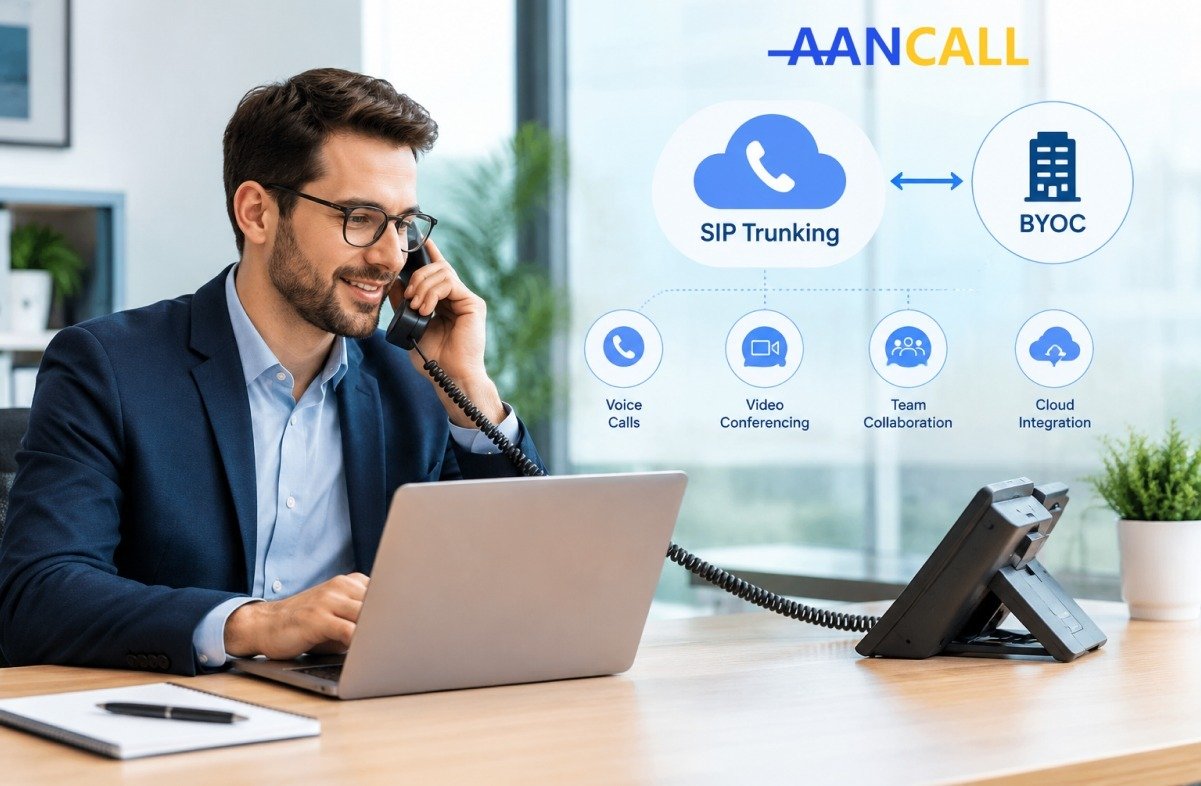
AANCALL is highlighting the importance of flexible voice connectivity strategies as enterprises look for ways to modernize business communications, support distributed teams, and manage increasingly complex customer interactions.
SIP trunking and Bring Your Own Carrier (BYOC) integration are two approaches that businesses can evaluate when upgrading their communication infrastructure. Together with compatible business phone systems and contact center platforms, these technologies can help organizations build communication environments that better align with their operational requirements.
As companies expand across locations and serve customers through multiple channels, traditional telephony infrastructure can become difficult to scale. Flexible connectivity options offer businesses an alternative approach to managing voice services while planning for future growth.
SIP Trunking Supports Scalable Business Voice Connectivity
Session Initiation Protocol (SIP) trunking enables voice calls to travel over IP-based networks, connecting compatible business phone systems to the public telephone network through a service provider.
Unlike traditional telephone circuits, SIP trunking can allow businesses to adjust voice capacity according to their needs, subject to provider plans, network capabilities, and system configuration.
For enterprises managing multiple offices or high call volumes, this flexibility can support more efficient capacity planning. It can also help organizations evaluate their existing telephony infrastructure before committing to a complete system replacement.
SIP trunking may be particularly relevant for contact centers, business process outsourcing companies, financial services organizations, retailers, and other businesses that depend on reliable voice communications.
BYOC Gives Enterprises More Carrier Flexibility
Bring Your Own Carrier (BYOC) allows businesses to use a selected telecommunications carrier with a compatible cloud communications or contact center platform.
This approach can be useful for organizations that want to retain an existing carrier relationship, meet regional calling requirements, or maintain greater control over their voice services. However, implementation depends on carrier support, platform compatibility, regulatory requirements, and the availability of suitable connectivity options.
SIP trunking and BYOC serve related but different purposes. SIP trunking provides a method of connecting voice services over IP networks, while BYOC describes an approach to selecting and integrating a carrier with a communications platform.
For enterprises reviewing their technology investments, understanding this distinction can help clarify infrastructure requirements and avoid unnecessary complexity.
Supporting Changing Enterprise Communication Needs
Modern business communications must accommodate more than basic inbound and outbound calls. Organizations may also need call routing, contact center capabilities, virtual phone numbers, messaging, and support for geographically distributed teams.
A flexible communication strategy starts with understanding these requirements. Businesses should assess their current phone systems, expected call volumes, network readiness, security controls, and integration needs before selecting a solution.
A structured implementation process can include compatibility checks, pilot testing, call-quality monitoring, redundancy planning, and a review of emergency calling and local regulatory obligations. These steps help businesses identify potential issues before wider deployment.
Cost evaluation is equally important. Enterprises should consider recurring service fees, setup costs, international calling rates, existing equipment, support arrangements, and any additional charges associated with implementation.
AANCALL’s Business Communications Portfolio
AANCALL provides cloud-based business communication solutions, including Hosted PBX, call center software, virtual phone numbers, SMS/MMS, and contact center services. These offerings address a range of business calling, messaging, and customer interaction requirements.
Organizations evaluating SIP trunking or BYOC integration should confirm the specific carrier options, system compatibility, geographic availability, and technical capabilities relevant to their intended deployment.
By assessing business requirements before implementation, enterprises can make more informed decisions about their communication infrastructure and select solutions suited to their operational needs.
About AANCALL
AANCALL provides cloud-based business communication solutions designed to support business calling, messaging, and customer interactions. Its portfolio includes Hosted PBX, call center software, virtual phone numbers, SMS/MMS, and contact center services for organizations seeking flexible communication tools.
Media Contact:
AANCALL
Website: https://www.aancall.com/
Contact page: https://www.aancall.com/contact