























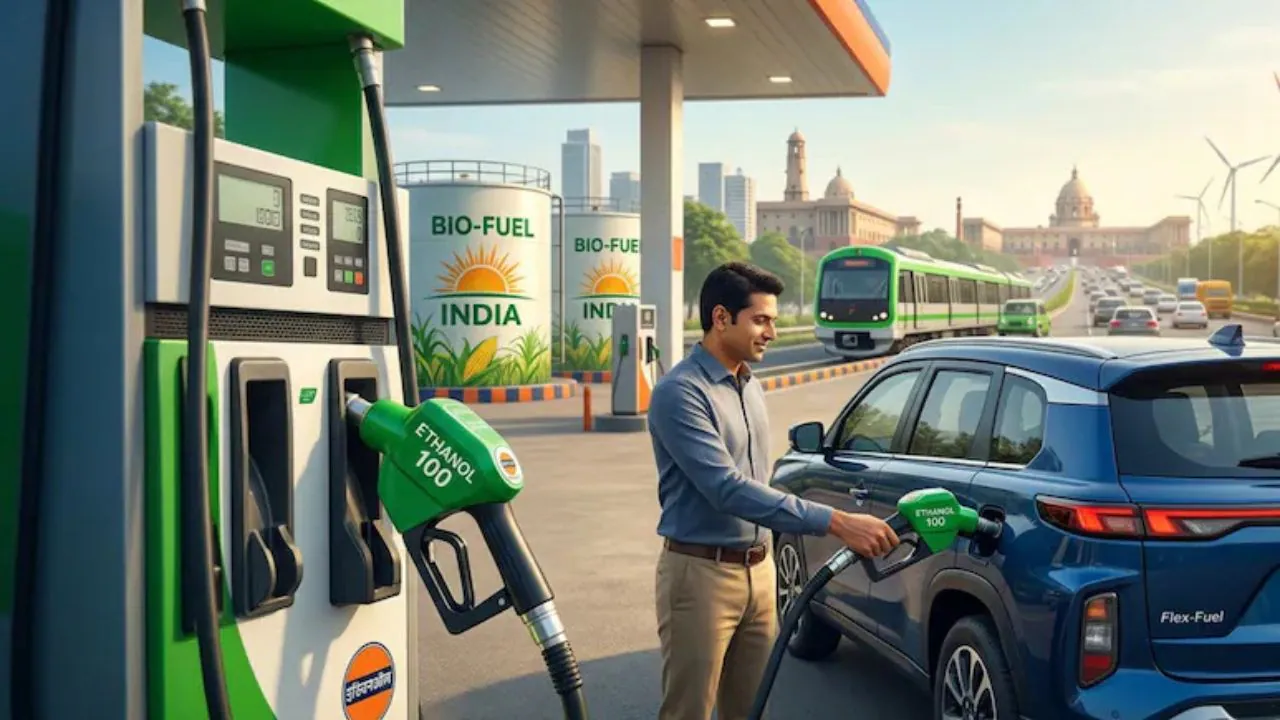
India has amended its motor vehicle rules to allow specially designed flex-fuel vehicles to use E100, a fuel consisting almost entirely of ethanol. The decision creates a regulatory pathway for higher-ethanol fuels, but ordinary petrol car and bike owners cannot switch to E100 without manufacturer-approved compatibility.
What Are the New E100 Fuel Rules in India?
The Ministry of Road Transport and Highways (MoRTH) notified amendments to the Central Motor Vehicles Rules, 1989, on October 26, 2026, bringing E100 into the regulatory framework alongside E85 for eligible flex-fuel vehicles. The amendment provides a clearer route for automakers to develop and certify vehicles capable of operating on higher ethanol blends.
Under the revised provisions, E85 or E100 can be used only in vehicles specifically designed by original equipment manufacturers (OEMs) as flex-fuel vehicles. This is an important distinction for Indian motorists because the change does not make every petrol-powered car or motorcycle compatible with high-ethanol fuel.
The government has also clarified that existing vehicle owners are not required to modify their vehicles or switch to a different fuel because of this amendment. The rules establish a framework for compatible vehicles rather than a compulsory change for the entire petrol vehicle fleet.
The amendment follows India’s broader efforts to increase the use of ethanol as an alternative automotive fuel and reduce dependence on imported crude oil.
E100 vs E85 vs E20: Understanding the Difference
The numbers used in ethanol-blended fuels indicate the approximate proportion of ethanol in the fuel. Understanding these labels is essential before choosing a fuel at a petrol pump.
E20 contains 20% ethanol and 80% petrol. It forms part of India’s ethanol-blended petrol programme and is intended for vehicles approved to use this blend.
E85 contains approximately 85% ethanol, with the remaining proportion consisting mainly of petrol. It is intended for flex-fuel vehicles engineered and certified to operate on high-ethanol blends.
E100 refers to fuel consisting almost entirely of ethanol. Although the name indicates 100, the actual composition and applicable fuel specifications depend on the relevant standards.
The main difference is not simply the percentage of ethanol. Each fuel has different combustion characteristics, energy content and material compatibility requirements. Vehicles designed for conventional petrol or E20 cannot automatically handle E85 or E100.
According to the Ministry of Road Transport and Highways, the higher-ethanol fuels covered by the revised rules are restricted to vehicles specifically designed and certified for them.
Can Existing Petrol Cars and Bikes Use E100?
No. The new E100 fuel rules do not permit owners of conventional petrol cars or motorcycles to start using E100 simply because the government has approved it for flex-fuel vehicles.
Ethanol behaves differently from petrol in several respects. It has different energy content and combustion characteristics, and it can affect materials used in fuel lines, seals, pumps and other fuel-system components. Engines and fuel systems must therefore be engineered for the approved range of ethanol blends.
Flex-fuel vehicles are designed to address these requirements. Depending on their specifications, they may use compatible fuel-system components, sensors and engine-management systems that adjust operation according to the fuel composition.
A conventional petrol vehicle approved for E20 does not automatically have these capabilities. Using a higher ethanol blend without manufacturer approval could cause performance problems or damage components that are not designed for it. It could also create warranty concerns.
Before purchasing E100 or E85, motorists should check the vehicle’s fuel compatibility sticker and owner’s manual. They should also consult an authorised service centre if the approved fuel range is unclear.
The government’s notification does not require existing vehicle owners to retrofit their cars or bikes for higher ethanol blends.
How Flex-Fuel Vehicles Work
Flex-fuel vehicles use an internal combustion engine adapted to operate on different petrol and ethanol mixtures within the manufacturer’s approved range.
Their fuel systems are designed to handle the relevant ethanol concentrations. Depending on the vehicle, electronic sensors and engine-control systems can help adjust fuel delivery and ignition settings to suit the blend being used.
This flexibility allows motorists to use different approved fuel mixtures without requiring a separate engine for each blend. However, compatibility varies by model, and the term flex-fuel should not be treated as a guarantee that a vehicle can run on every possible ethanol concentration.
The technology is already used in countries such as Brazil and the United States. India is now working towards wider adoption through vehicle regulations, fuel standards and the development of supporting infrastructure.
In June 2026, the government highlighted the launch of Maruti Suzuki’s Wagon R Flex Fuel passenger vehicle, which was presented as capable of operating on ethanol-petrol blends ranging from E20 to E100.
The availability of such vehicles will be an important factor in determining how quickly higher-ethanol fuels can become practical for Indian motorists.
Why Is India Promoting E100 and Higher Ethanol Blends?
One of the main objectives of India’s ethanol programme is to reduce dependence on imported crude oil. Since petrol is produced from crude oil, increasing the use of domestically produced ethanol in suitable vehicles could help diversify the country’s transport fuel supply.
Ethanol production can also create demand for agricultural feedstocks, including sugarcane and other crops used in biofuel production. This may provide additional economic opportunities for farmers and businesses involved in the ethanol supply chain.
Environmental benefits are another consideration. Ethanol use in appropriately designed vehicles can reduce certain exhaust pollutants. Its overall greenhouse gas impact, however, depends on factors such as the feedstock, agricultural practices, production methods, processing energy and transportation.
E100 should therefore not be described as automatically emission-free. The vehicle still uses an internal combustion engine, and the environmental impact of the fuel depends partly on how the ethanol is produced.
For India, the potential benefits will depend on the availability of competitively priced ethanol, efficient production, suitable vehicles and a reliable fuel distribution network.
Will E100 Be Available at Petrol Pumps Across India?
Regulatory approval for E100-compatible vehicles does not mean the fuel will immediately be available at every petrol pump.
Higher-ethanol fuels require appropriate storage, handling and dispensing arrangements. Fuel retailers must also be able to identify the correct fuel and provide it to vehicles approved for its use.
In June 2026, the Ministry of Petroleum and Natural Gas outlined plans to expand the availability of high-ethanol fuels through designated retail outlets. The proposed rollout included an expansion to around 500 outlets by December 2026 and approximately 5,000 outlets by December 2027.
These figures are stated rollout targets, not confirmation that the planned number of outlets is already operational. Actual availability will depend on implementation and local infrastructure.
For motorists in Tier-2 and Tier-3 cities, including Nagpur, practical access will be a key consideration. Even if a compatible vehicle becomes available, buyers will need to know whether suitable fuel is sold in their area before relying on it for regular travel.
Consumers should check current information from fuel retailers and vehicle manufacturers rather than assume E100 is available at their nearest petrol station.
What Should Drivers Know Before Buying a Flex-Fuel Vehicle?
For consumers considering a future flex-fuel car or motorcycle, the fuel compatibility range should be one of the first things to check. Buyers should confirm which blends the manufacturer has approved and whether the vehicle can use conventional petrol, E20, E85 or E100.
Running costs also deserve attention. Ethanol generally contains less energy per litre than petrol, which can mean higher fuel consumption by volume under comparable conditions. The actual difference depends on the blend, engine design, driving conditions and vehicle calibration.
Consumers should compare the vehicle’s expected running costs rather than assume a higher ethanol percentage automatically means cheaper travel. Fuel prices, mileage, maintenance requirements and local availability all influence the final cost.
Warranty coverage is another important factor. Owners should follow the manufacturer’s instructions and avoid unauthorised modifications to the fuel system.
Finally, buyers should consider the maturity of the refuelling network. A vehicle designed for multiple fuel blends may offer flexibility, but that advantage is limited if the required fuel is difficult to find.
Key Takeaways
- India amended the Central Motor Vehicles Rules in October 2026 to recognise E100 alongside E85 for eligible flex-fuel vehicles.
- Conventional petrol vehicles and vehicles approved only for E20 cannot automatically use E85 or E100.
- Existing motorists do not have to modify their vehicles or change fuels because of the new rules.
- Wider adoption will depend on certified vehicles, fuel availability, pricing and the expansion of suitable retail infrastructure.
Frequently Asked Questions
1. What is E100 fuel?
E100 refers to fuel consisting almost entirely of ethanol. It is intended for vehicles specifically designed and certified to operate on this high-ethanol fuel.
2. Can I use E100 in my existing petrol car?
No, not unless the vehicle is specifically designed and certified for E100. Approval to use regular petrol or E20 does not establish E100 compatibility.
3. Is E100 available at every petrol pump in India?
No. The availability of E100 depends on the rollout of appropriate storage and dispensing facilities. Motorists should verify availability at local fuel stations.
4. Does the new E100 rule mean petrol will be replaced?
No. The amendment provides a regulatory pathway for compatible flex-fuel vehicles. It does not require existing petrol vehicles to switch to E100 or establish an immediate nationwide replacement of conventional petrol.