































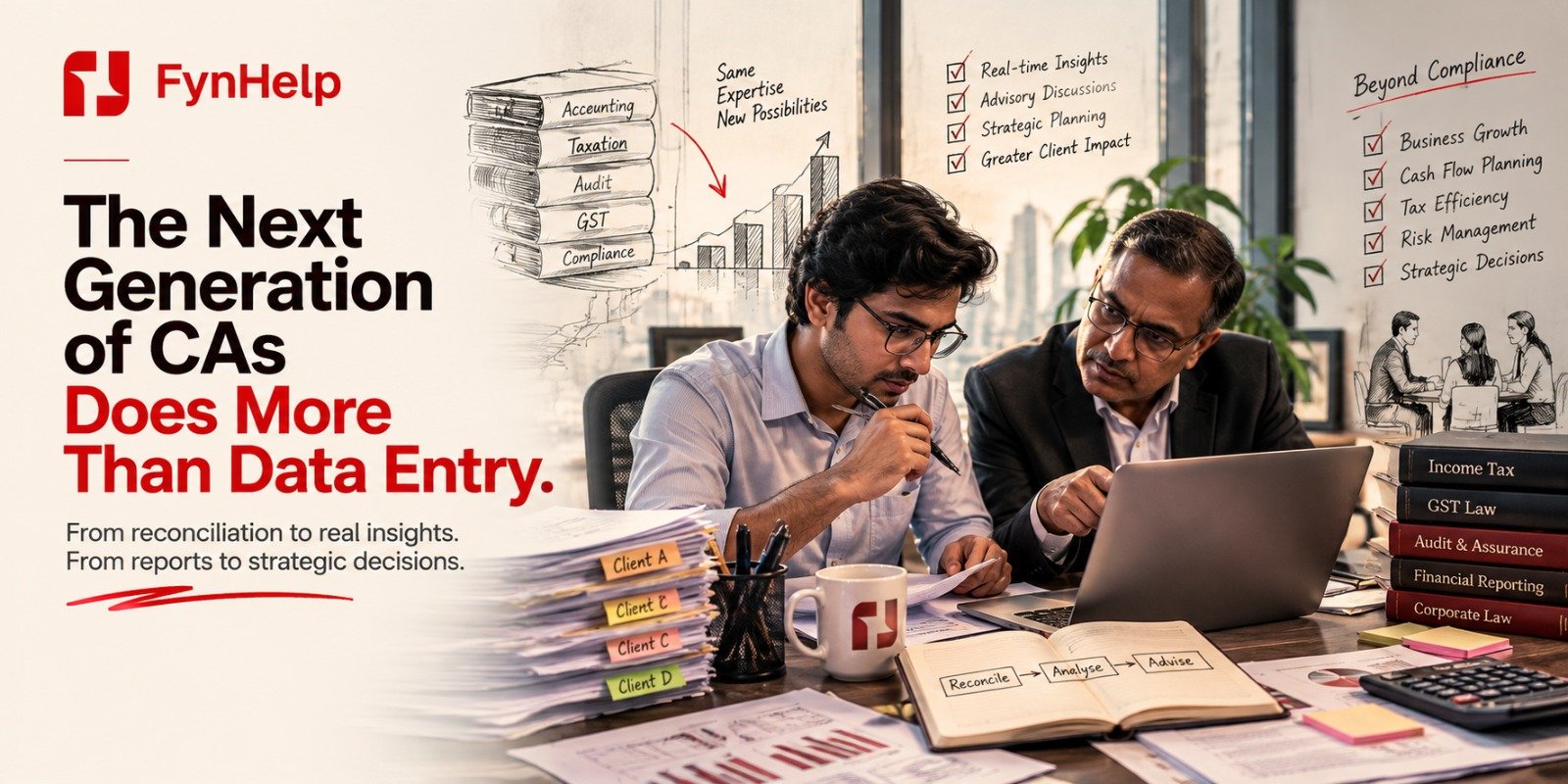
As AI agents take over reconciliation, India’s CA firms are being pushed from processing data to exercising judgement.
For generations, becoming a chartered accountant in India has meant earning your judgement the slow way.
You started by ticking ledger lines. You matched bank entries to invoices, chased missing bills and rebuilt reconciliations that didn’t tie. Somewhere in those years, almost by accident, you learned what a healthy set of books looks like and what a troubled one smells like.
That apprenticeship is about to look very different.
This October, a Bengaluru-based startup called FynHelp launched AI agents that take on the most repetitive part of a CA firm’s month: reconciling books against bank statements and GST data. It’s one small launch. But it points at a much bigger question for the profession. If software does the ticking, how do accountants learn, and what do firms sell?
From processing to judgement
Much of the work inside a typical practice today is processing. Collecting documents, extracting transactions, matching them, flagging gaps. It’s necessary, it’s billable only indirectly, and it eats the hours of the people firms most want to grow.
AI is now good enough to do a large share of it. FynHelp’s AI agents for CA firms read bank statements, invoices and GST documents, reconcile them against the books in Tally or Zoho Books, and pass only the exceptions to a person. They then build MIS and narration packs where every figure traces back to a source.
What’s left for humans is the part that was always the real job: deciding what an exception means, how a transaction should be treated, and what the numbers say about a client’s business.
“Accountants didn’t train for years to be matching machines,” says Tarun Adireddy, FynHelp’s co-founder and CEO. “Our agents do the work that doesn’t need a CA. That gives the CA more time for the work that does.”
A new kind of apprenticeship
The obvious worry is deskilling. If juniors never tick a ledger, will they ever learn to read one?
The more likely outcome is that learning moves earlier. A junior who spends the month investigating exceptions sees the interesting problems from day one: the unexplained credit, the supplier who didn’t file, the receipt that doesn’t fit any invoice. Those are exactly the cases that build judgement. In the old model, they were buried under hundreds of routine matches.
Early evidence supports this. A widely cited Stanford and MIT study of AI at work found the biggest gains went to newer, less experienced staff, with productivity up 34 percent for that group, and that AI appeared to help them learn faster.
Managers change too. Their time shifts from proofreading spreadsheets to coaching juniors through decisions. Partners shift from signing on trust to signing on evidence they can trace.
Firms will still need to teach fundamentals deliberately. But the raw material for learning gets better, not worse.
What firms will sell
The second shift is commercial. When close takes days instead of weeks, a firm has something new to offer: timely numbers. A monthly MIS that arrives on the fifth, with a clear explanation of what moved and why, is no longer a compliance output. It’s advice.
That’s the direction professional bodies like the Institute of Chartered Accountants of India have long encouraged members toward: more advisory, more insight, less pure compliance. The bottleneck has always been time. Tools that free it up make the shift practical rather than aspirational.
The institute is now acting on it. ICAI set up a dedicated AI in ICAI committee in 2024, and more than 16,000 chartered accountants were trained in AI applications between July 2024 and February 2025.
FynHelp’s own design reflects that. It doesn’t write to the ledger, so control and accountability stay with the firm. It prices per active client entity with unlimited users, so everyone from article assistant to partner can work in the same place. And it was shaped by conversations with practising chartered accountants about where their month actually goes.
What doesn’t change
None of this removes the chartered accountant from the picture. The signature still matters. Professional scepticism still matters. Knowing a client well enough to spot when something is off still matters, maybe more than ever, because the routine noise is gone.
The risk for firms isn’t that AI replaces them. It’s that competitors adopt it first, close faster, and turn the time saved into advisory work clients happily pay for.
The bigger picture
Adireddy sees FynHelp’s launch as a first step. The company starts with CA firms because that’s where the financial work of Indian businesses is concentrated. Over time, the same intelligence could help the businesses themselves understand their numbers sooner.
For the profession, the takeaway is simpler. The years of ticking may be ending. What replaces them will depend on how firms choose to use the time they get back.
CA firms thinking about how AI fits into their practice can see FynHelp’s approach at fynhelp.com.