























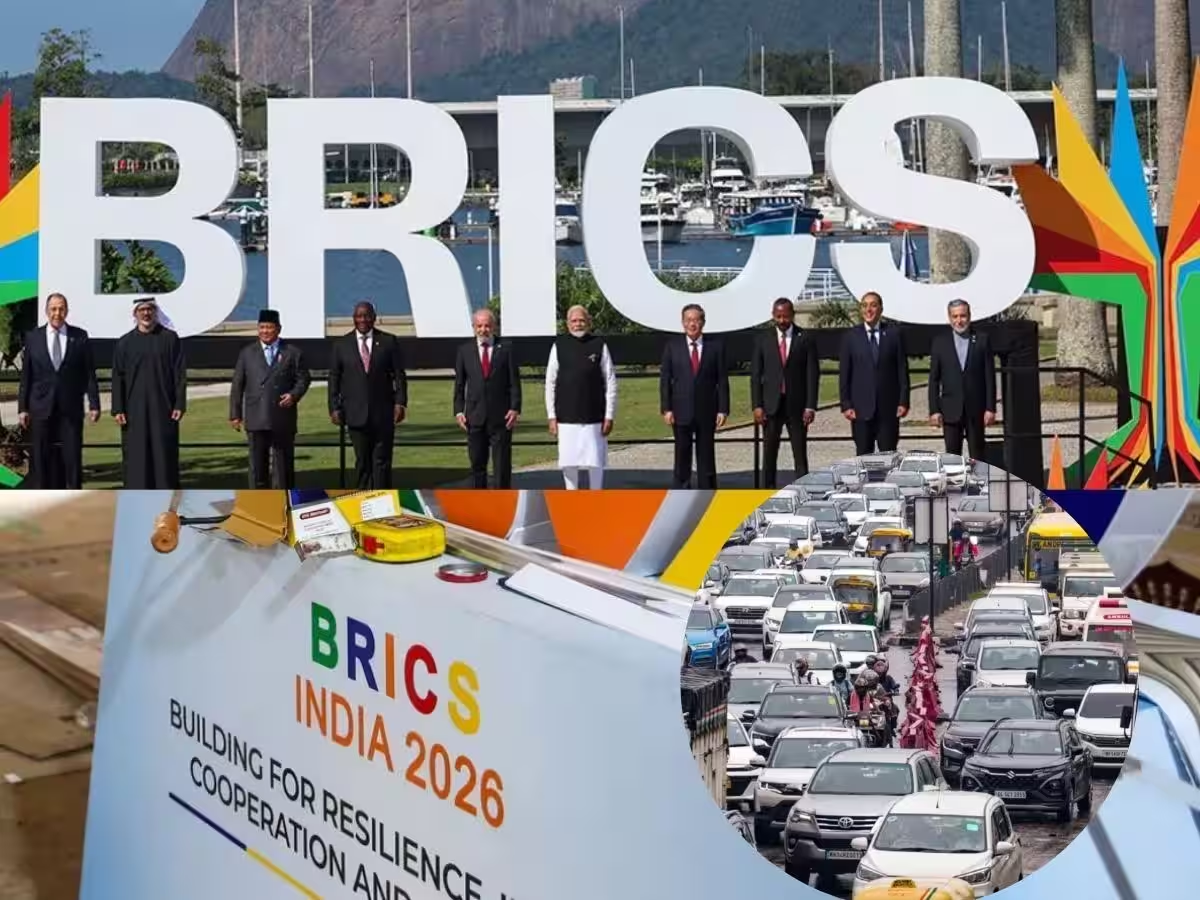
The BRICS Summit 2026 will take place in New Delhi on September 12 and 13, with India hosting the 18th BRICS Summit. The meeting could influence trade, digital technology, education, energy, infrastructure and India’s international economic relationships.
BRICS Summit 2026 begins in New Delhi
The BRICS Summit 2026 is a time-sensitive national and international news event, with the 18th summit scheduled at Bharat Mandapam in New Delhi on September 12 and 13. India is holding the BRICS chairship this year, and a series of ministerial and official meetings have already taken place ahead of the leaders’ summit.
For most Indians, BRICS can sound like a distant diplomatic grouping involving presidents, prime ministers and international negotiations. However, the decisions and partnerships discussed through the group can eventually affect areas that are much closer to everyday life.
Trade, investment, technology, digital payments, education, energy, urban development and opportunities for Indian businesses are among the areas where BRICS cooperation could have practical implications.
The important point is that the summit itself will not immediately change prices, salaries or government benefits. Its significance lies in the agreements, partnerships and policy directions that could develop after the meeting.
What is BRICS and why does India host it?
BRICS is a grouping of major emerging economies that has expanded considerably in recent years. The current group includes Brazil, Russia, India, China, South Africa, Egypt, Ethiopia, Iran, Indonesia and the United Arab Emirates.
India’s 2026 chairship has been built around the theme of resilience, innovation, cooperation and sustainability. Government meetings held during the chairship have covered areas including trade, education, environment, urbanisation and communications.
India’s approach has also emphasised a people-centric and Global South-oriented agenda.
That gives the summit a broader purpose than simply discussing relations between governments. The BRICS platform allows member countries to discuss common economic and developmental challenges and explore areas where cooperation could be useful.
For India, hosting the summit is also an opportunity to present its priorities and strengthen its position in discussions involving emerging economies.
BRICS trade talks could matter for Indian businesses
Trade is one of the areas with the clearest potential impact on ordinary Indians.
At the BRICS Trade Ministers’ Meeting in Jaipur in August, member countries discussed progress towards the Strategy for BRICS Economic Partnership 2030. The meeting also produced guiding principles related to MSME credit and highlighted the importance of expanding trade in services and building more resilient global supply chains.
For Indian small businesses, easier access to international markets could eventually create opportunities for exporters.
This is particularly relevant for businesses outside major metros. Manufacturers, textile companies, food processors, handicraft sellers, engineering firms and technology businesses in Tier-2 and Tier-3 cities increasingly participate in national and international supply chains.
However, it would be premature to say that the summit will immediately increase exports or create jobs. Those outcomes would depend on the implementation of agreements and the willingness of companies and governments to follow through.
MSMEs could get greater access to global markets
Small businesses are likely to remain an important part of India’s BRICS economic agenda.
The Jaipur trade meeting specifically highlighted the need to address the trade finance gap and expand small businesses’ access to global markets.
For an MSME owner in Nagpur, Jaipur, Surat, Coimbatore or another non-metro city, access to affordable finance can be as important as access to customers.
International trade often requires working capital, logistics support, payment mechanisms and knowledge of foreign markets. If BRICS cooperation eventually makes any of these processes easier, smaller Indian businesses could benefit.
The impact, however, would likely emerge over time rather than immediately after the September summit.
Digital technology and payments are another key area
Digital cooperation is another area worth watching during India’s BRICS chairship.
At the BRICS Communications Ministers Meeting held in Pune in August, India highlighted sustainable digital infrastructure, cybersecurity, digital skilling, innovation, startups and entrepreneurship as important areas of cooperation.
This matters because India’s digital economy has expanded well beyond metropolitan technology companies.
Digital public infrastructure, online payments, cybersecurity and digital services are now relevant to small retailers, students, freelancers, startups and consumers across smaller cities.
Cross-border payment cooperation could also eventually make international transactions easier. But there are significant security and regulatory considerations.
A current example is India’s decision to stall a proposed UPI and Alipay+ linkage amid concerns involving data privacy, security, cyber fraud and money laundering. That shows that greater payment connectivity will need to be balanced against national security and data protection concerns.
Education and student opportunities could expand
Education has already been a major part of India’s BRICS chairship.
At the 13th BRICS Education Ministers’ Meeting in Bhubaneswar, member countries discussed academic leadership, faculty exchanges, scholarships, STEM education and greater knowledge sharing. The meeting also encouraged continued work involving the BRICS Network University.
For Indian students, such cooperation could create more opportunities for academic exchanges, research collaborations and international exposure.
Students outside major cities could particularly benefit if these programmes become more accessible through Indian universities and institutions across different states.
Again, the summit itself will not automatically create new scholarships for every student. The practical impact will depend on the programmes that member countries implement after agreements are reached.
Energy and international relations could affect the economy
BRICS also brings together countries that play major roles in global energy markets.
India’s relationship with Russia, China, the Gulf region and other emerging economies has economic consequences because energy imports, shipping routes and global commodity prices influence the Indian economy.
Prime Minister Narendra Modi and Russian President Vladimir Putin have discussed cooperation in areas including energy, trade, defence, space and mobility. Putin is expected to attend the BRICS Summit in New Delhi on September 12 and 13.
India’s engagement with China is another major issue to watch.
Reuters reported on September 10 that Chinese President Xi Jinping’s expected India visit for the BRICS summit could support a diplomatic thaw, although significant economic and regulatory concerns remain between the two countries.
For ordinary Indians, the relevance comes through trade, manufacturing, imports, technology and investment rather than diplomacy alone.
Cities and infrastructure are also part of the BRICS agenda
Urban development has featured prominently during India’s BRICS chairship.
The BRICS Urbanisation Forum held in New Delhi focused on affordable housing, municipal infrastructure, resilient cities, sustainable construction technology and digital innovation in urban governance. India also proposed a BRICS Urban Research and Knowledge Network.
These subjects are especially relevant as Indian Tier-2 and Tier-3 cities expand.
Better urban planning, resilient infrastructure and improved municipal systems can influence public transport, housing, water management and disaster preparedness.
The challenge is converting international cooperation into projects that actually work at the city level.
What should ordinary Indians realistically expect?
The biggest misconception would be to expect immediate changes in daily life after the BRICS Summit 2026.
There is unlikely to be a sudden change in household prices, taxes, salaries or government schemes simply because the summit takes place.
Instead, Indians should watch for concrete agreements and follow-up programmes involving trade, investment, education, technology, digital infrastructure, energy and urban development.
The summit could provide a framework for cooperation, but implementation will determine whether that cooperation produces measurable results.
For India’s smaller cities and businesses, the most meaningful developments may come months or years later through new investment, export opportunities, technology partnerships, education programmes or infrastructure initiatives.
Key takeaways
- The 18th BRICS Summit will be held in New Delhi on September 12 and 13, with India hosting the event during its 2026 chairship.
- Trade, MSME finance, digital infrastructure, education, urbanisation and sustainability have already emerged as important areas under India’s BRICS agenda.
- Ordinary Indians are unlikely to see immediate changes in prices or income because of the summit, but longer-term economic and technology partnerships could have an impact.
- India-China relations, Russia ties, trade and payment systems will be among the broader issues worth watching around the summit.
FAQ
When is the BRICS Summit 2026?
The 18th BRICS Summit is scheduled for September 12 and 13, 2026, in New Delhi. The summit will be held at Bharat Mandapam.
What could BRICS mean for ordinary Indians?
The potential impact is mainly through trade, investment, technology, education, digital infrastructure, energy and business opportunities. Most effects would emerge through policies and projects implemented after the summit rather than immediately.
Can Indian MSMEs benefit from BRICS cooperation?
Potentially. BRICS trade discussions have included expanding small businesses’ access to global markets and addressing the trade finance gap. The actual benefit will depend on implementation and participation by businesses.
Will BRICS change UPI or digital payments in India?
BRICS discussions include digital cooperation, but there is no basis to say the summit itself will immediately change India’s UPI system. Cross-border payment initiatives remain subject to regulatory, security and data-protection considerations.