





















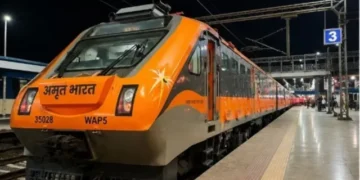






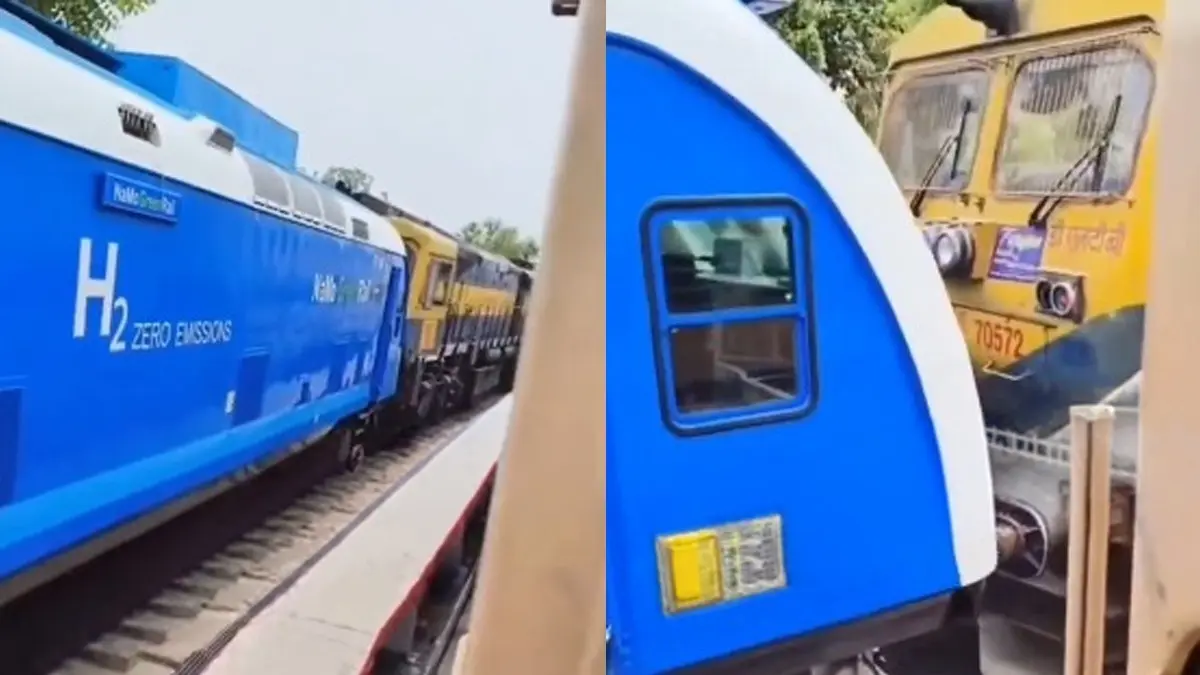
A video showing India’s first hydrogen-powered train being pulled by a diesel locomotive recently went viral on social media, leading many users to question whether the country’s new green train had suffered a technical failure. Indian Railways has now issued an official clarification, stating that the claims circulating online are misleading and that the diesel locomotive was being used as part of a planned operational procedure rather than because of any fault in the hydrogen train.
The Indian Railways hydrogen train viral video quickly attracted widespread attention after users claimed the country’s first hydrogen-powered train was unable to run on its own. However, Northern Railway clarified that the train was being hauled only for maintenance movement outside its designated operating section. The hydrogen propulsion system continues to operate on its approved route between Jind and Sonipat in Haryana.
What Did the Viral Video Show?
The viral clip showed the newly launched hydrogen-powered train being pulled by a diesel locomotive, prompting social media users to suggest that the hydrogen technology had failed.
Several posts claimed the train had developed a fault immediately after its inauguration. The video spread rapidly across multiple platforms, with many users questioning the practicality of hydrogen-powered trains.
Because the train had only recently been inaugurated by Prime Minister Narendra Modi on July 17, the footage generated significant public interest and sparked debates about India’s investment in green transport technology.
However, the viral claims lacked important context regarding how the train is maintained and moved outside its operational route.
Indian Railways Says the Claims Are Misleading
Northern Railway responded to the viral posts by calling them “factually baseless and misleading.”
According to the official clarification, the hydrogen-powered train is authorised to operate only on the Jind-Sonipat section under Northern Railway. Whenever the train needs to travel outside this dedicated route for scheduled maintenance, it is hauled in a “dead” condition by a conventional locomotive.
Railway officials explained that this is a standard operational practice and should not be interpreted as a failure of the hydrogen propulsion system.
The clarification also referred to a Railway Board approval issued in May 2026, which specifies that the trainset would be transported by locomotive between Jind and Shakurbasti for maintenance activities because servicing facilities are located there.
Why Was a Diesel Engine Used?
The use of a diesel locomotive was linked to logistics rather than propulsion.
India’s first hydrogen-powered passenger train operates on a fixed pilot corridor between Jind and Sonipat. Its maintenance facility, however, is located at Shakurbasti, outside the approved hydrogen operating section.
As a result, the train is hauled without using its hydrogen propulsion system whenever it travels to or from the maintenance depot.
Railway experts note that such movements are common during pilot projects, testing phases and maintenance operations. Similar procedures are followed globally for new rolling stock before wider commercial deployment.
Therefore, the presence of a diesel locomotive does not indicate that the hydrogen train itself is dependent on diesel during normal passenger service.
How India’s First Hydrogen Train Works
India’s first hydrogen-powered train uses hydrogen fuel cells to generate electricity onboard instead of relying on diesel engines.
The hydrogen stored inside the train reacts with oxygen inside fuel cells to produce electrical energy, which powers the traction motors. The only direct emission from this process is water vapour, making it a cleaner alternative for non-electrified railway sections.
The indigenous trainset consists of two hydrogen-powered driving cars and passenger coaches with a total capacity of around 2,600 passengers. It operates at speeds of up to 75 kmph on the Jind-Sonipat route.
Indian Railways has also established dedicated hydrogen storage, refuelling infrastructure and multiple safety systems to monitor hydrogen leaks, fire hazards and temperature changes.
Why Hydrogen Trains Matter for Indian Railways
Although more than 99 percent of India’s broad-gauge railway network has already been electrified, hydrogen technology is being explored for routes where conventional electrification may not always be practical or economical.
The hydrogen train project also supports India’s broader National Green Hydrogen Mission and long-term objective of achieving net-zero emissions by 2070.
Beyond passenger transportation, the pilot project helps Indian Railways develop expertise in hydrogen storage, fuel cell technology, maintenance systems and safety standards that could support future clean-energy applications.
Officials have repeatedly described the current service as a demonstration project that will help evaluate operational performance before any wider expansion of hydrogen-powered rail services.
Lessons From the Viral Incident
The viral video demonstrates how short clips shared online can sometimes present incomplete information.
Without the accompanying operational context, many viewers assumed the hydrogen train had failed. The official clarification from Indian Railways showed that the train was following a planned maintenance procedure rather than experiencing a technical breakdown.
The incident also highlights the importance of verifying claims through official sources before drawing conclusions, especially when videos involve new technologies that are still in their pilot phase.
As India continues investing in cleaner transport systems, similar misconceptions may arise unless accurate operational details accompany viral content.
Takeaways
- Indian Railways confirmed the viral diesel-engine video was misleading.
- The hydrogen train is hauled by a locomotive only when travelling outside its designated operating section for maintenance.
- Passenger operations on the Jind-Sonipat route continue using the hydrogen propulsion system.
- The project remains a pilot initiative supporting India’s green rail and clean energy goals.
FAQ
Q1. Why was the hydrogen train pulled by a diesel engine?
The diesel locomotive was used to transport the train to and from its maintenance facility outside the approved hydrogen operating section. This is a planned operational procedure, not a technical failure.
Q2. Did India’s first hydrogen train break down?
No. Northern Railway has officially stated that the viral claims of a breakdown are false and misleading.
Q3. Where does the hydrogen train operate?
The train currently operates as a pilot service between Jind and Sonipat in Haryana.
Q4. What fuel does the hydrogen train use during passenger service?
The train uses hydrogen fuel cells that generate electricity onboard, producing water vapour as the only direct emission.
(Internal Keywords: Indian Railways hydrogen train, hydrogen train viral video, diesel engine clarification, Jind Sonipat hydrogen train, hydrogen fuel cell train India, Northern Railway clarification, green rail India, fact check hydrogen train)