





























Mumbai’s traffic plan revamp has brought a new signal-free corridor proposal into focus, aimed at reducing congestion and travel time. The plan targets key arterial routes and is part of a broader push to improve urban mobility across the city.
Mumbai Traffic Plan Revamp Targets Congestion Hotspots
The Mumbai traffic plan revamp centers around a signal-free corridor proposal designed to streamline vehicle movement across high traffic zones. Authorities in Mumbai are evaluating ways to reduce stoppages at intersections by constructing flyovers, underpasses, and dedicated lanes.
The initiative is being discussed alongside existing infrastructure projects led by agencies like the Brihanmumbai Municipal Corporation and the Mumbai Metropolitan Region Development Authority. These bodies are focusing on long term solutions to tackle chronic congestion.
Signal free corridors are not a new concept in Mumbai, but the current proposal aims to expand the network and connect more routes to ensure uninterrupted traffic flow across major stretches.
What the Signal-Free Corridor Proposal Includes
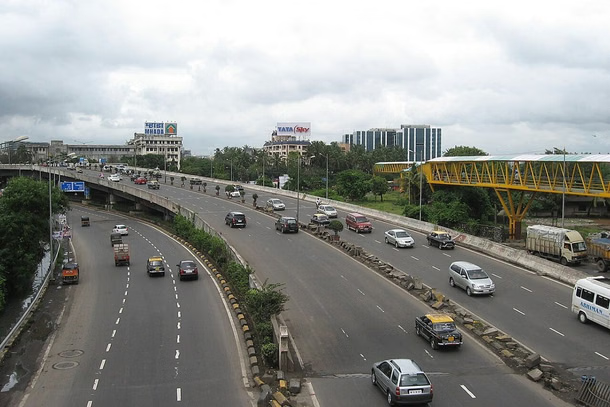
The signal-free corridor proposal involves eliminating traffic signals along selected routes by redesigning intersections. This is typically achieved through grade separators such as flyovers and tunnels, allowing vehicles to pass without stopping.
In practical terms, commuters traveling through these corridors would experience fewer delays, especially during peak hours. The plan also includes improving road width, optimizing entry and exit points, and better traffic management systems.
Secondary elements may involve synchronized traffic control in surrounding areas to ensure that congestion is not simply shifted to nearby roads. Urban planners emphasize that corridor efficiency depends on how well it integrates with the overall road network.
Expected Impact on Daily Commute in Mumbai
If implemented effectively, the Mumbai signal-free corridor plan could significantly reduce travel time for daily commuters. Routes that currently take over an hour during peak traffic could see noticeable improvements.
For a city like Mumbai, where road space is limited and vehicle density is high, even small reductions in stoppage time can lead to major efficiency gains. Reduced idling at signals can also lower fuel consumption and emissions.
However, experts caution that benefits depend on execution. Poorly planned corridors can create bottlenecks at entry and exit points, negating the intended advantages.
Challenges in Implementing Signal-Free Corridors
Implementing a signal-free corridor in a dense urban environment presents several challenges. Land acquisition, construction disruptions, and coordination between multiple agencies can slow down progress.
In areas with heavy pedestrian movement, completely eliminating signals may not always be feasible. Safety considerations must be balanced with traffic efficiency.
There is also the issue of induced demand. Improved roads can attract more vehicles over time, potentially bringing congestion back to earlier levels. This has been observed in other cities where infrastructure upgrades did not fully solve traffic issues.
Integration With Mumbai’s Broader Infrastructure Push
The signal-free corridor proposal is part of a larger strategy to modernize Mumbai’s transport infrastructure. Projects such as metro rail expansion, coastal roads, and improved public transport systems are being developed in parallel.
Agencies like the Brihanmumbai Municipal Corporation are focusing on creating a multi modal network where road, rail, and public transport complement each other.
Urban planners suggest that signal-free corridors should not be seen as standalone solutions but as components of a broader mobility framework. Encouraging public transport usage remains critical to reducing overall traffic volume.
What Commuters Should Expect Next
The proposal is currently in planning and evaluation stages, with detailed project reports and feasibility studies expected to guide implementation. Timelines will depend on approvals, funding, and coordination between agencies.
Commuters in Mumbai can expect phased development rather than immediate citywide changes. Initial corridors may serve as pilot projects to assess effectiveness before scaling up.
Public feedback and traffic data analysis are likely to play a role in refining the plan. Authorities will need to balance speed of execution with long term sustainability.
Takeaways
- Mumbai traffic plan revamp focuses on creating signal-free corridors to reduce congestion
- Proposal includes flyovers, underpasses, and redesigned intersections
- Potential benefits include reduced travel time and lower fuel consumption
- Execution challenges and urban constraints remain key concerns
FAQs
Q1. What is a signal-free corridor?
A signal-free corridor is a road stretch where vehicles can move without stopping at traffic signals, usually through flyovers or underpasses.
Q2. Will this plan reduce traffic in Mumbai?
It can improve flow on specific routes, but overall impact depends on execution and integration with other transport systems.
Q3. Which areas will be covered under the proposal?
Specific routes are expected to be identified based on traffic density and feasibility studies.
Q4. When will the project be completed?
The project is still in planning stages, and timelines will depend on approvals and construction progress.