





























Skincare has increasingly moved beyond simply choosing products based on fragrance, texture or packaging. Consumers are now paying closer attention to the active ingredients in their routines, particularly when dealing with concerns such as acne, clogged pores, dark spots, tanning and uneven skin tone.
Two ingredients that frequently appear in these conversations are glycolic acid and salicylic acid.
Although both are exfoliating acids, they are not interchangeable. Glycolic acid is an alpha hydroxy acid (AHA) that primarily works on the skin’s surface, while salicylic acid is a beta hydroxy acid (BHA) that can penetrate into oil-filled pores. This difference is important when deciding which ingredient is more relevant to a particular skin concern.
For consumers considering acid-based cleansers or soaps, understanding how these ingredients differ can make product selection more informed.
What Is Glycolic Acid?
Glycolic acid is an AHA commonly used as a chemical exfoliant. Because it is water-soluble, it primarily works on the skin’s surface by helping loosen dead skin cells.
According to Cleveland Clinic, glycolic acid can help improve the appearance of skin tone and texture and is also used in skincare products targeting pigmentation and dull-looking skin.
This makes glycolic acid particularly interesting for people concerned about:
- Dull-looking skin
- Rough body texture
- Uneven-looking skin tone
- Surface buildup
- The appearance of dark spots
- Tanning and discoloration
Glycolic acid isn’t simply an ingredient for facial skincare. It is also increasingly appearing in body-care products, particularly products designed around exfoliation and improving the appearance of uneven texture.
However, more exfoliation does not necessarily mean better results. Overuse of glycolic acid can contribute to dryness, irritation and increased sensitivity, particularly for people who are new to chemical exfoliants.
What Is Salicylic Acid?
Salicylic acid belongs to the BHA family and differs from glycolic acid in how it interacts with the skin.
Because salicylic acid is oil-soluble, it can work within pores where oil and dead skin cells can accumulate. This is one reason it is commonly used in products formulated for acne-prone and congested skin.
The American Academy of Dermatology notes that salicylic acid can unclog pores and exfoliate the skin and is particularly useful for whiteheads and blackheads.
For that reason, salicylic acid is often considered when the primary concerns include:
- Blackheads
- Whiteheads
- Clogged pores
- Excess oil
- Acne-prone skin
- Body breakouts
This distinction is especially relevant for consumers choosing between a glycolic acid soap and a salicylic acid soap.
Glycolic Acid vs Salicylic Acid: What’s the Difference?
The easiest way to understand the difference is to look at where each ingredient primarily works and what type of concern it addresses.
| Skin concern | Glycolic acid | Salicylic acid |
| Surface exfoliation | ✓ | ✓ |
| Rough texture | ✓ | ✓ |
| Dull-looking skin | ✓ | — |
| Uneven-looking tone | ✓ | — |
| Appearance of dark spots | ✓ | — |
| Clogged pores | — | ✓ |
| Blackheads | — | ✓ |
| Whiteheads | — | ✓ |
| Excess oil | — | ✓ |
| Acne-prone skin | Some relevance | Stronger relevance |
This doesn’t mean glycolic acid cannot be useful for acne-prone skin or that salicylic acid cannot contribute to smoother-looking skin. There is overlap between the two ingredients.
The key difference is that glycolic acid is generally associated with surface exfoliation and improving the appearance of tone and texture, while salicylic acid is particularly relevant to pores, oil and acne-related concerns.
Which Is Better for Acne?
For people primarily concerned with blackheads, whiteheads or clogged pores, salicylic acid may be the more relevant ingredient to look for.
The American Academy of Dermatology identifies salicylic acid as an ingredient that can open clogged pores and exfoliate the skin. It is available in several types of products, including cleansers.
However, acne is not a single-condition problem. Different types and severities of acne can require different approaches.
People with persistent, painful or severe acne should consider professional dermatological advice rather than relying exclusively on an exfoliating soap or cleanser. The AAD also emphasizes that acne treatment is not one-size-fits-all.
Which Is Better for Dark Spots and Uneven Skin?
When the main concern is the appearance of dark spots, dullness or uneven-looking skin, glycolic acid may be a more relevant ingredient to investigate.
Glycolic acid’s exfoliating action helps remove accumulated dead skin cells from the surface, while dermatology sources recognize glycolic acid among ingredients that can help improve the appearance of hyperpigmentation.
This is particularly relevant to consumers dealing with pigmentation following acne.
The American Academy of Dermatology notes that darker skin tones can be more prone to post-inflammatory hyperpigmentation after acne and that treating the underlying acne as well as the resulting dark spots is important.
That means choosing an ingredient should depend not only on the visible pigmentation but also on what is causing it.
What About Body Acne?
Body skincare is another area where the distinction between these ingredients becomes useful.
Back, chest and shoulder breakouts can involve clogged pores and excess oil. In such cases, salicylic acid is often considered because of its ability to exfoliate and help unclog pores.
For consumers looking for an ingredient-focused body cleanser, a salicylic acid soap can therefore be a practical option to explore when clogged pores and breakouts are the main concern.
What About Rough and Dull Body Skin?
Not every body-skin concern is related to acne.
Some people are more concerned with rough texture, dullness, uneven-looking skin or areas that appear darker than the surrounding skin.
This is where glycolic acid can have a different role.
Because it works primarily as a surface exfoliant, glycolic acid is commonly used in products designed to improve the appearance of texture, tone and pigmentation.
This has contributed to growing interest in glycolic acid body-care products rather than limiting exfoliating acids to facial skincare.
How BAKE Cosmetics Approaches Glycolic and Salicylic Acid Body Care
The growing demand for ingredient-led skincare has encouraged Indian beauty brands to develop products around specific skin concerns rather than treating every concern with the same formula.
BAKE Cosmetics is one example of this approach, with separate body-care products centered around glycolic acid and salicylic acid.
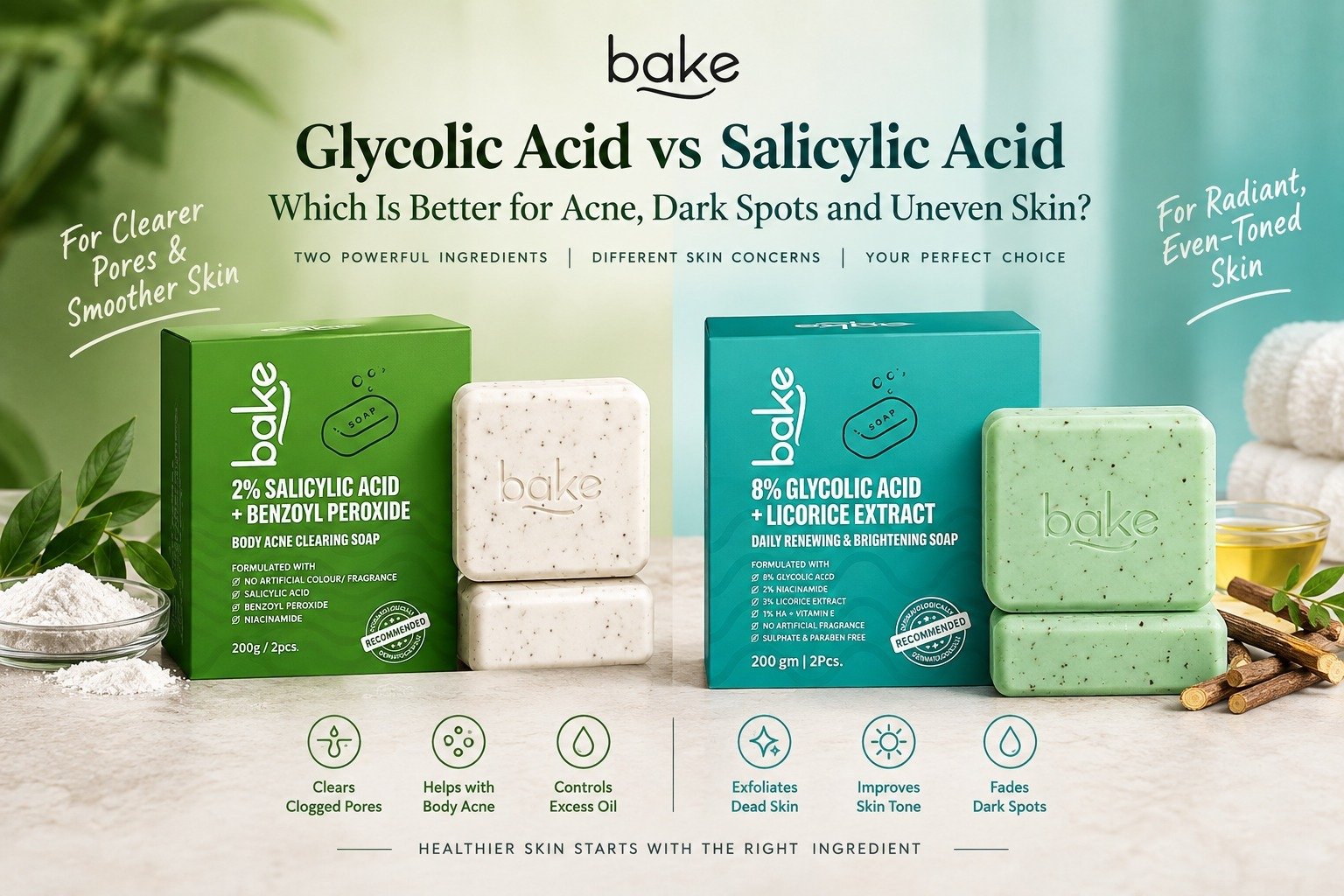
Its 8% Glycolic Acid Scrub Treatment Soap with 3% Niacinamide is positioned around exfoliation, pigmentation, tanning, uneven-looking skin and areas such as underarms.
This gives consumers looking specifically for glycolic-acid-based body care an option built around surface exfoliation and tone-related concerns.
For consumers exploring this category, BAKE’s 8% Glycolic Acid Soap provides a product-specific example of this approach.
BAKE also offers a 2% Salicylic Acid Soap, designed around concerns such as excess oil, clogged pores, blackheads, whiteheads and body acne.
That makes it a different proposition from the glycolic-acid bar rather than simply another version of the same product.
Consumers specifically looking for salicylic-acid body care can explore BAKE’s 2% Salicylic Acid Soap.
Can Glycolic Acid and Salicylic Acid Be Used Together?
Both ingredients can have a place in skincare, but using more active ingredients does not automatically produce better results.
Combining multiple exfoliating ingredients can increase the possibility of irritation, dryness or sensitivity. Cleveland Clinic specifically advises caution when introducing glycolic acid alongside other exfoliating acids, particularly for people who are new to active skincare.
For someone starting with chemical exfoliation, using one active at a time can make it easier to understand how the skin responds.
If irritation develops, reducing frequency or stopping the product may be appropriate. The AAD similarly notes that ingredients such as glycolic and salicylic acid can help oily skin but may be too harsh for some people.
How Should You Choose?
Instead of asking “Is glycolic acid better than salicylic acid?”, consumers can start with a simpler question:
What is my main skin concern?
If the priority is:
Blackheads, whiteheads, clogged pores or body acne
→ Salicylic acid may be the more relevant ingredient to consider.
Rough texture, dullness or uneven-looking skin
→ Glycolic acid may be worth exploring.
Dark spots or pigmentation
→ Glycolic acid can be one ingredient used in a broader pigmentation-focused routine, depending on the cause.
Excess oil and congestion
→ Salicylic acid is commonly used because of its pore-focused exfoliating action.
There is no universal acid that is right for everyone. Skin type, sensitivity, the location being treated and the underlying cause of the concern all matter.
The Growing Shift Toward Concern-Based Skincare
The glycolic acid versus salicylic acid conversation reflects a broader change in skincare: consumers are becoming more interested in matching ingredients to specific concerns.
Instead of choosing a product simply because it contains an active ingredient, shoppers are increasingly asking what that ingredient actually does and whether it fits their needs.
For acne-prone and congested skin, salicylic acid has a well-established role in unclogging pores and exfoliation. For surface texture, dullness and the appearance of pigmentation, glycolic acid offers a different exfoliating approach.
Brands such as BAKE Cosmetics are responding to this shift by developing separate ingredient-led body-care products rather than treating exfoliation as a one-size-fits-all category.
Ultimately, the choice between glycolic acid and salicylic acid comes down to the concern being addressed, the individual’s tolerance for exfoliation and the overall skincare routine.
For consumers exploring acid-based body care, understanding that difference can be the first step toward making a more informed product choice.