





























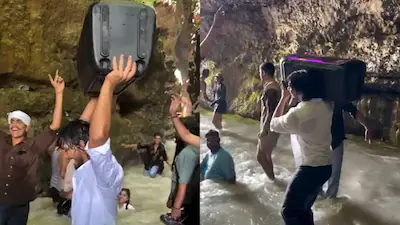
A viral video from Dehradun’s Robber’s Cave has triggered criticism after tourists were seen playing loud music and dancing inside the popular natural attraction. The incident has renewed debate over responsible tourism, public behaviour and protecting India’s environmentally sensitive tourist destinations.
Tourists’ Dance Inside Robber’s Cave Goes Viral
A video from Dehradun’s Robber’s Cave has drawn widespread attention after a group of tourists were seen playing music through a boombox and dancing inside the natural attraction. The incident has sparked criticism on social media, with users questioning whether visitors should treat such locations as party spaces.
The video reportedly shows tourists dancing to the Haryanvi song Lofar while inside the cave. The footage circulated online and quickly became a talking point, with many viewers objecting to the loud music and behaviour at a site known for its natural surroundings.
The incident is being discussed as part of a broader concern around tourist behaviour at popular destinations, particularly when visitors prioritise making social media content over respecting the character of the location.
Why Robber’s Cave Is a Popular Dehradun Tourist Spot
Robber’s Cave, locally known as Gucchu Pani, is one of Dehradun’s better-known tourist attractions. The cave is associated with a distinctive natural formation where a stream flows through a narrow rocky passage.
Its combination of water, rocks and a cave-like landscape makes it popular among tourists looking for a short nature-oriented outing around Dehradun. Visitors often explore the water channel and surrounding formations while taking photographs and videos.
That setting is also what makes the latest incident controversial. For many visitors, the attraction lies in experiencing the natural environment rather than turning it into a conventional entertainment venue.
The viral video has therefore raised a simple question: where should tourists draw the line between enjoying a destination and disturbing the experience for others?
Social Media Backlash Over Loud Music
The strongest criticism surrounding the video has focused on the use of a boombox inside the cave. Social media users criticised the tourists for creating a loud party-like atmosphere in a place generally associated with nature and quiet exploration.
Some reactions described the behaviour as inappropriate and disrespectful to the destination. The Times of India report noted that social media users went as far as calling the conduct hooliganism.
However, it is important to distinguish between criticism of the behaviour and verified information about any legal violation. Viral social media reactions do not by themselves establish that the tourists broke a particular law or rule.
There has also been no need to assume criminal wrongdoing simply because the video attracted criticism. The central issue raised online is about responsible conduct in a public tourist location.
Responsible Tourism Becomes the Bigger Question
The Dehradun cave incident highlights a wider challenge facing popular tourist destinations across India. As travel content becomes increasingly important on Instagram, YouTube and other platforms, visitors frequently record themselves at attractions.
Taking photographs and videos is not inherently problematic. In many cases, social media content can help smaller destinations gain visibility and attract visitors.
The problem begins when content creation affects other tourists, damages natural surroundings or changes the character of a location. Loud music, littering, dangerous stunts and overcrowding can turn a nature destination into an uncomfortable or unsafe environment.
For Tier-2 and Tier-3 cities that depend on tourism, this issue matters because viral attention can quickly increase visitor numbers. A destination that suddenly becomes popular online may face additional pressure on its infrastructure and natural environment.
Why Viral Tourism Videos Keep Drawing Attention
The Dehradun incident is another example of how ordinary tourist behaviour can become a national social media discussion within hours.
Short-form video platforms reward content that generates strong reactions. A tourist doing something unusual at a well-known location can therefore receive far more attention online than a conventional travel video.
This creates a complicated cycle. Visitors may imitate behaviour they have already seen online because they believe unusual content is more likely to become viral. Other users then criticise that behaviour, creating another wave of engagement.
For tourism authorities and visitors, the challenge is to ensure that the pursuit of viral content does not overshadow basic public etiquette.
What Tourists Should Remember at Natural Attractions
Visitors to caves, waterfalls, forests, lakes and other natural attractions should follow the rules applicable to the location and respect other tourists.
Basic responsible tourism includes avoiding littering, keeping noise under control, staying within permitted areas and avoiding actions that could damage natural formations.
Tourists should also avoid dangerous stunts simply for photographs or videos. A location that looks suitable for a social media challenge may have slippery rocks, uneven surfaces, fast-moving water or other hazards that are not obvious in a short video.
The larger lesson from the Robber’s Cave controversy is straightforward. Enjoying a tourist attraction and creating content can go together, but neither should come at the expense of the place or other visitors.
The Debate Is About More Than One Viral Video
The backlash over the Dehradun cave video is not simply about tourists dancing. It reflects a growing debate over how Indians behave at public and natural tourist destinations in the age of social media.
India has seen several instances where tourist behaviour at heritage sites, beaches, mountains and natural attractions becomes the subject of online criticism. Each viral incident can trigger discussion about cleanliness, noise, safety and civic responsibility.
At the same time, social media criticism should remain grounded in verified facts. Viral videos often show only a short portion of an incident, making it difficult to establish the complete context.
For now, the Robber’s Cave video has mainly become a conversation about public behaviour and responsible tourism rather than a confirmed case of criminal misconduct.
Key Takeaways
- A video from Dehradun’s Robber’s Cave shows tourists dancing while loud music plays inside the attraction.
- The footage has attracted criticism on social media over noise and tourist behaviour.
- Online criticism should not automatically be treated as proof of a legal violation.
- The incident highlights the importance of responsible tourism as travel content becomes increasingly popular.
Frequently Asked Questions
What happened at Dehradun’s Robber’s Cave?
A viral video showed tourists playing music through a boombox and dancing inside Robber’s Cave in Dehradun. The footage attracted criticism on social media over the behaviour at the natural tourist destination.
Why is Robber’s Cave famous?
Robber’s Cave, also known as Gucchu Pani, is a popular Dehradun attraction known for its natural cave-like rock formation and stream flowing through the area.
Did the tourists face legal action?
The available report confirms social media criticism but does not establish that the tourists faced legal action. Claims about arrests, fines or specific offences should not be made without official confirmation.
Why are tourist behaviour videos going viral?
Short-form social media platforms can quickly amplify unusual or controversial tourist behaviour. Videos that trigger strong reactions often receive significant engagement, leading to wider circulation.