































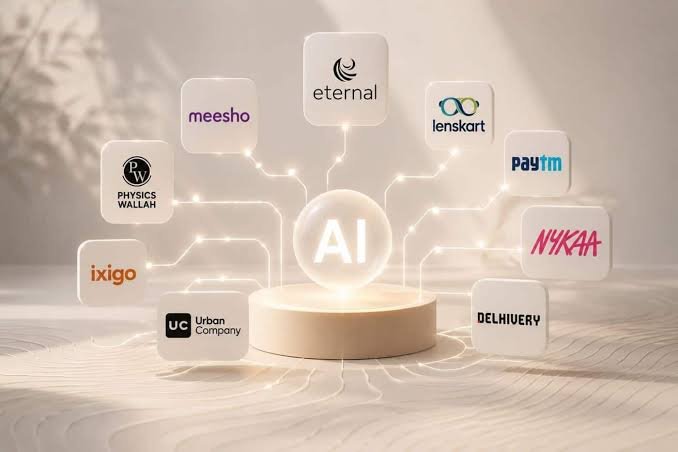
Agentic AI is becoming the next major phase of enterprise artificial intelligence in India, with businesses moving beyond chatbots and simple content-generation tools toward systems that can plan tasks, make decisions and execute multi-step workflows with limited human intervention.
From Chatbots to AI That Can Take Action
For several years, Indian businesses primarily used artificial intelligence for chatbots, customer support, content generation, data analysis and software assistance. In 2026, the focus is increasingly shifting toward agentic AI, a model in which AI systems can work toward a defined goal rather than simply respond to individual prompts.
An AI agent can, for example, receive a business objective, gather information from approved systems, analyse the available data and carry out several connected steps. This could involve preparing a report, checking an order, escalating an exception or assisting with financial planning.
The change matters because businesses are no longer looking at AI only as a tool employees use. They are beginning to explore AI as part of the workflow itself.
EY’s India research found that 24% of surveyed business leaders were already deploying agentic AI, while 91% identified deployment speed as a major factor in their AI buying decisions.
Indian GCCs Are Emerging as Early Adopters
India’s Global Capability Centres, or GCCs, are among the clearest examples of this shift. These centres increasingly handle technology, finance, cybersecurity, research, analytics and other global functions for multinational companies.
According to EY’s GCC Pulse Survey 2025, 58% of India-based GCCs were investing in agentic AI, while another 29% planned to scale their investments within the following year. The same research found that 83% of GCCs were already investing in generative AI.
The applications are not limited to technology teams. EY reported that GenAI use cases among these centres included customer service, finance, operations, IT and cybersecurity.
This indicates why agentic AI is attracting attention in India. GCCs already operate complex, data-heavy processes, making them natural testing grounds for AI systems capable of coordinating multiple tasks.
Customer Service Is Moving Beyond Simple Chatbots
Customer support is one area where the difference between conventional chatbots and AI agents can become visible.
A traditional chatbot may answer a customer’s question about an order or service. An agentic system can potentially connect several steps, such as understanding the customer’s request, checking account information, retrieving order details, identifying the relevant policy and initiating an approved action.
This does not mean human employees disappear from the process. Complex complaints, sensitive financial decisions and unusual customer situations can still require human intervention.
The distinction is becoming important as Indian companies attempt to automate repetitive work while keeping people involved in decisions that carry greater financial, legal or reputational consequences.
Finance and Treasury Become Important Use Cases
Financial operations are another area attracting attention. In September 2026, EY India reported that treasury teams can spend 60% to 70% of their time on manual and low-value activities. Its report said agentic AI-enabled treasury models could potentially improve forecasting accuracy to as much as 90% across 30-, 60- and 90-day liquidity horizons.
For businesses, the attraction is not simply automation. Treasury teams deal with cash flows, liquidity, forecasts and financial information spread across multiple systems.
An AI agent could potentially help bring these sources together, identify changes and prepare recommendations for human review. However, financial decisions require strong controls because an incorrect action can have direct monetary consequences.
That makes human approval, audit trails and restricted system access important parts of enterprise agentic AI deployment.
Indian Companies Face a Governance Challenge
Greater autonomy also creates greater risk.
A chatbot that gives an incorrect answer is a problem. An AI agent that can access business systems and execute actions can create a much larger problem if it misunderstands instructions or uses incorrect information.
EY has highlighted the need for governance models that connect AI autonomy with clear accountability and control. The firm notes that as agentic systems gain more authority, errors can scale more quickly across enterprise workflows.
Recent reporting also highlights the practical gap between having AI policies and enforcing them. A 2026 Delinea report cited by Express Computer found that 99% of surveyed Indian enterprises had AI data access policies, but 84% reported instances where AI tools accessed data beyond their authorised scope.
These findings show why businesses cannot treat agentic AI simply as another software upgrade.
Data, Infrastructure and Skills Will Decide Adoption
Agentic AI depends heavily on the quality of a company’s underlying data and technology infrastructure.
Businesses with fragmented databases, outdated software and inconsistent information may struggle to deploy agents reliably. An AI system can only make useful decisions when the information available to it is accurate, current and appropriately structured.
Infrastructure is another concern. Cisco India has pointed to challenges involving compute capacity, networking, security and fragmented data as Indian enterprises move from AI experimentation toward larger deployments.
Skills will also matter. Employees need to understand how to supervise AI systems, identify errors and redesign workflows around human and machine collaboration.
This means the agentic AI transition is partly a technology project and partly an organisational change project.
Sovereign AI Is Becoming Part of the Conversation
Data control is particularly important for Indian enterprises handling sensitive customer, financial or government-related information.
In September 2026, IBM and Yotta Data Services announced a sovereign agentic AI platform aimed at Indian enterprises. The initiative is designed to allow organisations to deploy AI agents while maintaining greater control over data and operational processes.
The development reflects a wider concern among enterprises: how to use increasingly autonomous AI without losing control over sensitive information.
For Indian businesses, this issue can become especially relevant as AI moves from experimental tools into systems connected to core operations.
What Agentic AI Could Mean for Smaller Indian Businesses
The agentic AI discussion is currently concentrated around large enterprises and GCCs, but the technology could eventually affect smaller businesses as well.
A retailer could use AI to coordinate inventory monitoring and supplier communication. A logistics company could use agents to track shipments and flag delays. A financial services business could automate parts of document processing and customer follow-up.
The important point is that smaller businesses are unlikely to adopt complex autonomous systems simply because the technology exists. Cost, integration, data quality and security will determine whether these systems make practical sense.
For Tier-2 and Tier-3 cities, this could eventually create opportunities for smaller companies to access automation that previously required large technology teams.
India’s AI Shift Is Moving From Experiment to Execution
The current enterprise AI environment is also putting pressure on India’s technology industry. Reuters reported in October 2026 that major Indian IT companies were facing pressure from AI-led pricing changes and cautious client spending, with traditional billable-hours models coming under strain.
At the same time, research shows that businesses are continuing to invest in AI and experiment with new operating models.
The next phase will therefore be less about whether companies have access to AI and more about how effectively they can integrate it into real business processes.
Agentic AI does not automatically make an organisation more productive. Companies need reliable data, clearly defined workflows, security controls, employee training and measurable business objectives.
For Indian businesses, 2026 is increasingly becoming the year when the conversation moves from asking what AI can generate to asking what AI can responsibly do.
Key Takeaways
- Agentic AI allows systems to handle multi-step tasks rather than only responding to individual prompts.
- EY found that 58% of India-based GCCs were investing in agentic AI, with another 29% planning to scale within a year.
- Data governance, cybersecurity, infrastructure and human oversight remain major requirements for enterprise adoption.
- The biggest shift is from AI as a standalone tool toward AI being integrated directly into business workflows.
Frequently Asked Questions
What is agentic AI?
Agentic AI refers to AI systems designed to pursue defined goals by planning and carrying out multiple connected tasks, often using business tools and data sources with varying levels of human supervision.
How is agentic AI different from a chatbot?
A chatbot generally responds to a user’s individual request. An AI agent can potentially plan a sequence of actions, use approved tools, retrieve information and execute parts of a workflow to achieve a broader objective.
Are Indian companies already using agentic AI?
Yes. EY research indicates that Indian GCCs are among the active adopters, with 58% reporting investment in agentic AI in its 2025 survey.
What are the biggest risks of agentic AI?
Key risks include incorrect decisions, unauthorised data access, security vulnerabilities, poor-quality business data and insufficient human oversight. As AI systems receive greater authority to act, governance and accountability become increasingly important.














