































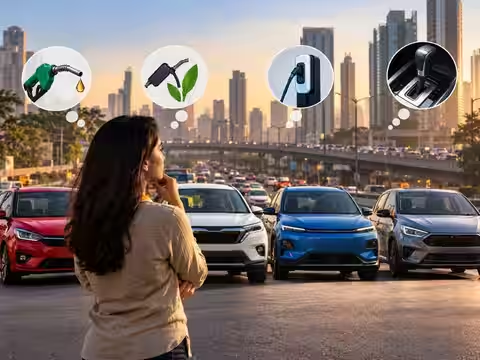
Choosing between a petrol hatchback and a compact SUV is a common dilemma for Indian families buying a new car. While hatchbacks generally offer lower purchase and running costs, compact SUVs provide higher ground clearance and a raised seating position. The right choice depends on budget, family needs and everyday driving conditions.
Petrol Hatchback vs Compact SUV: Understanding the Difference
A petrol hatchback is generally designed to be compact, economical and easy to manoeuvre. Models such as the Maruti Suzuki Swift, Baleno, Hyundai i20 and Tata Altroz illustrate the range of options available to buyers who want a practical car for daily commuting and family use.
Compact SUVs and subcompact crossovers, including models such as the Tata Nexon, Maruti Suzuki Brezza, Hyundai Venue and Tata Punch, offer a taller body, higher seating position and, in many cases, greater ground clearance.
The distinction is not simply about size. A premium hatchback can offer a spacious cabin, useful features and comfortable rear seating, while a compact SUV may be more convenient for passengers who prefer getting in and out of a taller vehicle.
Both categories can serve small and medium-sized families. However, their advantages become clearer when buyers consider where they drive, how often they travel with passengers and how much they can comfortably spend on ownership.
Purchase Price and Budget: Which Car Offers Better Value?
For families purchasing their first car, the initial price is often the most important consideration. Petrol hatchbacks generally provide a more affordable entry point into car ownership than comparable compact SUVs, although prices vary significantly by model, variant and equipment.
The difference between the two categories can affect more than the showroom bill. A higher-priced vehicle may also involve a larger loan, a higher monthly EMI and a greater insurance premium, depending on the vehicle’s insured value and the policy selected.
Buyers should compare the on-road price rather than relying only on the ex-showroom figure. Road tax, registration charges, insurance and other applicable costs can change the final amount substantially between states.
A family with a fixed budget may find that a hatchback leaves more money available for fuel, servicing, emergency savings and other household expenses. Alternatively, an entry-level compact SUV could be worth considering if its higher seating position or ground clearance addresses a genuine daily requirement.
The practical rule is to compare similarly equipped variants and calculate the full purchase cost before deciding. Stretching the budget simply to own an SUV-style vehicle may not be worthwhile if the additional features do not improve everyday usability.
Fuel Efficiency and Petrol Running Costs
Fuel economy is another major factor in the hatchback versus compact SUV comparison. Hatchbacks often have an advantage because their lower weight and compact design can reduce the energy required to move the vehicle. However, actual efficiency depends on the engine, transmission, tyres, traffic conditions and driving style.
For families that use their cars every day, even a modest difference in fuel consumption can affect the annual household budget.
Consider a simple illustration. If a car travels 1,000 km per month and delivers 15 km per litre, it consumes approximately 66.7 litres of petrol. At 18 km per litre, it consumes around 55.6 litres for the same distance. The difference is approximately 11.1 litres per month.
These are illustrative figures, not mileage claims for specific vehicles. Actual savings depend on the fuel price and the efficiency each car achieves in real-world conditions.
City traffic can reduce mileage for both categories, particularly when journeys involve frequent stops, long idling periods and short trips. Highway mileage may also differ from city performance.
Before buying, families should compare official fuel-efficiency figures with credible real-world tests of the exact variants they are considering. A test drive on familiar roads can also help reveal whether the engine and transmission suit their driving habits.
City Driving, Traffic and Parking Convenience
For families living in crowded cities, a petrol hatchback can be particularly practical. Its compact dimensions generally make it easier to navigate narrow streets, negotiate tight turns and park in limited spaces.
These advantages matter in areas with congested residential lanes, crowded markets and apartment parking facilities. A smaller car can also be less stressful for first-time drivers who are still developing confidence in traffic.
Compact SUVs are not necessarily difficult to drive in cities. Many modern models have manageable dimensions, parking sensors and rear-view cameras, depending on the variant. However, a taller vehicle may have a larger footprint than a hatchback, making it important to assess parking space and visibility.
Buyers should check the turning circle, exterior dimensions and visibility from the driver’s seat instead of assuming that every hatchback is easier to handle than every SUV.
A test drive should include common driving situations, such as a U-turn, a tight parking manoeuvre and driving through a narrow lane. These practical checks can reveal more about everyday convenience than a showroom inspection alone.
For households that primarily commute to work, school or nearby markets, the hatchback’s compact design may be more useful than the SUV’s taller stance.
Ground Clearance and Indian Road Conditions
Road conditions can make a compact SUV a sensible option for some families. Broken road surfaces, steep speed breakers, uneven approaches to residential buildings and potholes can create challenges for cars with limited ground clearance.
Many compact SUVs offer more clearance than conventional hatchbacks, reducing the likelihood of the underbody scraping on certain obstacles when the vehicle is driven appropriately.
This can be particularly useful for families living in developing neighbourhoods or travelling regularly on poorly maintained roads. Drivers in cities that experience monsoon waterlogging may also appreciate a vehicle with greater clearance, although this does not make an SUV safe to drive through deep or moving floodwater.
Ground clearance is not the only factor affecting ride comfort. Suspension tuning, tyre size, wheelbase and seat design also influence how a vehicle handles uneven surfaces.
A hatchback can still perform well on ordinary Indian roads when driven carefully, while an SUV can experience discomfort or underbody contact in the wrong conditions. Buyers should inspect the ground clearance of the exact variant rather than relying on the SUV label.
The decision should reflect the roads the family actually uses. If daily journeys involve repeated speed breakers and rough stretches, the additional clearance may justify spending more. If most roads are well maintained, it may be a less important consideration.
Family Comfort, Rear Seats and Boot Space
A car that works well for the driver must also accommodate passengers comfortably. Families should examine rear-seat legroom, shoulder room, seat cushioning, headroom and the ease of entering and exiting the cabin.
Compact SUVs often provide a higher seating position, which some passengers find more convenient. Older family members may prefer a seat that allows them to enter without lowering themselves as much as they would in a low-slung car.
However, cabin comfort cannot be judged by body style alone. Some premium hatchbacks have generous rear-seat space, while some compact SUVs have limited room for three adults sitting across the rear bench.
Boot capacity is equally important for households that travel with children, groceries, shopping bags or holiday luggage. Buyers should check the published boot capacity and, ideally, see whether their usual luggage fits without obstructing visibility or compromising passenger comfort.
Families with child seats should also check the availability and location of compatible mounting points, including ISOFIX where provided, along with the space needed to install the seat correctly.
A useful showroom test is to take the family along, sit in every row and assess the car with the kind of luggage normally carried. This is more reliable than assuming a taller vehicle will automatically be more spacious.
Maintenance, Tyres and Long-Term Ownership
The cost of owning a car extends well beyond fuel. Routine servicing, insurance, tyres, brakes, repairs and depreciation all contribute to the total expense over several years.
Petrol hatchbacks often have an advantage because their purchase prices and running costs may be lower than those of comparable compact SUVs. However, maintenance costs depend heavily on the specific model, service schedule, component prices and local workshop rates.
Compact SUVs may use larger tyres or more expensive components in some variants. Replacing a set of tyres can therefore cost more, although this is not a universal rule. Insurance premiums also depend on several factors, including vehicle value, location, selected coverage and the insurer.
Before making a purchase, request the scheduled service details and compare the cost of common replacement items. It is also worth checking the availability of service centres and spare parts in the area where the family lives.
Depreciation should not be ignored. Resale value depends on demand for the model, kilometres driven, maintenance history, accident records, ownership history and the condition of the vehicle.
Rather than assuming an SUV will always retain more value or a hatchback will always be cheaper, buyers should examine comparable used-car listings and consider the total cost of ownership over their intended holding period.
Safety Features Matter More Than Body Style
Safety should be a central part of the decision, regardless of whether the family chooses a hatchback or a compact SUV.
A taller vehicle is not automatically safer than a smaller car. Buyers should compare the safety performance of the exact model and variant, available airbags, electronic stability control where offered, braking systems, seat-belt provisions and child-seat compatibility.
Crash-test ratings can provide useful evidence, but families must check which model year, body configuration and variant the assessment covers. Equipment and specifications may differ between versions sold under the same model name.
A vehicle’s height and ground clearance do not establish its crashworthiness. Similarly, a lower-priced hatchback should not be rejected without examining its actual safety equipment and independent assessment results.
Families should also check whether rear passengers have accessible seat belts and head restraints, and whether all occupants can sit correctly without compromising comfort. Safety features should be verified in the exact variant being purchased, rather than inferred from a model’s advertising or appearance.
The best choice is the vehicle that combines suitable safety performance, practical features and affordability without forcing the family into an uncomfortable financial commitment.
Petrol Hatchback or Compact SUV: Which Should Your Family Buy?
A petrol hatchback is generally worth prioritising if the family needs an affordable daily commuter, drives mainly in urban areas, faces tight parking conditions and wants to keep fuel expenses under control.
A compact SUV is worth considering if the family regularly encounters uneven roads, values a higher seating position, frequently travels with luggage or finds easier entry and exit important.
Neither category is the universal winner. A family that drives mostly on smooth roads may gain little from paying extra for ground clearance. Another household that regularly travels across rough roads may find the additional clearance useful enough to justify the difference in price.
The final decision should be based on the exact models under consideration, not a general preference for hatchbacks or SUVs. Compare the on-road price, safety equipment, cabin dimensions, fuel economy, servicing costs and expected resale value.
A car is a long-term household purchase. The most sensible option is the one that meets the family’s needs while leaving enough room in the budget for fuel, maintenance, insurance and other essential expenses.
Key Takeaways
- Petrol hatchbacks generally suit budget-conscious families that prioritise city driving, parking convenience and lower running costs.
- Compact SUVs can offer greater ground clearance and a higher seating position, which may be useful on uneven roads.
- Rear-seat comfort, luggage capacity and safety equipment vary by model, so families should inspect the exact variants before buying.
- The best choice depends on the on-road budget and total ownership cost, not simply the vehicle’s size or appearance.
Frequently Asked Questions
1. Is a petrol hatchback better than a compact SUV for a small family?
A hatchback can be a sensible choice for a small family that mainly drives in cities and wants lower purchase and running costs. A compact SUV may be more suitable when ground clearance, a higher seating position or frequent travel on uneven roads matters more.
2. Which is generally more fuel-efficient, a hatchback or a compact SUV?
Petrol hatchbacks often deliver better fuel efficiency because they are generally lighter. However, mileage depends on the engine, transmission, driving conditions and exact model. Compare real-world figures for the vehicles you plan to buy.
3. Are compact SUVs better for Indian roads?
They can be more convenient on roads with potholes, steep speed breakers and uneven surfaces because many offer greater ground clearance. However, suspension quality, tyre choice and driving behaviour also matter. No vehicle should be driven through unsafe floodwater.
4. What should families compare before buying a car?
Compare the on-road price, fuel economy, safety features, rear-seat comfort, boot space, ground clearance, insurance, scheduled servicing and tyre replacement costs. A family test drive can help establish which vehicle best fits everyday needs.














