



























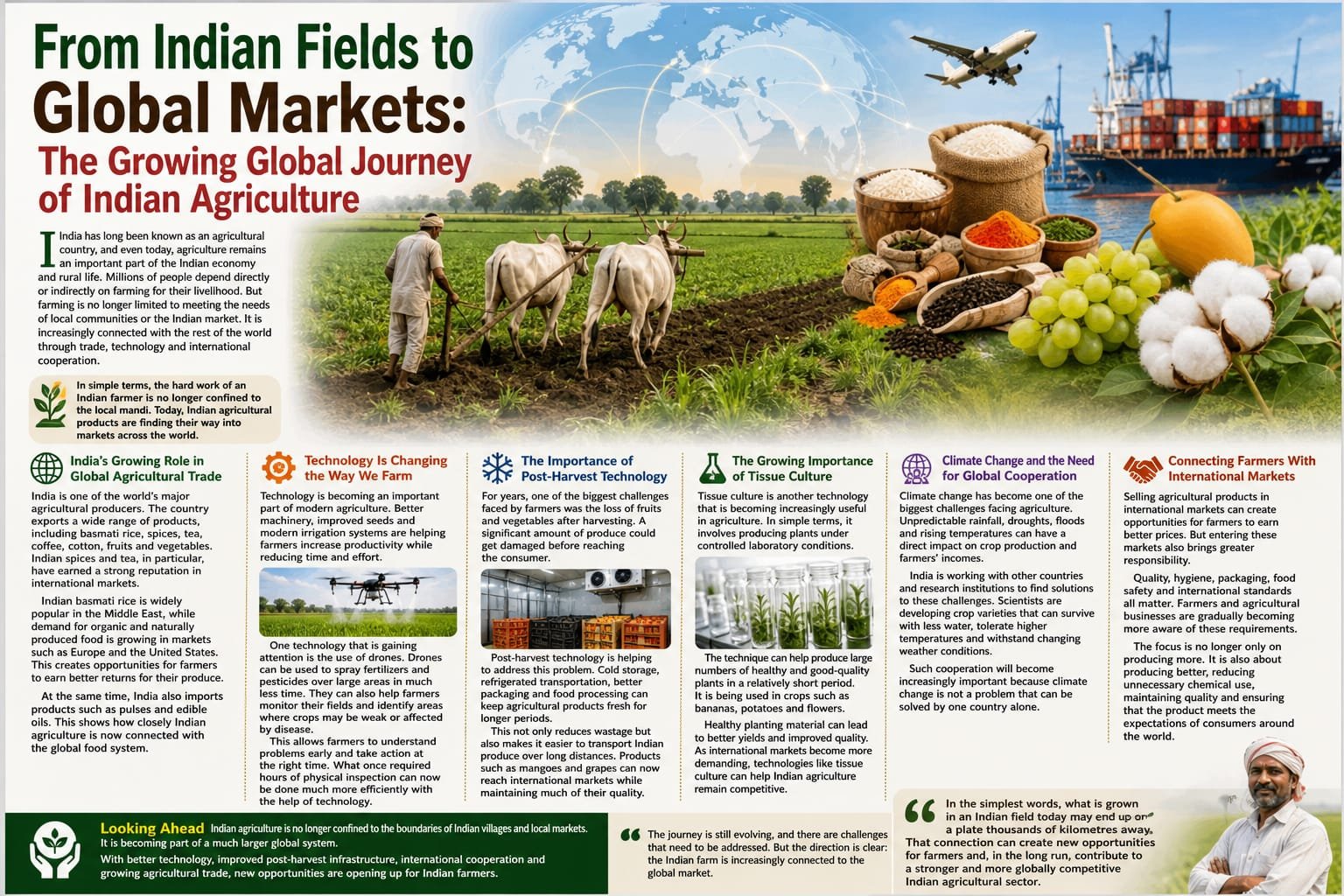
India has long been known as an agricultural country, and even today, agriculture remains an important part of the Indian economy and rural life. Millions of people depend directly or indirectly on farming for their livelihood. But farming is no longer limited to meeting the needs of local communities or the Indian market. It is increasingly connected with the rest of the world through trade, technology and international cooperation.
In simple terms, the hard work of an Indian farmer is no longer confined to the local mandi. Today, Indian agricultural products are finding their way into markets across the world.
India’s Growing Role in Global Agricultural Trade
India is one of the world’s major agricultural producers. The country exports a wide range of products, including basmati rice, spices, tea, coffee, cotton, fruits and vegetables. Indian spices and tea, in particular, have earned a strong reputation in international markets.
Indian basmati rice is widely popular in the Middle East, while demand for organic and naturally produced food is growing in markets such as Europe and the United States. This creates opportunities for farmers to earn better returns for their produce.
At the same time, India also imports products such as pulses and edible oils. This shows how closely Indian agriculture is now connected with the global food system.
Technology Is Changing the Way We Farm
Technology is becoming an important part of modern agriculture. Better machinery, improved seeds and modern irrigation systems are helping farmers increase productivity while reducing time and effort.
One technology that is gaining attention is the use of drones. Drones can be used to spray fertilizers and pesticides over large areas in much less time. They can also help farmers monitor their fields and identify areas where crops may be weak or affected by disease.
This allows farmers to understand problems early and take action at the right time. What once required hours of physical inspection can now be done much more efficiently with the help of technology.
The Importance of Post-Harvest Technology
For years, one of the biggest challenges faced by farmers was the loss of fruits and vegetables after harvesting. A significant amount of produce could get damaged before reaching the consumer.
Post-harvest technology is helping to address this problem. Cold storage, refrigerated transportation, better packaging and food processing can keep agricultural products fresh for longer periods.
This not only reduces wastage but also makes it easier to transport Indian produce over long distances. Products such as mangoes and grapes can now reach international markets while maintaining much of their quality.
The Growing Importance of Tissue Culture
Tissue culture is another technology that is becoming increasingly useful in agriculture. In simple terms, it involves producing plants under controlled laboratory conditions.
The technique can help produce large numbers of healthy and good-quality plants in a relatively short period. It is being used in crops such as bananas, potatoes and flowers.
Healthy planting material can lead to better yields and improved quality. As international markets become more demanding, technologies like tissue culture can help Indian agriculture remain competitive.
Climate Change and the Need for Global Cooperation
Climate change has become one of the biggest challenges facing agriculture. Unpredictable rainfall, droughts, floods and rising temperatures can have a direct impact on crop production and farmers’ incomes.
India is working with other countries and research institutions to find solutions to these challenges. Scientists are developing crop varieties that can survive with less water, tolerate higher temperatures and withstand changing weather conditions.
Such cooperation will become increasingly important because climate change is not a problem that can be solved by one country alone.
Connecting Farmers With International Markets
Selling agricultural products in international markets can create opportunities for farmers to earn better prices. But entering these markets also brings greater responsibility.
Quality, hygiene, packaging, food safety and international standards all matter. Farmers and agricultural businesses are gradually becoming more aware of these requirements.
The focus is no longer only on producing more. It is also about producing better, reducing unnecessary chemical use, maintaining quality and ensuring that the product meets the expectations of consumers around the world.
Looking Ahead
Indian agriculture is no longer confined to the boundaries of Indian villages and local markets. It is becoming part of a much larger global system.
With better technology, improved post-harvest infrastructure, international cooperation and growing agricultural trade, new opportunities are opening up for Indian farmers.
The journey is still evolving, and there are challenges that need to be addressed. But the direction is clear: the Indian farm is increasingly connected to the global market.
In the simplest words, what is grown in an Indian field today may end up on a plate thousands of kilometres away. That connection can create new opportunities for farmers and, in the long run, contribute to a stronger and more globally competitive Indian agricultural sector.
By –
Dr. Nawaz Ahmad Khan, Professor, Acharya Narendra Deva University of Agriculture & Technology , Ayodhya, Uttar Pradesh