



























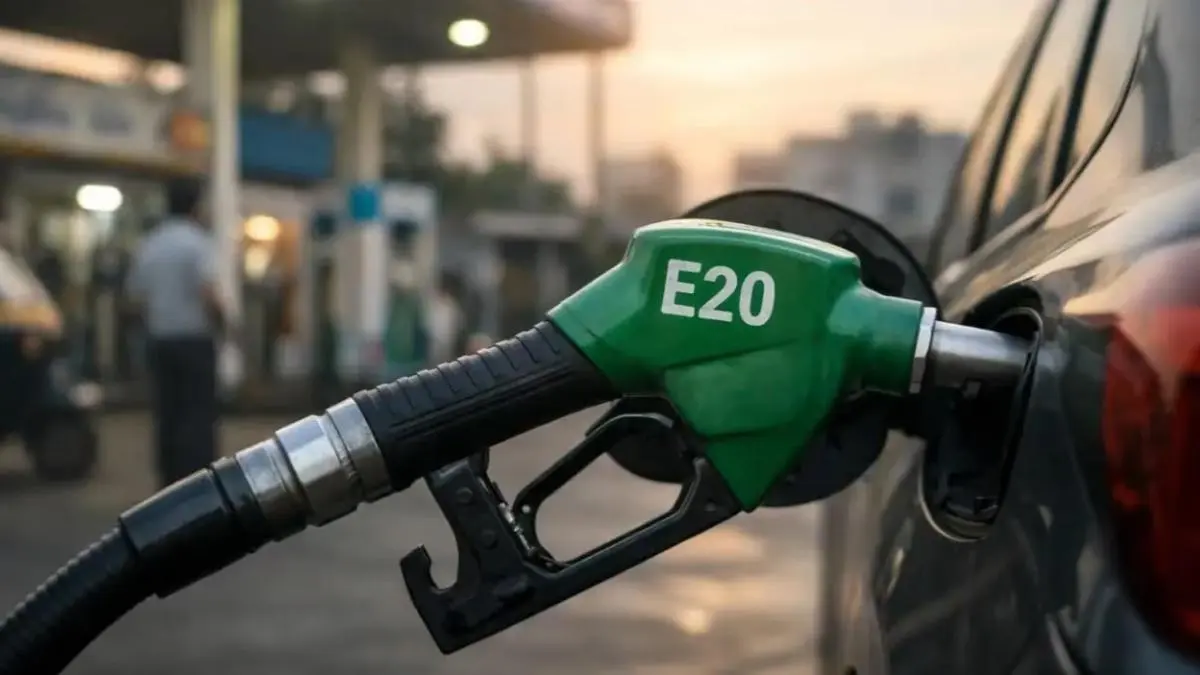
Social media is flooded with claims that E20 fuel damages engines, drastically reduces mileage, and shortens vehicle life. While the debate has intensified in 2026, available scientific studies, government clarifications, and industry data show that many viral claims are exaggerated or lack evidence. Here’s what experts say.
The topic is time sensitive, as it is linked to ongoing public debate, recent court proceedings, government clarifications, and viral social media discussions surrounding India’s E20 fuel rollout. Therefore, this article follows a news reporting style while separating verified facts from misinformation.
E20 fuel, which contains 20 percent ethanol and 80 percent petrol, has become a major talking point across India. Viral videos and social media posts have claimed that the fuel causes severe engine damage, reduces mileage by as much as 40 to 60 percent, and is unsafe for most vehicles. However, experts say the reality is more nuanced. While some concerns deserve attention, many widely shared claims are either misleading or unsupported by scientific evidence.
What Is E20 Fuel and Why Is India Using It?
E20 fuel is petrol blended with 20 percent ethanol, a renewable fuel primarily produced from sugarcane and grain-based feedstocks. The Indian government has expanded ethanol blending to reduce dependence on imported crude oil, lower carbon emissions, and improve energy security.
Most new petrol vehicles manufactured under recent emission norms have been designed or updated for E20 compatibility. Automobile manufacturers have gradually introduced E20-ready engines, while fuel retailers have expanded the availability of blended fuel nationwide. The policy is also intended to provide additional demand for agricultural products used in ethanol production.
Viral Claim: E20 Fuel Damages Every Vehicle Engine
One of the most common claims circulating online is that E20 petrol automatically damages engines regardless of vehicle type. Current evidence does not support this broad conclusion.
The Automotive Research Association of India (ARAI) has stated that it has found no evidence of widespread engine damage caused by E20 fuel during extensive testing across different categories of vehicles. Similarly, an IIT Kanpur study reported no scientific evidence that E20 itself causes engine damage or significant long-term performance issues when used in compatible vehicles.
However, experts also note that owners of older vehicles should always follow their manufacturer’s recommendations because fuel compatibility can differ depending on model year and engine design.
Viral Claim: Mileage Drops by 50 Percent or More
Several social media videos have claimed that E20 petrol cuts mileage in half. Experts say this is inaccurate.
Because ethanol contains less energy per litre than conventional petrol, some reduction in fuel economy is expected. Industry experts and government officials generally estimate the reduction to be modest, often in the range of about 3 to 5 percent under normal driving conditions. A dramatic drop of 50 percent or more would typically indicate another mechanical issue rather than the fuel itself.
A recent example involved a popular content creator who later clarified that the severe mileage drop in his vehicle was linked to an engine problem rather than E20 fuel, after his earlier claims had gone viral.
Why Is There Still a Public Debate?
Although many viral claims have been challenged, the debate has not disappeared.
Recently, an Indian consumer court ruled in favour of a vehicle owner who alleged that E20 fuel had damaged his SUV, ordering compensation from the manufacturer. The automaker has denied responsibility and announced plans to appeal the decision. Since the case is likely to move through higher courts, it should not be viewed as scientific proof that E20 fuel generally damages compatible vehicles. Instead, it highlights the importance of examining individual cases on their specific facts.
Experts continue to distinguish between isolated disputes, mechanical failures, fuel quality issues, and broader scientific evidence regarding E20 compatibility.
What Should Vehicle Owners Do?
Vehicle owners should rely on official guidance instead of viral social media posts.
First, check whether your specific vehicle model is approved for E20 fuel by consulting the owner’s manual or an authorised dealership. Second, use fuel from authorised petrol stations that comply with Bureau of Indian Standards specifications. Third, maintain regular servicing because neglected engines may develop problems regardless of fuel type.
The Press Information Bureau has also rejected viral claims suggesting that ethanol separates inside fuel tanks or that E20 supplied through authorised outlets fails to meet quality standards. According to official clarification, ethanol-blended petrol supplied by oil marketing companies undergoes quality testing and conforms to prescribed standards.
The available evidence indicates that E20 fuel is not responsible for many of the dramatic claims circulating online. Scientific studies, automotive researchers, and industry experts have not found proof that E20 causes widespread engine damage in compatible vehicles. At the same time, consumers with older vehicles should continue following manufacturer recommendations and stay informed through verified sources rather than relying on viral social media content.
Key Takeaways
- There is no scientific evidence that E20 fuel causes widespread engine damage in compatible vehicles.
- A small reduction in fuel economy is expected, but dramatic mileage loss claims are not supported by expert studies.
- Owners of older vehicles should always follow manufacturer guidance regarding fuel compatibility.
- Viral social media claims should be verified against scientific studies and official advisories before being accepted.
Frequently Asked Questions
Q1. Does E20 fuel damage every petrol car?
No. Current studies have not found evidence that E20 damages vehicles designed or approved for E20 use.
Q2. Will E20 fuel reduce mileage?
A slight reduction in mileage may occur because ethanol has lower energy content than petrol, but experts do not support claims of massive mileage loss under normal conditions.
Q3. Should owners of older vehicles be concerned?
Owners should consult their vehicle manual or authorised service centre to confirm whether their specific model is compatible with E20 fuel.
Q4. Are all viral claims about E20 fuel false?
Not all concerns are baseless, but many widely circulated claims exaggerate the risks or present isolated incidents as universal facts. It is important to rely on verified technical evidence and manufacturer guidance.
(Internal keyword suggestions: E20 fuel fact check, E20 petrol India, ethanol blended petrol, E20 engine damage myth, E20 mileage facts, E20 compatible cars, ethanol blending India, E20 fuel experts, ARAI E20 study, E20 fuel FAQs)