































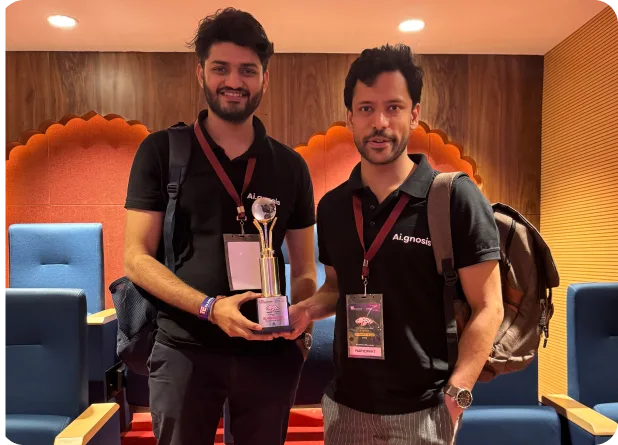
Jaipur-based healthtech startup Aignosis has raised ₹4 crore in seed funding to expand its AI-assisted autism and developmental screening technology across India. The company plans to take its screening system deeper into government health centres, clinics and schools while expanding its referral network.
Aignosis Raises ₹4 Crore in Seed Funding
Aignosis has raised ₹4 crore in a seed funding round led by Antler, Nikhil Kamath and angel investors including Varun Dua and IIMA Ventures. The fresh capital comes as the Jaipur-based startup prepares to expand its AI-assisted autism and developmental screening technology across India’s healthcare ecosystem.
The company was founded by Raksheet Jain and Divyansh Mangal and has been working on technology designed to make early developmental screening more accessible.
According to the company, the funding will support its move from technology development and validation toward broader deployment. Its expansion plans include both public and private healthcare settings, with a particular focus on primary health centres, paediatric practices and schools.
The startup has already completed more than 8,000 screenings and is targeting at least 100,000 screenings by the end of FY27.
How Aignosis Uses AI for Autism Screening
Aignosis’ technology is designed as an initial screening layer rather than a replacement for clinical diagnosis.
The system is intended for children between 16 months and nine years of age. It uses a standard laptop and webcam to capture a short video based on nine stimulus modules. Computer vision is then used to analyse behavioural signals, including gaze, response to name and reactions to facial expressions.
The technology produces a risk report indicating whether a formal clinical assessment may be warranted.
This distinction is important. A screening result does not establish that a child has autism. Instead, it can help identify children who may need further assessment by qualified healthcare professionals.
The approach is aimed at adding an early screening step to existing healthcare interactions rather than replacing paediatricians, psychologists or other clinical professionals.
From Government Health Centres to Schools
Aignosis has already started deploying its technology outside traditional private hospital settings.
The company says its system has been deployed across more than 20 government primary health centres in Rajasthan. This forms part of its clinic-in-clinic approach, where paediatricians can incorporate developmental screening into existing healthcare services rather than requiring families to purchase or install a separate medical device.
The startup is also beginning operations with Apollo Shines, the Apollo Group’s school infirmary division, across around 125 schools.
It has additionally partnered with Mankind Pharma. According to the company, nearly 1,300 medical representatives from Mankind Pharma are supporting screening camps with paediatricians across India.
This distribution strategy is significant because access to developmental screening can depend heavily on where families live and which healthcare facilities are available to them.
Why Early Screening Is a Key Focus
Autism screening is part of a broader challenge in child developmental healthcare. Families may notice differences in communication, social interaction or behaviour but still face delays before receiving a formal clinical evaluation.
Aignosis is attempting to address one part of this process by providing an initial screening mechanism that can be used in settings already visited by families.
The company’s own 2026 impact report says its technology was used to screen 1,622 children through 21 government urban primary health centres in Jaipur, alongside screening camps and psychologist evaluation calls. The report also says more than 20 children were referred for full diagnostic care. These figures are company-reported and should not be treated as independent clinical validation.
The broader objective is to identify children who may benefit from further professional assessment earlier in the care pathway.
Regulatory Progress and Previous Support
Aignosis has also completed its CDSCO regulatory process and received Class B certification for its screening technology, according to the company and current funding reports.
The startup was incubated at IIM Ahmedabad Ventures and was selected for Google’s 2025 Google for Startups Accelerator: AI First cohort.
The company had also received earlier backing. Reports from 2025 said Aignosis secured funding through Shark Tank India and was selected for the WTFund programme associated with Nikhil Kamath.
The latest ₹4 crore round therefore represents another stage in the company’s effort to move its technology from development and early deployment toward wider healthcare adoption.
Aignosis Plans Expansion Into More States
Following its work in Rajasthan, Aignosis plans to expand into several additional regions.
The company has identified Punjab, the National Capital Region, Haryana, Tamil Nadu, Jharkhand, Karnataka and Maharashtra as expansion markets. The goal is to build screening and referral access through both government and private healthcare networks.
For Tier-2 and Tier-3 cities, this expansion could be particularly relevant if screening services are integrated into primary healthcare facilities and smaller clinics rather than being concentrated only in large metropolitan hospitals.
However, wider deployment will also depend on factors such as availability of paediatricians, clinical referral networks, healthcare infrastructure and awareness among parents.
Human Oversight Remains Important
The use of AI in developmental screening also raises questions about accuracy, privacy and the role of healthcare professionals.
An AI-based screening system can identify signals that warrant further attention, but screening and diagnosis are different processes. A clinical diagnosis involves professional assessment and consideration of a child’s broader developmental history and behaviour.
For that reason, the usefulness of technologies such as Aignosis will depend not only on the screening algorithm but also on what happens after a risk report is generated.
A clear referral pathway can determine whether a child moves from an initial screening result to an appropriate clinical evaluation and, where necessary, support services.
The company’s current clinic-in-clinic model is designed around this connection between technology and healthcare professionals.
What the New Funding Means for Aignosis
The ₹4 crore funding gives Aignosis additional capital to expand its existing model and reach more children through healthcare and education networks.
Its target of at least 100,000 screenings by the end of FY27 represents a significant increase from the more than 8,000 screenings reported so far.
The next stage will therefore involve more than simply deploying software. Aignosis will need to establish partnerships, support healthcare professionals, maintain appropriate data and security practices, and ensure that children identified as potentially needing further evaluation can access qualified clinical services.
For India’s growing healthtech sector, the development also highlights how AI is increasingly being applied to specific healthcare workflows rather than only general-purpose applications.
Aignosis’ approach is centred on one defined problem: providing an accessible first layer of developmental screening that can connect families with the next stage of professional care.
Key Takeaways
- Aignosis has raised ₹4 crore in seed funding led by Antler, Nikhil Kamath and participating angel investors.
- Its AI-assisted system uses a laptop and webcam to analyse behavioural signals during an initial screening process.
- The technology provides a risk report and is not intended to replace formal clinical diagnosis.
- The startup plans to expand from Rajasthan into Punjab, NCR, Haryana, Tamil Nadu, Jharkhand, Karnataka and Maharashtra.
Frequently Asked Questions
How much funding has Aignosis raised?
Aignosis has raised ₹4 crore in its latest seed funding round. The round was led by Antler, Nikhil Kamath and angel investors including Varun Dua and IIMA Ventures.
What does Aignosis’ AI technology do?
The system uses a standard laptop and webcam to capture a short video involving nine stimulus modules. Computer vision analyses behavioural signals such as gaze, response to name and reactions to facial expressions before generating a risk report.
Does Aignosis provide an autism diagnosis?
No. The company’s technology is designed for initial screening. Its report indicates whether a formal clinical assessment may be warranted. A screening result should not be treated as a medical diagnosis.
Where is Aignosis expanding?
Aignosis plans to expand into Punjab, the National Capital Region, Haryana, Tamil Nadu, Jharkhand, Karnataka and Maharashtra after its existing deployment work in Rajasthan.














