































Sustainability has become one of the more overused words in interior design marketing — but in the case of wood veneer, the underlying material logic is genuinely straightforward. A single log, sliced into sheets as thin as a fraction of a millimetre, can clad many times the surface area that the same log would cover as solid timber. For a Mumbai supplier like Sparlin, that arithmetic is the starting point for a broader conversation the veneer trade is increasingly having about responsible material use.
The Simple Math of Efficiency
“People sometimes assume veneer is a compromise material — a cheaper stand-in for ‘real’ wood,” says the team at Sparlin, which has supplied natural wood veneer to architects and designers across Mumbai since 2011. “It’s the opposite. Veneer is how you get genuine timber character — real grain, real species, real figure — while using a small fraction of the log that solid wood construction would require.”
That efficiency matters more as certain species become scarcer and slower-growing timber becomes harder to source responsibly. A rare burl or a striking exotic grain pattern that would be prohibitively resource-intensive to specify as solid wood becomes viable — and repeatable — once sliced into veneer.
What Responsible Sourcing Looks Like in Practice
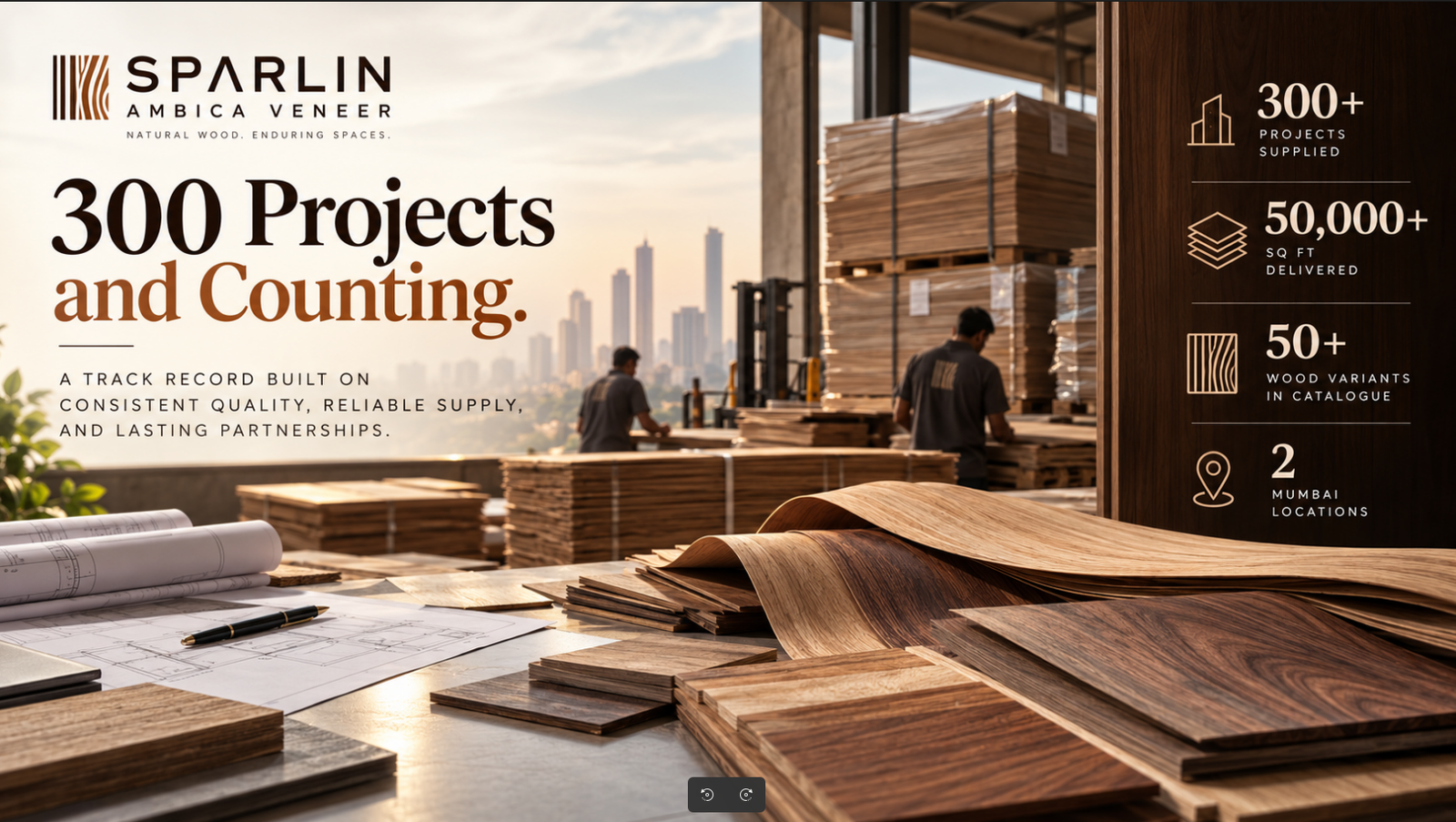
For a wholesale trader operating at Sparlin’s scale — more than 50,000 square feet of veneer delivered across 300-plus projects — responsible sourcing isn’t an abstract commitment; it’s a daily sourcing discipline:
- Selecting timber stock with an eye to yield, so more usable veneer comes from each log processed.
- Grading rigorously, so material is allocated to the application it suits best rather than wasted on mismatched specification.
- Maintaining a wide species catalogue, so designers have sustainable alternatives to the handful of over-specified species that come under the most sourcing pressure.
- Supplying to trade volumes that match actual project needs, reducing the offcuts and overordering that come with poorly planned procurement.
A Material Whose Time Has Come — Again
Wood veneer isn’t a new invention dressed up as a sustainability story. Furniture makers and architects have used it for centuries, precisely because it let them apply rare and beautiful timber without the waste of solid construction. What’s changed is the urgency of the underlying case: as the design industry faces real scrutiny over material sourcing, a technique that was once valued mainly for its economics and aesthetics is being re-evaluated for its environmental logic too.
For suppliers like Sparlin, that reframing doesn’t require a change in what they do — sourcing carefully, grading rigorously, using timber efficiently has always been the job. What’s changed is that the design industry is finally asking the right questions about it.
Efficiency Doesn’t Mean Compromise
One misconception the company says it regularly has to correct is that sustainable sourcing and design ambition pull in opposite directions — that a “responsible” material choice necessarily means a plainer or more limited one. In practice, veneer’s efficiency is precisely what makes ambitious specification possible: a rare burl or a striking exotic grain that would be functionally unobtainable at solid-wood volumes becomes something a project can actually specify and receive, repeatably, once sliced thin enough to stretch across the surface area a design calls for.
That’s a different sustainability story than the one usually told in design marketing — less about restraint, more about getting more genuine material character out of every log processed. For architects and designers increasingly asked by their own clients to account for material choices, it’s also a considerably easier story to stand behind: the case for veneer doesn’t require an asterisk.
As sourcing scrutiny becomes a standard part of the specification conversation rather than an occasional question, suppliers who can speak to their process in plain, specific terms — not just as a checkbox, but as a description of how the work actually gets done — are likely to find themselves fielding more of it, not less.
About Sparlin (Ambica Veneer): Sparlin is a Mumbai-based wholesale supplier of natural wood veneer, operating from Andheri East and Byculla East since 2011, supplying architects, interior designers, and contractors with responsibly sourced timber across more than 50 wood variants. Learn more at sparlinveneer.com.














