































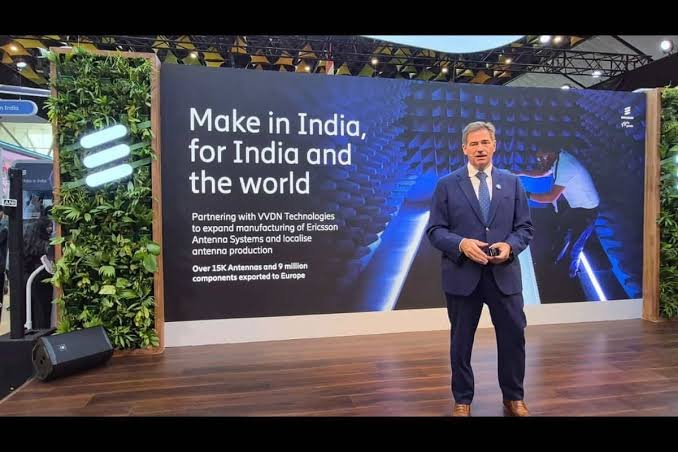
India’s telecom manufacturing sector has gained fresh international attention after Ericsson announced plans to export antennas manufactured in India to Europe and other global markets at India Mobile Congress (IMC) 2026. The development highlights India’s growing role in global telecom supply chains, while raising questions about manufacturing capacity, skilled jobs and future export opportunities.
IMC 2026: Ericsson Announces Global Exports From India
India’s telecom equipment manufacturing industry received a significant boost in visibility during the 10th edition of India Mobile Congress 2026, held at Yashobhoomi in New Delhi from October 7 to 10.
Swedish telecommunications equipment company Ericsson announced plans to expand the international reach of its India-manufactured antennas, including exports to Europe and other global markets. The announcement marks an important development in the company’s manufacturing operations in India and reflects the country’s increasing relevance to international telecom supply chains.
According to reports published during IMC 2026, Ericsson has manufactured more than 15,000 radio antennas and 25 million components in India since July 2025. The company is expanding its local manufacturing capabilities to support its broader global operations.
The announcement is relevant because telecom equipment manufacturing involves more than assembling products for domestic use. International exports require manufacturers to meet technical specifications, quality requirements and the needs of network operators in different markets.
For India, the opportunity lies in attracting more manufacturing activity, developing technical expertise and establishing local facilities as reliable suppliers to international customers.
What Telecom Equipment Is Being Exported?
Telecom antennas are essential components of mobile communication networks. They transmit and receive radio signals, helping mobile devices connect with nearby network infrastructure.
The antennas manufactured by Ericsson in India are designed for advanced mobile networks, including 5G standalone deployments and networks that can support artificial intelligence-related applications. The equipment is intended to serve the requirements of modern telecom infrastructure rather than only basic mobile connectivity.
Different countries use different spectrum bands and operate under varying technical and regulatory requirements. Manufacturers therefore need to adapt equipment to the needs of individual markets before supplying it to network operators.
This makes international telecom manufacturing more complex than producing a standard consumer electronic product. Antennas must satisfy performance, reliability, compatibility and quality requirements under demanding operating conditions.
The export announcement also illustrates how India’s manufacturing ecosystem can contribute to specialised equipment used in sophisticated communication networks. If international demand grows, local production facilities may gain opportunities to increase output, improve processes and develop additional technical capabilities.
However, the announcement should not be interpreted as evidence that all telecom equipment used globally is now being manufactured in India. It concerns Ericsson’s India-made antennas and the company’s plans to supply international markets.
Why India’s Telecom Equipment Exports Matter
The export plan comes at a time when countries are investing in faster mobile networks, improved connectivity and infrastructure capable of supporting data-intensive applications. India has already built a large telecommunications market, making it an important location for equipment manufacturers seeking production scale and technical talent.
For Indian manufacturing, the benefits of exporting specialised telecom equipment can extend beyond the value of individual shipments. International orders can encourage suppliers to improve quality control, strengthen component sourcing and invest in engineering capabilities.
Local suppliers may also gain opportunities to work with multinational companies. Such partnerships can help businesses develop expertise in precision manufacturing, testing, product design and compliance with international standards.
There are potential benefits for employment as well. Expanding production can create demand for technicians, engineers, quality-control specialists, logistics professionals and workers involved in component manufacturing. However, the scale of these benefits will depend on future production volumes, investment decisions and the extent to which domestic suppliers participate in the supply chain.
For smaller industrial centres, this could create opportunities if manufacturers establish supplier networks beyond major metropolitan areas. Such expansion is possible, but the announcement alone does not confirm new factories or a specific number of jobs in any Indian city.
IMC 2026 and India’s Push for Telecom Manufacturing
India Mobile Congress is an annual telecommunications and technology event organised jointly by the Department of Telecommunications and the Cellular Operators Association of India. Its 2026 edition was held from October 7 to 10 in New Delhi under the theme Scale Without Boundaries.
The event brought together technology companies, telecom operators, policymakers, researchers and startups to discuss developments in connectivity, artificial intelligence, network infrastructure and next-generation communications.
The government has been seeking to strengthen India’s position in telecom manufacturing through domestic production, research and development, and initiatives supporting indigenous technology. The broader objective is to reduce dependence on imported equipment in selected areas while enabling Indian facilities and companies to serve international markets.
Ericsson’s export announcement fits into this wider industry trend, although the company is Swedish and its India-based manufacturing operations form part of its global business. The development should therefore be understood as an example of manufacturing and export activity taking place in India, rather than proof that the entire product ecosystem is Indian-owned.
India’s longer-term success will depend on how much value is created locally, including through component production, engineering, research and intellectual property.
Challenges India Must Address to Expand Telecom Exports
International demand creates opportunities, but telecom manufacturing also faces considerable challenges. Equipment makers must meet strict technical specifications, maintain consistent product quality and adapt products to the requirements of different markets.
Telecom networks rely on equipment that must operate reliably over long periods. Manufacturers need testing facilities, skilled personnel, dependable component suppliers and systems for handling technical problems after installation.
Global competition is another factor. Indian manufacturing facilities must compete with established production hubs on quality, cost, delivery timelines and technological capability. Exchange-rate movements, trade policies and changes in international demand can also influence export performance.
Research and development will remain important as networks evolve beyond conventional 5G deployments towards more advanced architectures and future 6G technologies. Producing equipment locally is a useful step, but building design expertise and developing proprietary technologies can create greater long-term value.
The key measure of progress will not simply be the number of products manufactured. It will also include sustained export orders, stronger domestic supplier participation, investment in engineering and the ability to compete in demanding international markets.
What Happens Next for India’s Telecom Industry?
Ericsson’s plan to export India-made antennas to Europe and other markets is an encouraging development for the country’s telecom manufacturing ambitions. It shows how an established international technology company can use its Indian operations to support customers beyond the domestic market.
The next indicators to watch will be the scale of actual exports, the expansion of local manufacturing and sourcing, and whether other telecom equipment makers follow a similar path.
For India, the larger opportunity is to move further into high-value manufacturing, research and technology development. Achieving that goal will require consistent investment, skilled workers, reliable infrastructure and a policy environment that supports long-term industrial growth.
The IMC 2026 announcement is a concrete step in that direction, but its wider economic impact will become clearer as export activity develops.
Key Takeaways
- Ericsson announced plans to export antennas manufactured in India to Europe and other international markets at IMC 2026.
- The company reported producing more than 15,000 antennas and 25 million components in India since July 2025.
- Growing telecom exports could support manufacturing, technical employment and domestic supplier participation, although the scale of these benefits remains uncertain.
- India’s long-term competitiveness will depend on research, product quality, local value addition and the ability to meet international technical standards.
Frequently Asked Questions
1. What was the major telecom manufacturing announcement at IMC 2026?
Ericsson announced plans to expand the export of antennas manufactured in India to Europe and other global markets, strengthening the international role of its Indian manufacturing operations.
2. What telecom equipment is being exported from India?
The announcement concerns Ericsson’s India-manufactured radio antennas designed for advanced mobile networks, including 5G standalone and AI-ready network applications.
3. How could telecom equipment exports benefit India?
Exports can support manufacturing activity, create demand for skilled workers, strengthen domestic supply chains and encourage investment in engineering and research. The actual impact will depend on production growth and future international orders.
4. Does this mean India now manufactures all its telecom equipment?
No. The announcement concerns a specific manufacturer’s antennas and export plans. India’s telecom equipment industry includes domestic and international companies, and manufacturing capabilities vary across product categories.














