






























A landslide on the Mumbai-Pune Expressway’s newly opened Missing Link has disrupted traffic during heavy monsoon rains and sparked discussions about infrastructure resilience. The incident has highlighted the challenges of building and maintaining critical transport corridors in landslide-prone regions.
The Mumbai-Pune Expressway landslide has become one of Maharashtra’s biggest infrastructure stories this monsoon. A rain-triggered rockfall and landslide near Tunnel 2 of the recently inaugurated Missing Link project forced temporary road closures, traffic diversions, and extensive restoration work. While authorities have stated that the tunnel itself remains structurally safe, the incident has raised broader questions about whether India’s major infrastructure projects are fully prepared for increasingly intense monsoon conditions.
What Happened on the Mumbai-Pune Expressway?
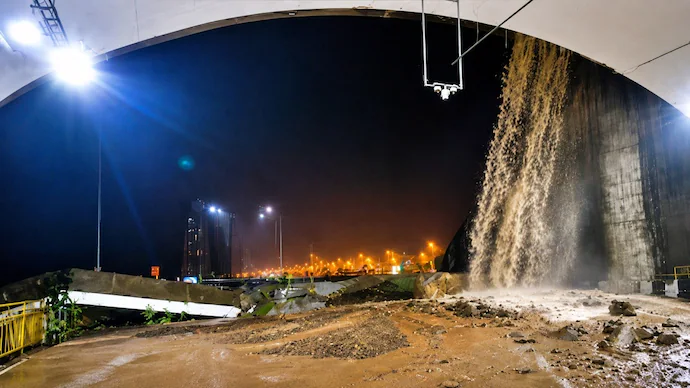
The landslide occurred after exceptionally heavy rainfall lashed the Lonavala and Khandala ghat region. Rocks and debris slid down the hillside near the entrance of Tunnel 2 on the Pune-bound Missing Link section, damaging the entrance façade and blocking the carriageway.
The Maharashtra State Road Development Corporation (MSRDC) temporarily closed the affected stretch to remove debris, inspect the tunnel, and ensure commuter safety. Traffic was diverted while engineers assessed the site. After safety inspections and clearance operations, authorities reopened the connecting road, stating that the tunnel structure had not suffered any structural damage.
The Missing Link project, inaugurated only weeks earlier, was designed to reduce travel time and bypass one of the most congestion-prone sections of the expressway. Its first major monsoon challenge has therefore attracted significant public attention.
Heavy Monsoon Rains Tested Critical Transport Infrastructure
The incident occurred during one of Maharashtra’s most intense spells of monsoon rainfall this season. Several parts of Pune district and the Western Ghats recorded exceptionally heavy rain, increasing the risk of landslides, flooding, and falling rocks across mountain roads.
The impact was not limited to highways. Landslides also affected the Mumbai-Pune railway corridor, disrupting train services and leading to cancellations and diversions while restoration work continued.
Experts note that steep slopes, saturated soil, and prolonged rainfall create conditions where even engineered slopes require continuous monitoring. Protective measures such as rockfall barriers, retaining walls, drainage systems, and slope stabilization reduce risk but cannot eliminate it entirely during extreme weather events.
Why the Incident Matters Beyond One Expressway
The Mumbai-Pune Expressway is among India’s busiest transport corridors, carrying commuters, commercial vehicles, and logistics traffic between Maharashtra’s two largest economic centres.
Even temporary disruptions can affect freight movement, industrial supply chains, tourism, and emergency services. During this incident, commuters experienced delays while authorities prioritized safety over traffic movement.
The event also demonstrates how infrastructure planning increasingly needs to account for changing rainfall patterns. Climate experts have observed that many parts of India are witnessing shorter periods of much heavier rainfall, placing greater pressure on drainage systems, hill slopes, bridges, tunnels, and highways.
As India continues investing in expressways, tunnels, and mountain roads, resilience against extreme weather has become as important as speed and connectivity.
Authorities Defend the Project While Experts Seek Lessons
Following the landslide, MSRDC stated that the incident resulted from exceptionally heavy rainfall and described it as a natural event rather than evidence of a structural failure. Officials clarified that the tunnel itself remained safe and that only the entrance structure and surrounding slope were affected.
At the same time, infrastructure specialists have suggested that every major weather event provides valuable engineering data. Post-incident assessments help authorities evaluate drainage performance, slope protection systems, rockfall barriers, and emergency response procedures.
Such reviews are common after significant weather-related events and often lead to additional reinforcement or monitoring measures without necessarily indicating flaws in the overall project design.
What This Means for Future Monsoon Infrastructure
The expressway incident highlights a broader challenge facing infrastructure projects across India’s hill regions.
Roads through the Western Ghats, Himalayas, and other mountainous areas must withstand increasingly unpredictable rainfall while ensuring uninterrupted connectivity. This requires continuous slope inspections, real-time weather monitoring, improved drainage, early warning systems, and rapid response teams capable of clearing debris quickly.
Engineers also increasingly use technologies such as drones, ground sensors, and satellite-based monitoring to detect slope movement before major failures occur. Combined with regular maintenance, these measures can improve safety during future monsoon seasons.
The Mumbai-Pune Expressway landslide serves as a reminder that infrastructure development does not end when construction is completed. Long-term monitoring and adaptation remain essential, particularly as extreme weather events become more frequent.
Key Takeaways
- Heavy monsoon rain triggered a landslide near Tunnel 2 of the Mumbai-Pune Expressway Missing Link.
- Authorities stated that the tunnel remained structurally safe after detailed inspections.
- Road and rail connectivity between Mumbai and Pune experienced temporary disruptions.
- The incident has renewed focus on building climate-resilient infrastructure for India’s monsoon conditions.
FAQs
Q1. What caused the Mumbai-Pune Expressway landslide?
The landslide was triggered by intense monsoon rainfall that caused rocks and debris to slide onto the roadway near Tunnel 2.
Q2. Was the Missing Link tunnel structurally damaged?
According to MSRDC, inspections found that the main tunnel remained structurally safe, although the entrance area and surrounding slope were affected.
Q3. Did the landslide disrupt travel?
Yes. The affected expressway section was temporarily closed for safety inspections and debris removal, while railway services in the ghat section also faced disruptions.
Q4. Why is this incident important?
The event highlights the need for stronger monsoon preparedness, continuous infrastructure monitoring, and climate-resilient engineering on major transport corridors.
(Internal Keyword Suggestions: Mumbai-Pune Expressway landslide, Missing Link project, Maharashtra monsoon news, Mumbai Pune Expressway update, Tunnel 2 landslide, monsoon infrastructure India, Western Ghats landslide, MSRDC, expressway safety, Maharashtra rainfall)