



























Short summary: Bengaluru-based SatSure has secured ₹60 crore from a government-backed space technology fund as part of its ₹200 crore Series B round. The company plans to strengthen satellite imaging, Earth observation and AI-powered data services for industries in India and overseas.
SatSure Funding: What Happened in November 2026?
Indian space technology startup SatSure has raised ₹60 crore, approximately $7 million, from the Antariksh Venture Capital Fund (AVCF), a government-backed investment fund anchored by India’s space regulator IN-SPACe and managed by SIDBI Venture Capital.
Announced on November 20, 2026, the investment marks the first close of SatSure’s ongoing ₹200 crore Series B funding round. The Bengaluru-headquartered company is developing technology that combines satellite imagery, artificial intelligence and data analytics to help organisations make decisions about agriculture, banking, insurance, infrastructure and natural resources.
The funding is significant because it supports a part of the space industry that receives less public attention than rocket launches and satellite manufacturing: converting information collected from space into practical business intelligence.
SatSure plans to use the capital to develop satellite imaging payloads, expand its data analytics capabilities and participate in India’s planned Earth observation satellite network. The company also intends to increase its international commercial operations. Reuters+2
Understanding the ₹200 Crore Series B Funding Round
The ₹60 crore investment from Antariksh Venture Capital Fund is part of a larger ₹200 crore Series B round. The company has structured the funding through three components.
- Primary equity: ₹165 crore in fresh equity investment.
- Venture debt: ₹25 crore in debt financing.
- Secondary transactions: ₹10 crore involving existing shares.
The full round is expected to close on a rolling basis through December 2026.
Following the first close, SatSure’s cumulative institutional capital raised stands at ₹427 crore, excluding government grants. The investment values the company at approximately ₹870 crore, or around $93 million, according to the reported funding announcement.
The participation of Antariksh Venture Capital Fund is also notable because it represents the fund’s first investment in the downstream data analytics and artificial intelligence segment of India’s space economy.
The fund is anchored by IN-SPACe and managed by SIDBI Venture Capital. Its investment in SatSure indicates interest in companies that can turn space infrastructure into commercial products and services. SatSure+2
How SatSure Uses Satellite Data and Artificial Intelligence
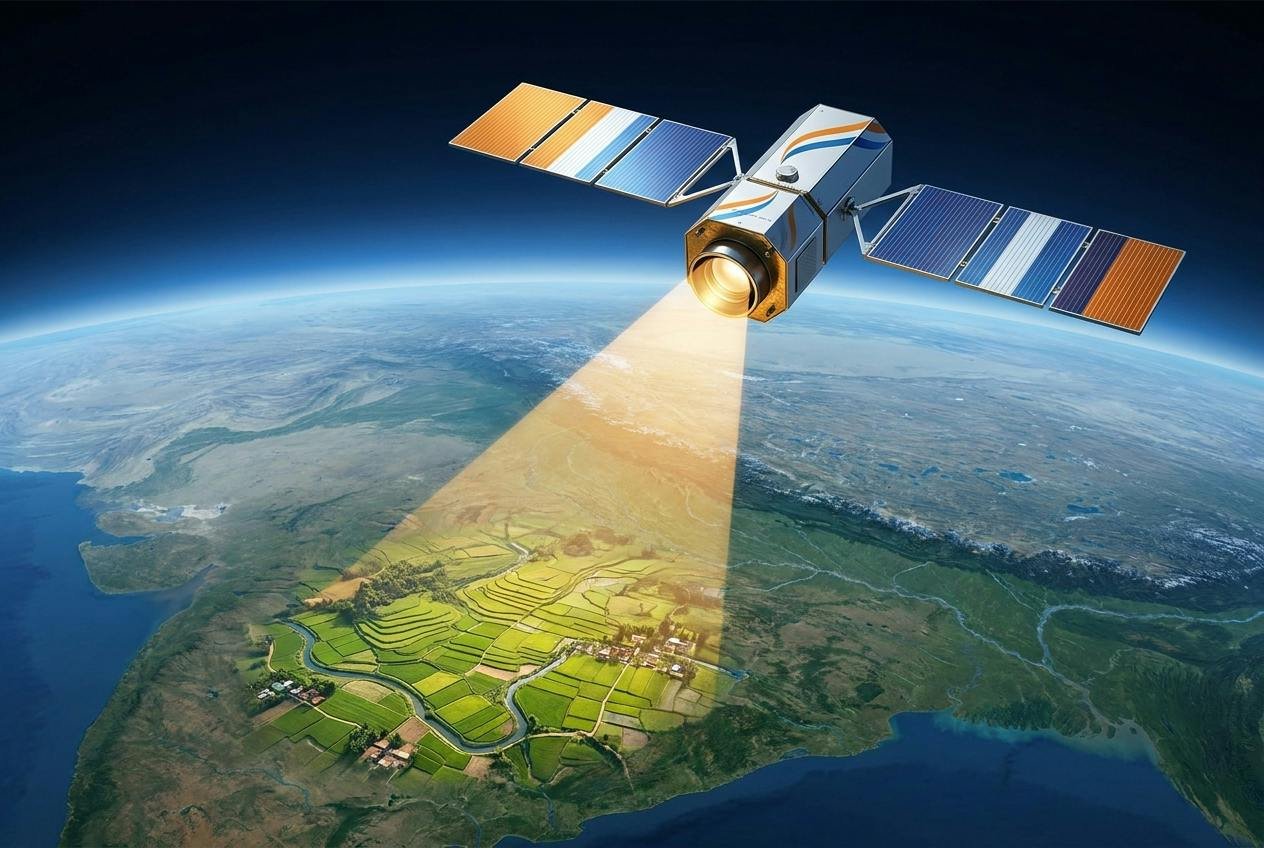
Satellite imagery is essentially visual information collected by satellites observing the Earth’s surface. However, raw satellite images are not always sufficient for making business decisions.
Organisations often need to understand what has changed in a particular location, how land is being used, whether crops are developing normally or whether infrastructure is being affected by environmental conditions.
This is where SatSure’s technology comes into the picture.
The company combines Earth observation data with artificial intelligence, machine learning and other information sources to generate insights for specific industries.
For example, satellite images can show changes in agricultural land over time. When combined with weather information and agricultural data, these observations can help estimate crop conditions and identify potential risks.
Similarly, infrastructure companies can use satellite-based monitoring to observe construction activity, land changes and vegetation near important assets.
SatSure describes its business as Earth intelligence, which means converting information collected through satellites, aerial imagery and other sources into data that organisations can use for planning and risk assessment. Global Earth Intelligence Company+2
Agriculture: How Satellite Technology Can Help Farmers and Lenders
Agriculture is one of the important applications of SatSure’s technology.
Traditional agricultural assessments often depend on physical field inspections, surveys and information collected from farmers. These methods can require considerable time, particularly when lenders or insurers need to evaluate large numbers of farms across different regions.
Satellite-based monitoring offers another way to observe agricultural conditions.
By analysing images collected at different points during a crop cycle, technology platforms can identify changes in vegetation, monitor crop development and assess land conditions. When combined with weather and historical agricultural information, these observations can support crop performance estimates.
This information can be useful to several groups:
- Banks: Satellite-based agricultural insights can support farm-level credit risk assessment.
- Insurance companies: Images taken before and after an event can help assess potential crop damage.
- Agribusiness companies: Crop monitoring can support procurement and supply-chain planning.
- Government agencies: Geospatial information can assist with agricultural planning and monitoring.
SatSure’s solutions include agricultural monitoring and risk assessment tools. The company also highlights applications involving farm productivity, crop insurance and rural lending.
However, satellite information does not replace every physical inspection. Weather conditions, image resolution, crop types and local variations can affect the accuracy of assessments. It is most useful when combined with other reliable information sources. Turning EO Data into Intelligence+2
Banking and Insurance: Why Financial Companies Need Satellite Intelligence
SatSure’s technology also has applications in banking and insurance.
Agricultural lending involves assessing borrowers whose income may depend on weather conditions, crop performance and local agricultural activity. Financial institutions need information to understand the risks associated with lending to farmers and rural businesses.
Satellite data can provide additional information about agricultural land and crop conditions. Banks and insurers can use these insights alongside financial records, field assessments and other relevant information.
For insurance companies, satellite imagery can support crop damage assessment and claims validation. Instead of depending entirely on physical inspections, insurers can compare images from different dates to identify changes in agricultural conditions.
SatSure’s reported customers include HDFC Bank, ICICI Bank, Axis Bank, ITC, Bayer and the Airports Authority of India.
The presence of financial institutions and large businesses among its customers indicates that the company is targeting commercial applications rather than limiting its technology to research projects.
Still, adoption depends on whether satellite-based insights are accurate, cost-effective and compatible with the existing systems used by these organisations. MWC Sandbox/Syndication+2
KaleidEO: SatSure’s Plan to Develop Satellite Imaging Technology
An important part of SatSure’s expansion strategy involves its subsidiary, KaleidEO.
While SatSure focuses on processing Earth observation data and developing industry-specific intelligence, KaleidEO works on satellite imaging systems and optical payloads.
An optical payload is an instrument installed on a satellite to capture images of the Earth’s surface. The quality of these instruments influences the resolution and usefulness of the data collected.
KaleidEO is developing high-resolution multispectral Earth observation payloads. Multispectral imaging captures information across different portions of the electromagnetic spectrum, allowing users to study characteristics that may not be visible in ordinary photographs.
This technology can support applications such as agricultural monitoring, land-use analysis, infrastructure mapping and environmental observation.
SatSure plans to advance its optical payloads ahead of orbital flight in 2027. Developing this capability could give the company greater control over the data collection process and help it build a more integrated Earth observation business.
However, the planned satellite missions still involve technical development, testing and deployment milestones. Their eventual performance will need to be assessed after the systems reach orbit and begin collecting operational data. SatSure+2
Dhaarini: SatSure’s Large Earth Observation AI Model
Another important development connected to the funding is Dhaarini, SatSure’s Large Earth Observation Model.
The model is designed to work with Earth observation information and support the development of AI-powered insights from satellite data.
The idea behind such models is to make it easier to interpret large amounts of geospatial information. Instead of analysing every image independently, AI systems can identify patterns, classify land features and help detect changes across large geographical areas.
According to SatSure’s funding announcement, Dhaarini previously received a ₹24.6 crore grant under IN-SPACe’s Technology Adoption Fund.
The company’s plan to scale Dhaarini is part of a broader effort to combine satellite hardware, data processing and artificial intelligence.
This approach could help SatSure develop specialised services for businesses and government organisations that need regular information about land, agriculture and infrastructure.
The commercial value of the model will depend on its accuracy, the quality of the underlying satellite data and its ability to deliver useful results across different geographical conditions. SatSure+1
Why India’s Space Technology Sector Is Attracting Investment
India’s private space industry has expanded following policy reforms that created more opportunities for private companies to participate in satellite manufacturing, launch services and space-based applications.
IN-SPACe plays an important role in promoting and authorising private-sector participation in the country’s space activities.
The growth of this ecosystem has created opportunities for startups working in different areas:
- Satellite manufacturing: Developing spacecraft and supporting systems.
- Launch technology: Building rockets and launch-related infrastructure.
- Earth observation: Collecting information about the planet through satellites.
- Space data analytics: Converting satellite information into useful commercial insights.
- Communication technology: Developing systems for satellite-based connectivity.
SatSure operates primarily in the Earth observation and data analytics segment, while KaleidEO gives the company a presence in satellite imaging hardware.
This combination is important because the value of space technology does not end when a satellite reaches orbit. Businesses also need reliable ways to collect, process and interpret the information generated by these systems.
The investment from a fund anchored by IN-SPACe also highlights the growing role of institutional capital in supporting India’s private space ecosystem. MWC Sandbox/Syndication+2
What Challenges Could SatSure Face as It Expands?
Despite the funding, SatSure will have to address several challenges as it expands its operations.
1. High satellite development costs
Developing imaging payloads and preparing them for orbital deployment requires specialised engineering, testing and infrastructure. Delays or technical problems can affect project timelines.
2. Data accuracy and reliability
Satellite images can be affected by cloud cover, atmospheric conditions and differences in image resolution. AI systems must process this information carefully to generate dependable results.
3. Commercial adoption
Banks, insurers and infrastructure companies need measurable benefits before adopting new technology. SatSure will need to demonstrate that its products improve existing workflows and provide value to customers.
4. International competition
The Earth observation market includes established global companies and emerging technology businesses. Indian startups must compete on data quality, pricing, coverage and customer support.
5. Scaling operations
Expanding from individual projects to large commercial contracts requires reliable infrastructure, technical teams and long-term customer relationships.
The latest funding provides additional resources to address these challenges. However, the company’s long-term performance will depend on execution, successful satellite development and continued demand for its services.
What SatSure’s Funding Means for India’s Space Economy
SatSure’s ₹60 crore investment is more than a funding announcement for one startup. It highlights an important shift in India’s space industry towards commercial applications built around satellite-generated information.
For years, public attention around space technology has largely focused on rockets, launch vehicles and missions. But satellite data can also support everyday economic activities, including agricultural planning, insurance assessment, infrastructure development and environmental monitoring.
Companies that can convert this information into practical services may create new commercial opportunities.
SatSure is attempting to build capabilities across several stages of this process, from satellite imaging through KaleidEO to AI-powered analytics and industry-specific solutions.
The next milestones will include the completion of its Series B round, progress on its planned 2027 satellite payload launches and the expansion of its international business.
The ₹60 crore investment is an important step, but the larger test will be whether SatSure can turn its technology into scalable services that customers continue to use.
Key Takeaways
- SatSure raised ₹60 crore, approximately $7 million, from the Antariksh Venture Capital Fund as the first close of its ₹200 crore Series B round.
- The Bengaluru startup uses satellite imagery, artificial intelligence and data analytics for agriculture, banking, insurance and infrastructure.
- Its subsidiary KaleidEO is developing optical satellite imaging payloads planned for orbital flight in 2027.
- The funding will also support Dhaarini, SatSure’s Earth observation AI model, and its international commercial expansion.
Frequently Asked Questions
1. How much funding has SatSure raised in November 2026?
SatSure raised ₹60 crore, approximately $7 million, from the Antariksh Venture Capital Fund. This is the first close of its ongoing ₹200 crore Series B round.
2. What does SatSure do?
SatSure is an Indian Earth intelligence company that combines satellite imagery, artificial intelligence and other data sources to provide insights for agriculture, banking, insurance, infrastructure and government applications.
3. What is KaleidEO?
KaleidEO is SatSure’s subsidiary that develops satellite imaging systems and optical payloads for Earth observation. Its payloads are planned for orbital flight in 2027.
4. How can satellite data and AI help Indian agriculture?
Satellite imagery and AI can help monitor crop conditions, identify changes in agricultural land and support crop risk assessment. Banks and insurers can also use these insights for agricultural lending and insurance claims, alongside other verification methods.