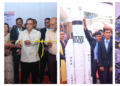

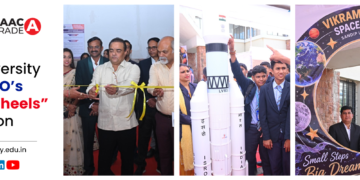


























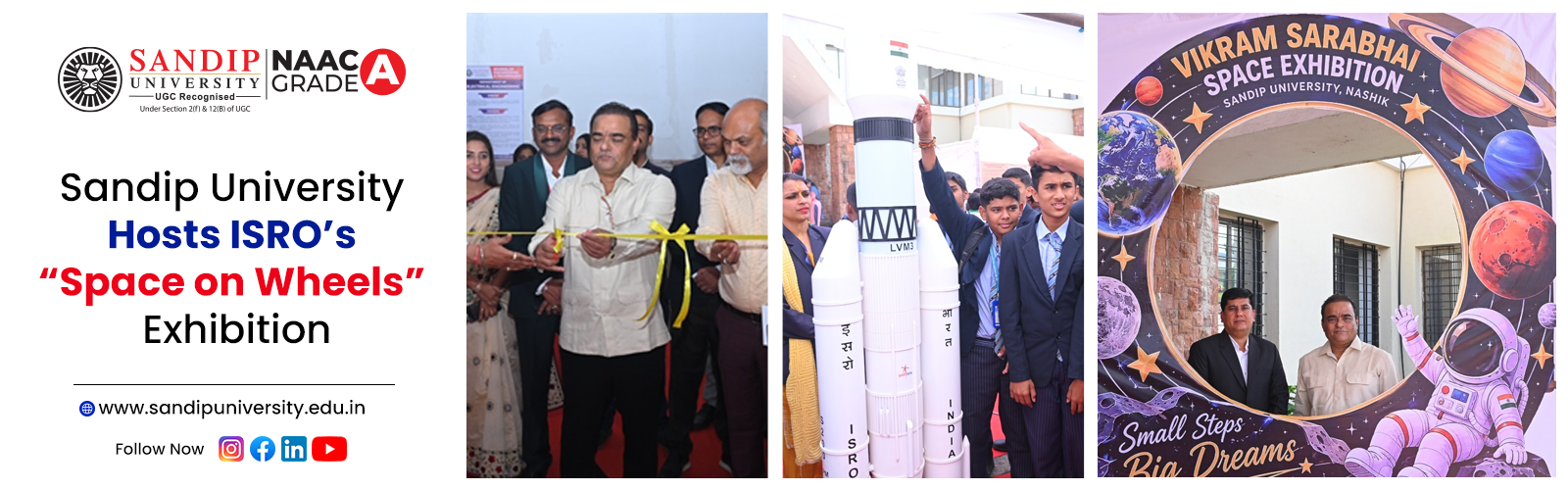
Space has moved from dream to destination; space has become a living laboratory that allows young minds to experiment with ideas, solve problems, and imagine possibilities. To move one step ahead towards the same, Sandip University, Nashik, organized the ‘Space on Wheels’ exhibition from 29th to 31st October, 2026 in collaboration with the Indian Space Research Organization (ISRO) through its Vikram Sarabhai Space Center (VSSC).
The exhibition conducted by the Department of Aeronautical & Aerospace Engineering of the university exposed the students, faculty members, school children, and others to the science that governs India’s space program. It was much more than an exhibition of models and display panels. It provided an opportunity for the participants to transcend the classroom and imagine themselves designing satellites, rocket designs, and other space-related applications.
What Is the Space on Wheels Exhibition?
“Space on Wheels” is an ISRO programme aimed at spreading awareness of space science beyond its research facilities. This is achieved through specially arranged mobile exhibitions by ISRO which take models, graphics and facts related to their missions all over the country, even to villages and remote areas.
In Sandip University, there were displays of satellites, rockets and other space missions conducted by our country. It was not just informative but also motivational for most visitors there. The student who would think rockets are far from him may actually end up having an interest in propulsion, avionics, satellites or even the entire space mission itself.
A Milestone for Sandip University
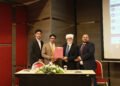
The inauguration ceremony is significant for Sandip University as it has become increasingly involved with educating its students in the field of aerospace. The exhibition was inaugurated on 29 October by Dr. Sandip Jha, Chairman, Sandip University, along with Shri Ravi Kumar Verma, Scientist/Engineer, ISRO.
Present were the sponsors of the programme, Mr. Aryan Jha, GSO, Sandip University; Prof. Pramod Karele, GSD; Mr. Vivek Nikam, GSD; and Prof. Dr. Pawan Bhaladhare, Vice Chancellor. The programme was organized by Prof. Dr. Prakash G. Burade, Associate Dean, School of Engineering and Technology. Organizing chairs were held by Prof. Yogesh Bhanvarkar, Head of the Department of Aeronautical Engineering, and Dr. Vishal N. Sulakhe, Professor, Mechanical Engineering, whereas the Co-coordinator was Dr. Vishal Vasistha. Deans, principals, heads of departments, faculty and students also graced the occasion.
Addressing the audience, Dr. Sandip Jha stated that the exhibition has bought the magnitude of the sky and the mysteries of the universe within the campus premises of Sandip University. He thanked ISRO for organizing such a programme and appreciated the response of the students.
A Message for Young Engineers
Addressing students of aerospace engineering, Dr. Sandip Jha made it clear that every great success starts from basics.
“Whatever breakthrough you see in space technology today started on an engineer’s table, with a mathematical or engineering equation. From that equation, it rose to the sky. I urge all our aerospace students to take their studies seriously, so that one day you get the opportunity to reach that level.”
Another fact he stated was that space is not only limited to governments anymore. With the arrival of private companies in the space technology field, there is an extensive scope available for engineers and scientists.
What Is the ISRO Centre of Excellence Planned at Sandip University?
One of the biggest announcements at the event was Sandip University’s plan to sign a Memorandum of Understanding (MoU) with ISRO to set up a Centre of Excellence on its Nashik campus.
“This collaboration will help us upgrade our curriculum and our aerospace labs. I want our aerospace students to work on capstone projects, get internships and secure good placements,” said Dr. Sandip Jha.
The Centre of Excellence to come up would act as a platform for high-end learning and research. This would also make them industry-ready. Students specializing in aerospace and aeronautical engineering could benefit greatly from the Centre as it would enable them to connect theory with practical aspects. They could learn about spacecraft systems, spacecraft propulsion, guidance and control, satellite communications, and space technology.
What Is SUN-SAT?
The boldest plan unveiled was was Sandip University’s plan to launch its own satellite, “SUN-SAT,” by 2030. This student-led project, developed with ISRO’s guidance, will give students real experience in designing, building, testing, and preparing a satellite for launch.
“If we are able to launch our satellite by 2030, we will be able to provide valuable data to local government on storm warnings, agriculture and groundwater availability,” said Dr. Sandip Jha. He added that it could also support traffic management and navigation.
This project is more than a symbolic goal. It aims to connect space technology with real local and national needs. Students from different fields—engineering, computer science, electronics, data science, environmental studies, and design—can contribute to the mission. Building a satellite teaches teamwork, precision, and problem-solving under real constraints. Most importantly, it gives students ownership of a mission instead of just studying space technology.
Why Space Exposure Matters for Engineering Students
The Indian space industry has made great progress. India became the first nation to successfully land close to the south pole region of the Moon in 2023, with Chandrayaan-3. Furthermore, India has made its space industry open to both private companies and startups.
This offers a number of career options for engineering students in sectors like:
- Satellite design and development
- Spacecraft and rocket propulsion systems
- Avionics and flight control
- Aerodynamics and structure analysis
- Satellite data and space applications
Exposure to events like Space on Wheels makes engineering students understand what they learn is the basis of space missions.
How Sandip University Prepares Future Space Engineers
Sandip University is training its future space engineers on a well-grounded basis. The university provides a B.Tech program in Aerospace Engineering and another B.Tech program in Aeronautical Engineering, which both require students to undertake four years of training in addition to an internship program. Students learn in designated laboratories, such as CAD laboratory, Flight Controls Laboratory, and Avionics Laboratory.
The curricula are developed by a Board of Studies that comprises specialists from IIT Bombay, IISc Bangalore, National Aerospace Laboratories (NAL), Hindustan Aeronautics Limited (HAL) Nashik, VSSC Thiruvananthapuram, and one specialist from Space Applications Centre of ISRO. In other words, the training process remains consistent with the requirements of research laboratories and industry.
The Future Has Already Begun
The journey from a campus exhibition to a satellite launch is a long and challenging one. This will require continued investment, mentoring from faculty members, support from the industry, and engineering skills. However, every major development in the field of space starts with an idea, which is always inspired by a student gazing up into the sky thinking they could be part of the solution.
Space on Wheels was not just an exhibition of India’s achievements in space. Instead, Space on Wheels opened doors for students to be part of the next big story in Indian space science through the proposed Centre of Excellence and the SUN-SAT mission. The future of space exploration is closer than we think.