





























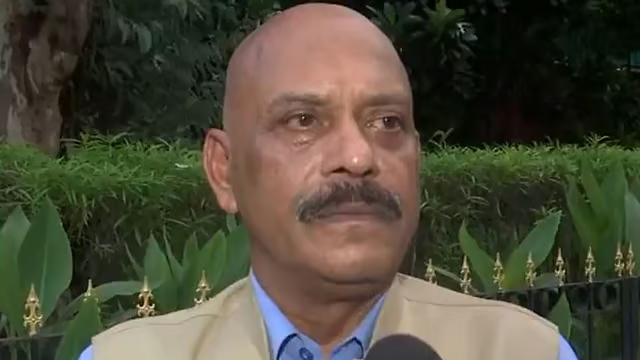
Retired Air Marshal Jeetendra Mishra has been appointed the first full-time CEO of the Shri Ram Janmabhoomi Teerth Kshetra Trust. The decorated former IAF commander brings nearly four decades of military experience to the administrative management of the Ram Mandir Trust.
Jeetendra Mishra appointed first full-time Ram Mandir CEO
The Ram Mandir Trust has appointed retired Air Marshal Jeetendra Mishra as its first full-time Chief Executive Officer, marking a significant change in the administrative structure of the Shri Ram Janmabhoomi Teerth Kshetra Trust.
The decision was taken at a Trust meeting in Ayodhya on September 2, 2026. Mishra, who retired from the Indian Air Force in April this year, was selected after a detailed recruitment process involving thousands of applicants.
His appointment comes at a time when the Trust is expanding its administrative responsibilities around the Ram Mandir and the wider pilgrimage infrastructure in Ayodhya. It also follows a recent controversy involving alleged theft of temple donations, which has brought greater attention to financial controls and administrative oversight at the Trust.
Mishra’s background is markedly different from that of traditional religious administrators. He spent most of his professional life in the armed forces, holding senior operational, command and testing positions.
Who is retired Air Marshal Jeetendra Mishra?
Jeetendra Mishra is a former Indian Air Force fighter pilot who served for nearly four decades. He was commissioned into the fighter stream of the IAF on December 6, 1986, and retired from service on April 30, 2026.
During his career, Mishra accumulated more than 3,000 hours of flying experience and flew a range of fighter, transport and helicopter platforms. He also trained at several prominent institutions, including the National Defence Academy, the Air Force Test Pilots School in Bengaluru, the Air Command and Staff College in the United States and the Royal College of Defence Studies in the United Kingdom.
His career included both operational and technical responsibilities. He served as a fighter combat leader, commanded a fighter squadron, worked as a test pilot and held senior positions involving aircraft testing and operational planning.
He later moved into high-level command roles, eventually becoming one of the Indian Air Force’s senior commanders.
Western Air Command role and Operation Sindoor
One of the most prominent chapters of Mishra’s military career was his leadership of the IAF’s Western Air Command.
He took charge as Air Officer Commanding-in-Chief of the Western Air Command on January 1, 2025. He remained in the position until his retirement in April 2026.
The Western Air Command is a major operational command of the Indian Air Force, making the position one of considerable responsibility. Mishra was heading the command when India launched Operation Sindoor in May 2025 following the Pahalgam terror attack.
His role during the operation subsequently became an important part of his public profile. He was among the senior military commanders recognised for their leadership during the operation and was awarded the Sarvottam Yudh Seva Medal by President Droupadi Murmu.
The award is one of India’s highest recognitions for distinguished service during war, conflict or hostilities.
From fighter pilot to temple administration
Mishra’s new position represents a major transition from military command to civilian institutional management.
The Trust is responsible for the administration and development of the Ram Janmabhoomi temple complex. As CEO, Mishra is expected to bring his experience in planning, coordination, logistics, personnel management and handling large-scale operations to the organisation.
His military career involved managing complex operations where multiple teams and resources had to work together under strict procedures. Those skills are relevant to the day-to-day functioning of a major religious destination that attracts large numbers of pilgrims.
The CEO role is therefore not limited to construction work. It involves the broader administrative functioning of the Trust and coordination across different areas connected with the temple’s operations.
What will Ram Mandir CEO Jeetendra Mishra do?
The exact division of responsibilities will depend on the Trust’s administrative structure, but reporting on the appointment indicates that Mishra will oversee important day-to-day functions.
These are expected to include pilgrim facilities, financial arrangements, staff coordination, security-related coordination and management of large religious events.
The scale of the responsibility is significant because Ayodhya has developed into a major pilgrimage destination following the opening of the Ram Mandir.
For the Trust, the CEO position creates a dedicated executive role focused on administration and implementation. Instead of relying only on committee-level management, the organisation will have a full-time professional responsible for coordinating its operational requirements.
Mishra’s experience with logistics and large formations could be particularly relevant to managing personnel, infrastructure and coordination during periods of heavy pilgrim movement.
How was Jeetendra Mishra selected?
Mishra was not appointed through a simple nomination process. The Trust conducted a formal selection exercise that attracted 5,585 applications.
According to The Times of India’s account of the process, 1,580 applicants were found eligible and suitable after initial scrutiny. The field was subsequently narrowed to 108 candidates for online interactive sessions. Sixteen finalists then participated in face-to-face interactions in Ayodhya.
A three-member search committee recommended three candidates to the Trust after completing the selection process.
The committee was constituted on July 6 and included retired Justice Permod Kohli, retired Lieutenant General V K Chaturvedi and nuclear scientist Dr Suresh Haware. The committee submitted its 75-page final report to the Trust on September 1, one day before Mishra’s appointment was announced.
The numbers underline how competitive the recruitment process was. Mishra ultimately emerged from a pool of thousands of applicants.
Appointment comes after donation controversy
The timing of the appointment is also important.
The Trust’s decision came roughly two months after a controversy surrounding alleged theft of temple donations. The issue led to arrests and prompted questions about financial and administrative controls at the temple.
The CEO appointment should not be described as a direct finding of wrongdoing against Mishra’s predecessors or as proof of financial misconduct by the Trust. The investigation and related proceedings concern specific allegations and individuals.
However, the controversy has increased public scrutiny of the way temple donations and administrative operations are handled.
Against that backdrop, bringing in a full-time executive with experience in organisational management, logistics and oversight gives the Trust a new administrative layer.
Mishra’s military background may also help the organisation strengthen procedures, coordination and accountability, although the actual impact will depend on how the Trust defines his authority and responsibilities.
New trustees also appointed in Ayodhya
Mishra’s appointment was part of a broader restructuring of the Trust.
Three new trustees were also appointed: Mahesh Bhagchandka, Madan Mohan Pandey and Nirmala Yadav. The appointments expand the Trust’s leadership structure alongside the creation of the CEO position.
The changes indicate that the Trust is looking beyond the construction of the temple itself and towards the long-term management of the institution.
The Ram Mandir has become a major pilgrimage centre, bringing responsibilities that extend across visitor management, infrastructure, finance, staffing and large public events.
A dedicated CEO can potentially provide continuity between the Trust’s decisions and their implementation on the ground.
Mishra’s career brings unusual experience to Ayodhya
Mishra’s professional record includes responsibilities far beyond conventional administration.
As a fighter and experimental test pilot, he worked in highly technical environments. As a commander, he was responsible for personnel and operational readiness. He also served as Deputy Chief of Integrated Defence Staff (Operations), giving him experience in strategic coordination.
His experience includes working with aircraft systems, operational planning and multinational military exercises. He also led the Indian Air Force contingent for Exercise Garuda IV in France.
The relevance of this experience to temple management will ultimately be measured by the results of his tenure. For now, his appointment signals the Trust’s decision to place a senior professional with extensive organisational experience in a newly created executive position.
What Mishra’s appointment means for Ram Mandir
The creation of the first full-time CEO position suggests that the Trust is moving towards a more structured administrative model as the Ram Mandir enters a long-term operational phase.
The temple is no longer only a construction project. It is also a destination that requires continuous management.
Pilgrim facilities, staffing, finances, security coordination, infrastructure and major religious events all require planning and execution. The CEO’s job will be to help coordinate these responsibilities within the framework established by the Trust.
Mishra now moves from leading one of the Indian Air Force’s major operational commands to managing a very different institution with a national religious significance.
His first full-time CEO role will therefore be closely watched, particularly for how the Trust’s administrative systems evolve under his leadership.
Key Takeaways
- Retired Air Marshal Jeetendra Mishra has been appointed the first full-time CEO of the Shri Ram Janmabhoomi Teerth Kshetra Trust.
- Mishra served nearly four decades in the Indian Air Force and headed the Western Air Command during Operation Sindoor.
- He is expected to oversee areas including administration, pilgrim facilities, financial arrangements, staff coordination and large religious events.
- He was selected from 5,585 applicants following a multi-stage process involving scrutiny, online interactions and face-to-face interviews.
FAQs
Who is Jeetendra Mishra?
Jeetendra Mishra is a retired Air Marshal and former Indian Air Force fighter pilot. He served nearly four decades in the IAF and held several senior command, operational and testing positions.
When was Jeetendra Mishra appointed Ram Mandir CEO?
The Shri Ram Janmabhoomi Teerth Kshetra Trust appointed Mishra as its first full-time CEO on September 2, 2026, during a meeting in Ayodhya.
What will Jeetendra Mishra do as Ram Mandir CEO?
His expected responsibilities include day-to-day administration, pilgrim facilities, financial arrangements, staff coordination, security-related coordination and management of large religious events.
How was Mishra selected for the CEO post?
The selection process received 5,585 applications. After several rounds of screening and interviews, a search committee recommended three candidates to the Trust. Mishra was ultimately selected and appointed on September 2.
(Jeetendra Mishra Ram Mandir CEO, Ram Mandir CEO 2026, Air Marshal Jeetendra Mishra, Ram Janmabhoomi Trust CEO, Ayodhya Ram Mandir news, Operation Sindoor commander, Shri Ram Janmabhoomi Teerth Kshetra Trust, Ram Mandir administration)