





























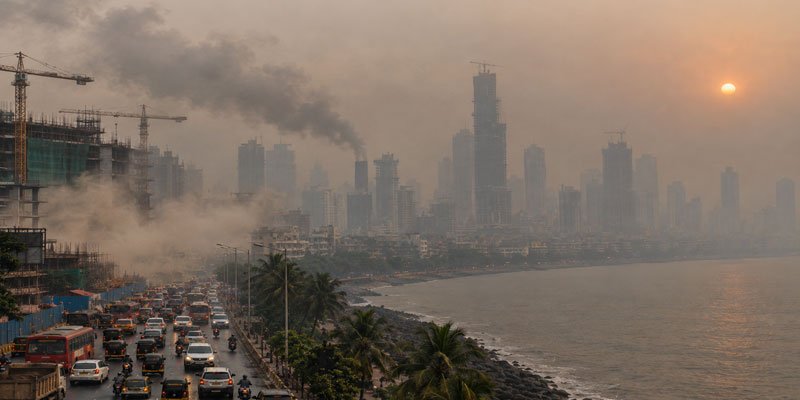
Mumbai’s air pollution remains a concern as several parts of the city record poor air quality during November. While the city’s overall AQI was reported in the moderate range on November 25, some monitoring stations recorded significantly higher pollution levels, raising concerns for commuters, children and people with respiratory conditions.
Mumbai AQI Today: Several Areas Record Poor Air Quality
Mumbai’s air quality has remained under scrutiny as pollution levels have fluctuated across different parts of the city during November 2026. On November 25, the city’s overall Air Quality Index (AQI) was reported at 108, placing it in the moderate category, according to The Indian Express.
However, the citywide figure does not reflect conditions at every monitoring station. Navy Nagar in Colaba recorded an AQI of 157 on Wednesday morning, falling into the poor category. Other areas reported comparatively lower readings, including Worli at 70, Byculla at 84 and Sewri at 92.
The Indian Express reported that 25 AQI monitoring stations were operational across Mumbai, with 12 recording satisfactory air quality readings.
The difference between individual locations highlights an important issue for residents. Air pollution is not distributed evenly across a large city, and people living or working near areas with higher pollution levels may experience different conditions from the citywide average.
Why Mumbai’s Air Pollution Is Becoming a Concern
Mumbai has experienced repeated periods of poor air quality during November. According to a report by The Indian Express published on November 25, several areas recorded AQI levels above 200 for at least three consecutive days during the month.
One of the major concerns is construction-related dust. Large infrastructure projects, building activity, road work and redevelopment can release particulate matter into the surrounding air when dust is not adequately controlled.
The Brihanmumbai Municipal Corporation (BMC) has identified construction dust as an important pollution source in its Mumbai Air Pollution Mitigation Plan, published in 2023.
Other sources also contribute to urban air pollution. These include emissions from road traffic, industrial activities, diesel generators, road dust and the burning of waste.
Weather conditions can influence how these pollutants disperse. Changes in wind speed, atmospheric mixing and rainfall can affect the concentration of pollutants near ground level.
The combination of local emission sources and weather conditions makes Mumbai’s air quality a changing issue rather than a problem limited to one neighbourhood or a single day.
BMC Construction Dust Rules and Pollution Control Measures
Construction activity has become an important part of the discussion around Mumbai’s air quality.
Under the BMC’s December 2024 Graded Response Action Plan, construction work must be halted at locations where the 24-hour average AQI exceeds 200 for three consecutive days.
The measure is intended to address pollution at individual construction sites rather than relying only on citywide air quality figures.
The rule was implemented during the previous year, when stop-work notices were issued to 45 construction sites in Borivali East and 33 sites in Byculla, according to The Indian Express.
The newspaper also reported that Navy Nagar in Colaba recorded AQI readings of 248, 266 and 222 between November 22 and November 24, 2026.
Additional Municipal Commissioner Avinash Dhakane said that Tuesday marked the third consecutive day and that the BMC would review the 24-hour average readings before deciding on further action.
The distinction between a monitoring station’s reading and the prescribed 24-hour average is important. A single hourly reading above 200 does not automatically establish that the conditions for a construction shutdown have been met.
The effectiveness of these measures will depend on consistent monitoring, enforcement and cooperation from construction operators.
What Poor AQI Means for Mumbai’s Daily Commuters
Air pollution can affect people differently depending on their health, exposure duration and the concentration of pollutants in the air.
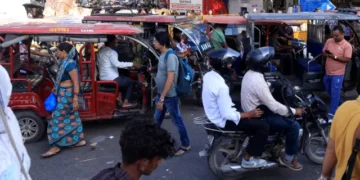
For Mumbai commuters, daily travel can involve spending considerable time near busy roads, traffic junctions, construction areas and crowded transport corridors.
People travelling by two-wheelers, walking to railway stations or waiting at bus stops may spend extended periods outdoors. Those who commute during busy traffic hours can also encounter concentrated vehicle emissions.
Fine particulate matter, particularly PM2.5, is a significant concern because these tiny airborne particles can penetrate deep into the lungs. Longer-term exposure is associated with respiratory and cardiovascular health risks.
People with asthma, chronic obstructive pulmonary disease and existing heart conditions may be particularly vulnerable to polluted air.
Even people without diagnosed respiratory conditions may experience irritation in the eyes, nose and throat when pollution levels rise.
For office workers, delivery personnel, street vendors, traffic police and other people whose jobs require prolonged outdoor exposure, reducing unnecessary exposure can be difficult. This makes pollution control measures important beyond individual precautions.