





























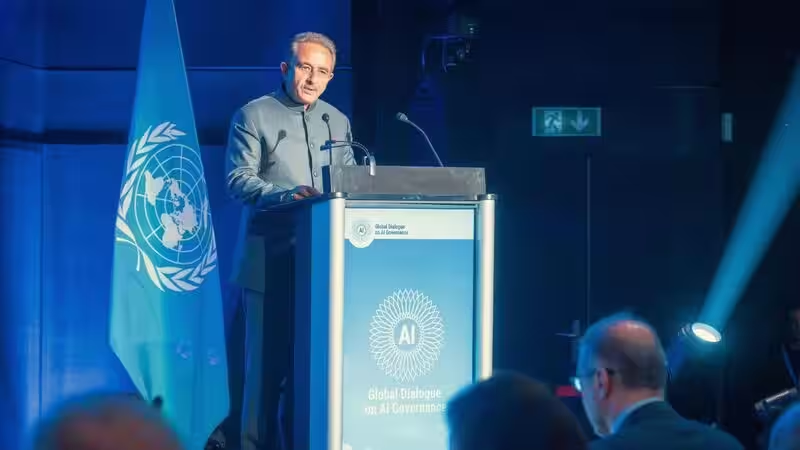
India has urged the United Nations to keep human judgement at the centre of artificial intelligence use in conflict situations. Addressing a UN Security Council debate on November 24, 2026, India highlighted how AI could support early warnings, peacekeeping and civilian protection while warning against its misuse in warfare.
India Raises Human-Centric AI at UN Security Council
India’s position on artificial intelligence in conflict prevention came into focus during a high-level open debate at the United Nations Security Council on November 24.
The debate, convened by Latvia, focused on the theme Conflict Resolution in an Era of Rapid Technological Change. India’s Permanent Representative to the UN, Ambassador Harish Parvathaneni, presented the country’s position on the growing role of artificial intelligence, autonomous systems and emerging digital technologies in international security.
India argued that technological progress should serve human-directed objectives rather than operate independently of human judgement. It called for responsible use of AI that respects national sovereignty and international law.
The Indian representative also highlighted the risks associated with the misuse of emerging technologies by terrorist groups and non-state actors.
The central message was clear: AI can help governments and international organisations make better-informed decisions, but it should not replace human responsibility in matters involving peace, security and human lives.
How AI Can Help Prevent Conflicts Before They Escalate
One of the most important applications of artificial intelligence in international security is early warning.
Conflicts rarely emerge without preceding developments. Changes in population movement, food availability, economic activity, public communication and security conditions can sometimes indicate rising instability.
AI-enabled analytical systems can process large volumes of information and identify patterns that may be difficult for human analysts to detect quickly.
For example, satellite imagery can help monitor changes around conflict-sensitive areas. Data analysis can support the identification of displacement patterns, damage to infrastructure and disruptions to essential services.
Such information could help the United Nations and governments identify emerging risks and plan responses earlier.
AI can also support diplomatic mediation by helping officials organise information, examine different scenarios and understand the possible consequences of policy decisions.
However, an early warning is not the same as preventing a conflict. Governments and international institutions must still interpret the information, verify its accuracy and take appropriate diplomatic or humanitarian action.
AI in Peacekeeping: Can Technology Protect Civilians?
India also highlighted the potential of emerging technologies to improve the safety and effectiveness of United Nations peacekeeping operations.
Peacekeeping missions often operate in difficult environments where access to reliable information can be limited. Personnel may have to monitor large geographical areas, assess security threats and protect civilians while working with restricted resources.
Technology could support these responsibilities in several ways.
Satellite monitoring: Satellite imagery can help peacekeeping teams observe changes in areas that are difficult to access physically.
Threat detection: Analytical tools can help identify unusual activity or changes in security conditions that require further investigation.
Communication systems: Digital platforms can improve information sharing between field teams and mission headquarters.
Humanitarian coordination: Data systems can help organisations understand where displaced populations may need food, medical assistance or shelter.
These applications could improve situational awareness and help personnel respond more effectively.
However, AI-generated information must be checked against reliable sources. A misleading assessment could result in incorrect decisions, particularly in areas where civilians are already vulnerable.
Human oversight therefore remains essential in peacekeeping operations.
Why India Wants Human Oversight in AI Warfare
The use of AI in military operations raises questions that go beyond technological performance.
Some military systems use algorithms to process intelligence, identify potential threats and support targeting decisions. Autonomous weapons systems raise additional concerns because certain systems can select and engage targets with limited or no direct human intervention.
India has stressed that emerging technologies used in conflict situations must remain responsible, respect sovereignty and comply with international law.
The issue is particularly important under international humanitarian law, which requires parties to armed conflicts to distinguish between civilians and combatants and take precautions to limit civilian harm.
AI systems may process information quickly, but they can also produce inaccurate assessments, reflect biases or operate in ways that are difficult to explain.
A system that incorrectly identifies a civilian object as a military target could have serious consequences.
The United Nations has also raised concerns about autonomous weapons. Its position highlights the need for clear prohibitions and regulations, particularly where systems operate without meaningful human judgement and control.
The broader debate is not simply about whether AI should be used in military environments. It is about determining which applications are acceptable, who remains accountable and how international law can be enforced.
Risks of AI Misuse by Terrorist Groups and Non-State Actors
India’s statement also drew attention to the possibility that terrorist organisations and other non-state actors could misuse emerging technologies.
AI tools are becoming increasingly accessible. While they can support legitimate research and communication, they may also be misused to create deceptive content, automate online propaganda or improve the scale of digital attacks.
Deepfakes and manipulated videos can make it difficult to distinguish genuine information from fabricated material. During a crisis, false reports about military activity or civilian casualties could increase public fear and complicate diplomatic efforts.
AI-generated misinformation can also spread across digital platforms quickly, potentially affecting public trust and creating additional pressure on governments.
Cybersecurity is another concern. AI tools could be used to identify vulnerabilities, automate malicious activity or support attempts to disrupt digital infrastructure.
For conflict prevention, the challenge is therefore not limited to monitoring physical developments. International institutions must also understand how digital information can influence public behaviour and diplomatic relations.
India’s call for responsible technology use reflects the need to address these risks without preventing beneficial applications of AI.
Why Developing Countries Need Equal Access to AI
India’s position at the UN also included a concern about unequal access to emerging technologies.
Developed economies generally have greater access to advanced computing infrastructure, research facilities, specialised talent and investment. Many developing countries face limitations in these areas.
If AI becomes an important part of conflict monitoring, peacekeeping and international security, unequal access could create another divide between countries.
Nations with advanced technology may have greater capacity to analyse information and influence international responses, while less-developed countries could remain dependent on external systems.
India argued that developing countries should have a meaningful role in shaping how emerging technologies are developed, governed and deployed.
The issue is relevant to the wider Global South, where access to computing resources, technical expertise and digital infrastructure remains uneven.
For AI to support international peace, countries need more than access to finished products. They also need opportunities to participate in research, governance discussions and decisions about technology standards.
India’s New Delhi Declaration and the Human-Centric AI Approach
India connected its position at the Security Council to the AI Impact Summit held in New Delhi in February 2026.
The summit produced the New Delhi Declaration, which was endorsed by more than 90 countries, according to India’s statement at the UN.
The declaration emphasised wider access to AI resources, secure and trustworthy systems, investment in human capabilities and the use of artificial intelligence for economic growth and social development.
India has consistently presented its approach as one that combines technological innovation with human values and accountability.
The country’s argument is that AI governance should not be limited to preventing technological risks. It should also ensure that the benefits of AI reach different sections of society and countries at different stages of development.
The UN debate extended this approach into international security, where the consequences of poorly governed technology can be particularly serious.
Can AI Actually Make Conflict Prevention Safer?
AI can improve the speed and scale of information analysis, but it cannot guarantee peace or prevent every conflict.
Its effectiveness depends on the quality of information available, the reliability of the systems being used and the ability of institutions to act on their findings.
There are several challenges that governments and international organisations must address.
Data accuracy: Incorrect or incomplete information can lead to misleading assessments.
Algorithmic bias: AI systems may reproduce biases related to gender, language, geography or socioeconomic conditions.
Accountability: It must be clear who is responsible when an AI-supported decision causes harm.
Human control: Decisions involving the use of force and civilian safety require meaningful human judgement.
International cooperation: Countries need common understandings and rules to prevent misuse and reduce the risk of technology-driven escalation.
AI can help identify warning signs and improve the information available to decision-makers. But diplomacy, political negotiations and accountable human leadership remain central to resolving disputes.
What India’s UN Position Means for the Future of AI Governance
India’s intervention comes at a time when governments are debating how international rules should respond to rapidly developing military and civilian technologies.
The challenge is to create safeguards without blocking useful applications in humanitarian assistance, peacekeeping and conflict monitoring.
For India, the debate also connects technology governance with the interests of developing countries. Its position is that the future of AI should not be determined only by nations with the largest technology industries or military capabilities.
The coming discussions at the United Nations will need to address human oversight, international law, access to technology and accountability for harmful outcomes.
The larger question is not whether artificial intelligence will influence future conflicts. It already has a growing role in military, intelligence and information systems.
The important question is whether governments can establish rules that ensure technology supports human security rather than creating new risks for civilians and international stability.
Key Takeaways
- India called for a human-centric and responsible approach to AI and emerging technologies during a UN Security Council debate on November 24, 2026.
- Ambassador Harish Parvathaneni highlighted AI’s potential in early warning systems, peacekeeping, mediation and civilian protection.
- India warned about the misuse of AI by terrorist groups and non-state actors and stressed that military applications must respect international law.
- India also called for equal access to emerging technologies, arguing that developing countries should have a meaningful role in global AI governance.
Frequently Asked Questions
1. What did India say about AI at the United Nations in November 2026?
India called for a human-centric and responsible approach to artificial intelligence in conflict situations. It stressed that human judgement and oversight must remain central to decisions involving security and military applications.
2. How can artificial intelligence help prevent conflicts?
AI can analyse satellite imagery, monitor emerging patterns, support early warning systems, improve situational awareness and help international organisations coordinate humanitarian and peacekeeping responses.
3. Why is human oversight important in AI warfare?
AI systems can make inaccurate assessments, reproduce biases or produce results that are difficult to explain. Human oversight is essential for accountability, compliance with international law and decisions involving civilian safety and the use of force.
4. What is India’s New Delhi Declaration on AI?
The New Delhi Declaration emerged from the AI Impact Summit held in February 2026. It emphasises wider access to AI resources, secure and trustworthy systems, investment in human capabilities and the use of AI for economic and social development.