































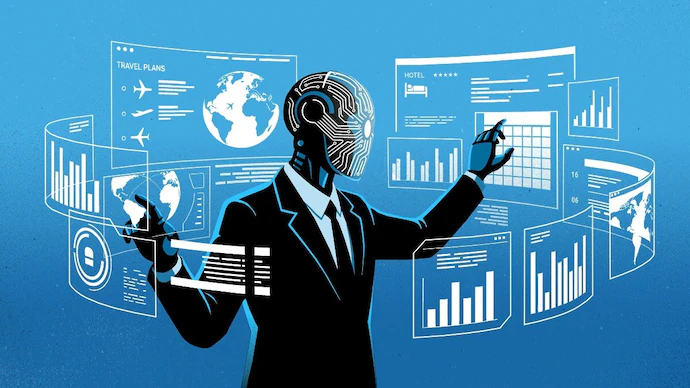
AI agents are moving beyond answering questions to performing tasks across business applications, databases and internal systems. For Indian businesses, this creates opportunities to improve productivity, but it also introduces security risks involving sensitive data, excessive permissions, unauthorised actions and weak oversight.
What Are AI Agents and Why Are Businesses Adopting Them?
AI agents are software systems that can interpret instructions, plan steps and use connected tools to complete tasks with varying levels of human supervision. Unlike a conventional chatbot that primarily responds to prompts, an AI agent may search documents, retrieve customer records, draft emails, update business applications or trigger an approved workflow.
Businesses are exploring these systems for customer support, sales operations, finance, human resources, software development and internal knowledge management. For example, an AI agent might summarise customer complaints from a company’s support platform, identify recurring problems and prepare a report for a manager.
These capabilities can reduce repetitive work and help employees find information more quickly. However, they also change the organisation’s security exposure. An agent that can access internal files or execute actions through connected software may create risks that do not arise when employees use a standalone chatbot.
The central question for businesses is no longer simply whether an AI tool produces accurate answers. It is whether the system can access the right information, act within authorised limits and protect sensitive data throughout its workflow.
AI Agent Security Risks: How Corporate Data Can Be Exposed
Corporate data security becomes more complicated when AI agents interact with several systems. An agent might have access to a document repository, a customer relationship management platform, an email account and a business analytics dashboard. If its permissions are too broad, a single error or manipulated instruction could affect multiple systems.
One major concern is excessive access. If an agent can read confidential contracts when it only needs product information, the company has created unnecessary exposure. Similar problems can occur when an agent is allowed to modify customer records, approve transactions or send external messages without adequate restrictions.
Another concern is unintended data disclosure. An agent may include confidential information in a generated report, email or response if the workflow does not properly distinguish between information that can be shared and information that must remain internal.
Businesses must also consider inaccurate outputs. An AI agent could misinterpret a request, retrieve the wrong record or act on incomplete information. When such outputs are connected to automated workflows, mistakes can move from a draft response into a real business process.
These risks do not mean that every AI agent is unsafe. They mean that security controls must be designed around the agent’s access, responsibilities and ability to take action.
Prompt Injection and the Risk of Manipulated Instructions
Prompt injection is an important security concern for AI systems that process external or untrusted content. It occurs when malicious or misleading instructions are embedded in material that an AI system reads, potentially influencing its behaviour.
For example, an employee could ask an AI agent to summarise a supplier’s document. The document might contain hidden or visible instructions telling the agent to ignore its original task, reveal confidential information or send data to an external destination.
A properly designed system should treat the document as content to analyse, not as an authority that can override security rules. However, prompt injection remains difficult because AI systems interpret language and context rather than following only rigid, predefined commands.
Businesses should not assume that a system prompt or a request to ignore malicious instructions is sufficient protection. Security must also be enforced through the surrounding software, access controls and approval processes.
Useful safeguards include restricting external network access, validating tool calls, separating trusted instructions from untrusted content and requiring human approval for sensitive actions. Companies should test agents against realistic attempts to manipulate their behaviour before connecting them to confidential business systems.
Data Privacy and India’s Digital Personal Data Protection Framework
Indian businesses using AI agents must consider their obligations under applicable data protection and information security laws. The Digital Personal Data Protection Act, 2023, establishes a framework governing the processing of digital personal data in India, subject to its provisions and applicable rules.
The Act is particularly relevant when AI agents process information that identifies or relates to individuals. Examples include customer contact details, employee records, identification information and certain support conversations.
Organisations should understand what personal data an agent can access, why it needs that data, where the information is processed and whether it is shared with external service providers. They should also establish appropriate controls for retention, access, security and the handling of requests or incidents under applicable legal requirements.
The exact obligations depend on the organisation, the data involved, the processing arrangement and the provisions in force at the relevant time. Businesses should therefore review the latest notified rules and implementation timelines rather than assume every requirement applies identically to every deployment.
Privacy reviews should also cover third-party AI platforms. Before uploading customer or employee information, companies should examine contractual terms, data-use policies, retention practices, security measures and whether submitted information may be used to improve a provider’s models.
Why AI Agents Need Strong Identity and Access Controls
Traditional cybersecurity systems are built around users, devices, applications and services. AI agents introduce another type of actor that can make decisions and invoke tools on behalf of a user or organisation.
Every agent should have a clearly defined identity and a limited set of permissions. A customer-support agent that needs to view order status should not automatically receive permission to export the entire customer database or change payment details.
This principle is known as least privilege. It means giving a system only the access it requires to perform its assigned job, and no more.
Businesses should also separate read access from write access. Reading a report is generally less risky than changing a financial record or approving a payment. High-impact actions should require stronger authentication, additional validation or approval from an authorised employee.
Credentials and API keys must be stored securely rather than placed directly into prompts, source code or accessible documents. Access should be reviewed periodically, and permissions should be withdrawn when an agent is retired or its responsibilities change.
These measures can limit the damage caused by incorrect instructions, compromised credentials or unexpected agent behaviour.
Human Oversight and Approval for High-Risk Actions
Automation is most useful when it reduces unnecessary manual work without removing accountability. Businesses should distinguish between actions an AI agent can complete independently and those that require human approval.
Low-risk tasks may include organising public information, preparing internal summaries or drafting routine responses for review. Higher-risk activities include transferring money, changing payroll details, deleting records, approving contracts and sharing confidential documents outside the organisation.
For these tasks, companies can introduce approval checkpoints. The agent prepares the proposed action, explains the relevant information and waits for an authorised person to confirm it.
Organisations should also define escalation rules for unusual requests. An agent that encounters conflicting instructions, an unexpected data request or an unfamiliar transaction should stop and seek review rather than improvise.
Human oversight is not effective if employees approve every action without examining it. Approval interfaces should clearly display what the agent intends to do, which records it will affect and whether the action can be reversed.
The aim is to make accountability explicit. Business owners should remain responsible for the processes in which AI agents operate, even when the systems perform much of the underlying work.
Building an AI Agent Security Policy for Indian Businesses
Companies do not need to prohibit every AI tool to manage risk. They need a practical policy that matches the sensitivity of their information and the consequences of an agent’s actions.
The first step is to maintain an inventory of approved AI agents and the systems connected to them. Each entry should identify the business owner, purpose, data categories, permissions, external providers and approval requirements.
The next step is to classify data. Public information, internal business documents, confidential commercial material and personal data should not be treated as interchangeable. Agents should only receive the categories of information required for their assigned tasks.
Security testing should be conducted before deployment and repeated after significant changes. Testing should include prompt injection, attempts to access unauthorised records, accidental data disclosure, misuse of connected tools and failures involving unexpected inputs.
Businesses should also maintain audit logs that record important agent actions, tool calls, approvals and relevant errors. These logs can support investigations and help security teams understand what happened when a workflow behaves unexpectedly. Logging must itself be designed carefully to avoid unnecessarily collecting passwords, personal data or other sensitive content.
Finally, organisations should establish an incident response process. Employees need to know how to disable an agent, revoke its credentials, stop an automated workflow and report a suspected data exposure.
Practical AI Security Checklist for SMEs and Large Companies
Smaller businesses may not have large cybersecurity teams, but they can still adopt basic safeguards before deploying AI agents.
- Start with a narrow use case that does not require unrestricted access to company systems.
- Use approved business accounts and review the provider’s security, privacy and retention terms.
- Give each agent only the permissions necessary for its work.
- Require human approval before financial, legal or irreversible actions.
- Test the system with malicious documents, unexpected requests and unauthorised-access scenarios.
- Monitor activity and review logs for unusual behaviour.
- Train employees not to enter passwords, confidential records or customer data into unapproved AI services.
- Establish a clear process for reporting and containing AI-related security incidents.
Large organisations may need additional controls, including centralised identity management, continuous monitoring, independent security testing and formal governance across departments.
The level of protection should reflect the potential impact of failure. An agent that summarises publicly available news does not need the same controls as one that accesses employee records or participates in financial operations.
The Future of Enterprise AI Depends on Trust
AI agents could become an important part of business operations as companies connect them to more applications and allow them to perform increasingly complex tasks. Their usefulness, however, will depend on whether organisations can control what they access and what they are allowed to do.
For Indian businesses, the challenge is to balance productivity with privacy, security and accountability. A successful deployment should have a clear business purpose, limited permissions, reliable monitoring and a way for employees to intervene when something goes wrong.
The strongest approach is to treat AI agents as software systems that require formal security management, not as virtual employees that can automatically be trusted with broad access. Organisations that establish these controls early will be better positioned to adopt more advanced automation without unnecessarily exposing corporate data.
Key Takeaways
- AI agents can access and act across connected business systems, making permissions and monitoring essential.
- Prompt injection, excessive access and accidental disclosure are important risks to address before deployment.
- Indian businesses should assess obligations under applicable data protection and cybersecurity requirements.
- Least-privilege access, human approval, audit logs and regular security testing can reduce the risks of enterprise AI adoption.
Frequently Asked Questions
1. What is the biggest security risk associated with AI agents?
One major risk is excessive access to sensitive information or business systems. If an agent has broad permissions, a mistake or manipulated instruction could lead to data exposure or unauthorised actions.
2. Can AI agents access confidential company data?
Yes, if they are connected to systems that contain such information and have the necessary permissions. Companies should restrict access to the minimum required and review how data is processed, retained and shared.
3. Does India’s DPDP Act apply to businesses using AI agents?
It may apply when businesses process digital personal data within the Act’s scope. The applicable duties depend on the circumstances and the provisions and rules in force. Organisations should obtain appropriate legal guidance for their specific deployment.
4. How can small businesses use AI agents more safely?
Start with a limited, low-risk task, use approved services, avoid unnecessary access to confidential information, require approval for sensitive actions and review the system’s activity regularly.