































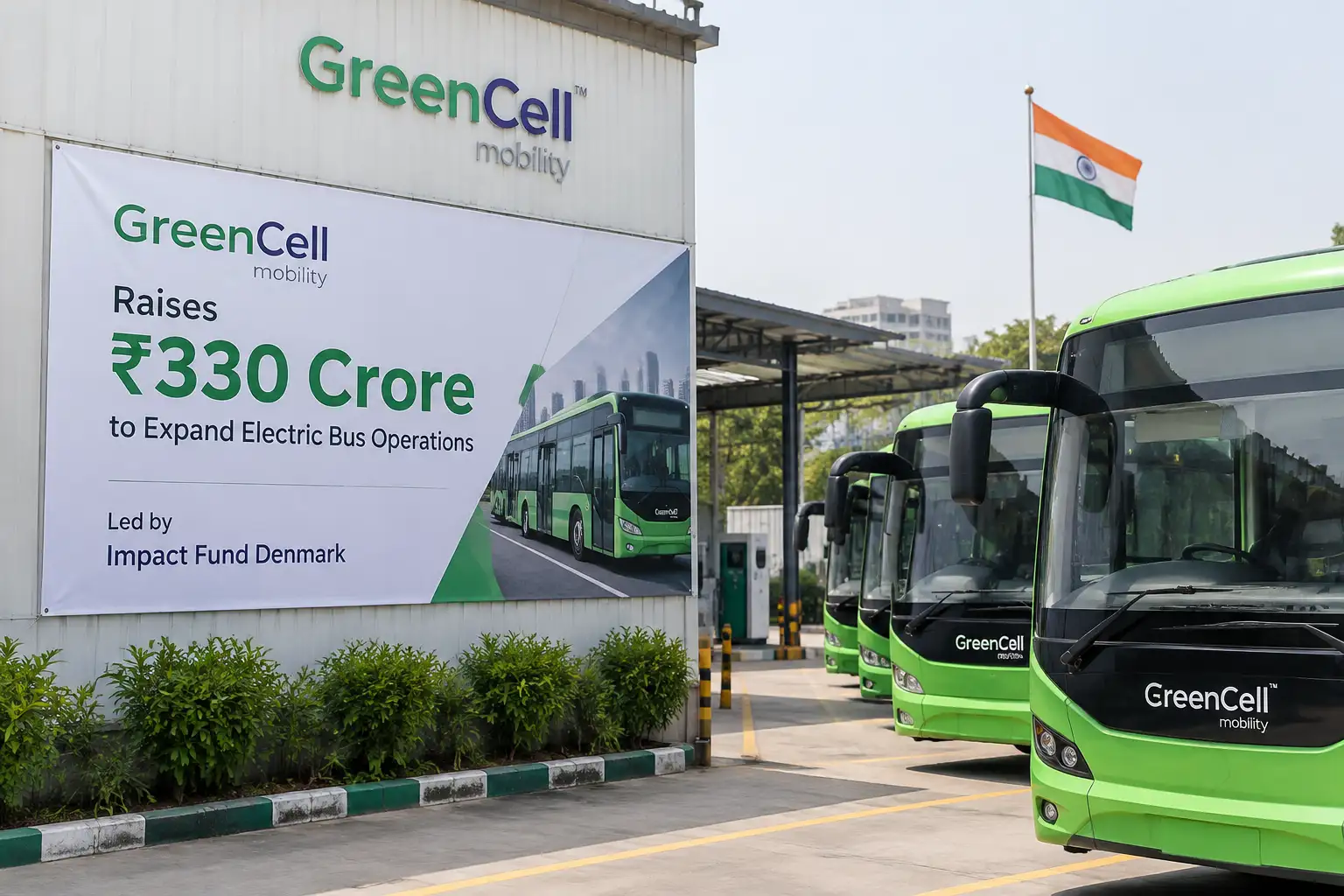
GreenCell Mobility has raised ₹330 crore in equity funding from Impact Fund Denmark to expand its electric bus operations across India. The investment will support plans to deploy around 4,500 additional buses, highlighting the growing role of institutional investors in the country’s electric public transport sector.
GreenCell Mobility Funding: What the ₹330 Crore Investment Means
GreenCell Mobility, an electric bus platform backed by Eversource Capital, announced the ₹330 crore investment from Impact Fund Denmark in October 2026. The funding is intended to support the company’s planned deployment of approximately 4,500 electric buses over the next six to eight quarters.
According to reporting published by The Economic Times on October 13, the expansion is expected to take GreenCell’s fleet beyond 5,000 electric buses across 105 cities. The company operates in both intra-city and intercity transportation, with its business covering electric bus operations and related mobility services. <Cite refs={[“turn750771search0″,”turn750771search7”]}/>
The investment comes at a time when Indian cities and transport authorities are exploring ways to expand public transportation while reducing dependence on conventional diesel-powered buses. However, the proposed fleet expansion will depend on deployment schedules, operational readiness, charging infrastructure and the execution of existing commitments.
The funding is therefore significant not simply because of its size, but because it is intended to support the practical expansion of electric public transport services.
Who Is Investing in GreenCell Mobility?
Impact Fund Denmark, formerly known as IFU, is the investor behind the latest equity funding round. The Danish investment institution supports businesses and projects connected with sustainable development and economic growth.
GreenCell Mobility is backed by Eversource Capital, an investment manager focused on climate-related and green infrastructure opportunities. Its existing institutional backers include the International Finance Corporation (IFC), British International Investment (BII) and Tata Capital.
The latest investment adds to GreenCell’s earlier fundraising activity. In January 2026, the company secured $89 million in mezzanine financing from IFC, British International Investment and Tata Capital, according to The Economic Times. Mezzanine financing is a form of funding that generally combines characteristics of debt and equity. <Cite refs={[“turn750771search0″,”turn750771search3”]}/>
The ₹330 crore transaction is an equity investment, which is different from a conventional loan that must be repaid according to a repayment schedule. The amount of ownership Impact Fund Denmark will receive and GreenCell’s valuation following the transaction were not disclosed in the cited report.
For the wider electric vehicle industry, the participation of institutional investors indicates that large-scale public transport electrification is attracting capital beyond early-stage startup funding.
Why GreenCell Mobility Is Expanding Its Electric Bus Fleet
Electric bus operations require substantial investment before services can operate at scale. Companies must arrange vehicles, charging facilities, maintenance systems, trained personnel and operational contracts. They also need to manage electricity consumption, vehicle availability and service reliability.
GreenCell Mobility operates through an electric Mobility-as-a-Service model. This approach involves providing electric transport services rather than focusing only on manufacturing or selling vehicles. The company works across city transport and intercity services, including operations through its NueGo brand.
Its expansion plans reflect the growing importance of fleet operators in India’s EV ecosystem. While vehicle manufacturers develop buses, operators are responsible for deploying them on routes, maintaining service schedules and ensuring that the vehicles remain available for passengers.
The company has said the latest funding will provide additional financial capacity to carry out its deployment plans. The planned addition of around 4,500 buses represents a substantial expansion, although the full rollout is expected to take place over several quarters rather than immediately. <Cite refs={[“turn750771search0″,”turn750771search8”]}/>
What the Funding Means for India’s Electric Bus Market
The investment highlights a shift in India’s electric mobility market from smaller deployments towards larger transport networks. Electric buses can help public transport operators reduce direct exhaust emissions in cities, while also lowering exposure to fluctuations in diesel prices.
However, the overall benefits depend on how the vehicles are used, the source of electricity and the efficiency of the charging and operating systems. Electric buses do not produce tailpipe emissions while driving, but their total environmental impact also depends on electricity generation, manufacturing and battery life-cycle management.
Large fleet deployments can also help build demand for charging infrastructure, maintenance services, battery management systems and skilled technical workers. These supporting activities are important because the success of electric public transport depends on more than the number of buses purchased.
For investors, the market presents an opportunity to finance transport infrastructure with long-term service contracts. For cities, electric buses may offer a route towards cleaner urban mobility, provided the procurement, financing and operating arrangements remain financially sustainable.
GreenCell’s fundraising does not, by itself, establish how quickly every planned bus will enter service. The outcome will depend on the company’s ability to implement contracts and coordinate with manufacturers, transport authorities and infrastructure providers.
What Electric Bus Expansion Could Mean for Tier-2 and Tier-3 Cities
The impact of electric bus investments is not limited to India’s largest metropolitan areas. Smaller cities also face challenges involving public transport availability, congestion, air quality and the cost of maintaining conventional bus fleets.
If electric buses are deployed under suitable city transport programmes, residents could benefit from additional public transport capacity and quieter journeys. Local transport authorities may also gain experience in managing electric fleets and planning charging infrastructure.
However, expansion into smaller cities requires careful planning. Charging facilities must be located where buses can access them conveniently, and routes must be designed around vehicle range, passenger demand and charging schedules.
Transport agencies also need to assess whether their budgets can support vehicle procurement, charging equipment, maintenance and long-term operating costs. The availability of suitable electricity connections and trained maintenance teams will influence how effectively a new fleet can be used.
For Tier-2 cities such as Nagpur, the broader significance lies in how investments in electric public transport may support future fleet upgrades and transport planning. GreenCell’s national expansion target should not be interpreted as confirmation that its newly planned buses will operate in any particular city unless specific deployments are announced.
Key Challenges Facing India’s Electric Bus Market
Despite growing investment, electric bus deployment involves several practical challenges. The upfront cost of an electric bus can be higher than that of a comparable conventional vehicle, although lifetime economics depend on electricity prices, maintenance, utilisation and financing.
Charging infrastructure is another major consideration. Operators must ensure that buses can be charged reliably without disrupting service schedules. Depot capacity, charging speed and electricity connections all influence operational planning.
Battery performance also matters. Batteries gradually lose capacity, and their performance can vary according to temperature, charging practices and usage. Operators need maintenance plans and clear arrangements for battery replacement and end-of-life handling.
Public transport projects may also face payment delays, procurement changes and difficulties coordinating among multiple agencies. These risks can affect cash flow even when demand for transport services is strong.
For this reason, the effectiveness of GreenCell’s ₹330 crore funding will ultimately depend on deployment execution, operational efficiency and the company’s ability to maintain reliable services as its fleet grows.
What Happens Next for GreenCell Mobility?
The immediate focus will be on implementing the planned deployment of approximately 4,500 additional electric buses over the next six to eight quarters. The target is to expand the fleet beyond 5,000 vehicles and increase its presence across 105 cities.
The company will need to coordinate vehicle procurement, charging infrastructure, staffing and route operations as the rollout progresses. Investors and the wider industry will also watch whether the planned expansion translates into reliable services and sustainable operating performance.
The investment adds to the institutional capital already supporting GreenCell Mobility. It also illustrates how India’s electric public transport market is attracting funding for operating infrastructure, not just vehicle technology.
The long-term significance will depend on how effectively the company converts this capital into buses on the road, dependable passenger services and financially viable operations.
Key Takeaways
- GreenCell Mobility raised ₹330 crore in equity funding from Impact Fund Denmark in October 2026.
- The investment will support plans to deploy around 4,500 additional electric buses over the next six to eight quarters.
- The company expects its fleet to exceed 5,000 buses across 105 Indian cities following the expansion.
- The funding reflects growing institutional interest in electric public transport, although deployment, charging infrastructure and operating costs remain important challenges.
Frequently Asked Questions
1. How much funding has GreenCell Mobility raised?
GreenCell Mobility has raised ₹330 crore in equity funding from Impact Fund Denmark. The investment was reported on October 13, 2026.
2. What will GreenCell Mobility use the funding for?
The funding will support the planned deployment of approximately 4,500 additional electric buses across India and help the company expand its operations.
3. How many electric buses will GreenCell Mobility operate after expansion?
The company expects its fleet to exceed 5,000 electric buses across 105 cities once the planned expansion is implemented.
4. Will GreenCell Mobility’s expansion benefit smaller Indian cities?
Potentially. Electric bus deployments can improve public transport capacity and reduce direct exhaust emissions. However, the actual benefits for individual cities will depend on confirmed routes, local transport contracts, charging infrastructure and deployment schedules.














