































India’s October 2026 by-elections have brought West Bengal, Tamil Nadu, Assam and Puducherry into the political spotlight. The contests offer an early look at changing party equations, voter participation and the challenges facing recently formed governments, although individual bypolls cannot independently predict future state or national election outcomes.
By-Election Results 2026: Six Constituencies in Focus
The October 2026 by-elections covered five Assembly constituencies and one Lok Sabha constituency across four regions. Polling took place on October 6, with counting scheduled for October 9. The Assembly seats were Nandigram and Rejinagar in West Bengal, Madurantakam and Dharapuram in Tamil Nadu, and Thattanchavady in Puducherry. Assam’s Nagaon constituency voted in the Lok Sabha by-election. <Cite refs={[“turn969967view2″,”turn538117search6”]}/>
The contests came at a significant political moment. West Bengal had recently experienced a change of government, while Tamil Nadu’s newly formed Tamilaga Vettri Kazhagam (TVK) government faced an early electoral test. Puducherry’s ruling All India N.R. Congress (AINRC) also had a constituency to defend, and Nagaon offered a contest involving the BJP, Congress and the All India United Democratic Front (AIUDF).
These elections were not statewide mandates. Instead, they provided constituency-level evidence of how political parties were performing after recent electoral changes.
The Election Commission of India (ECI) published constituency-wise trends and results on its official portal. Because counting updates can change during the day, final winners and vote margins should be checked against the completed official result records. <Cite refs={[“turn538117search0″,”turn538117search2”]}/>
West Bengal Bypolls: BJP Faces Its First Test After Change of Power
West Bengal was one of the most closely watched regions in the October by-elections. The Nandigram and Rejinagar contests attracted attention because they followed the BJP’s rise to power after the Trinamool Congress (TMC) had governed the state for 15 years.
Nandigram carries considerable political significance. The constituency was central to the land acquisition movement that helped shape West Bengal politics in the years before the TMC came to power in 2011. It also became a high-profile battleground in the 2021 Assembly election, when Suvendu Adhikari defeated Mamata Banerjee.
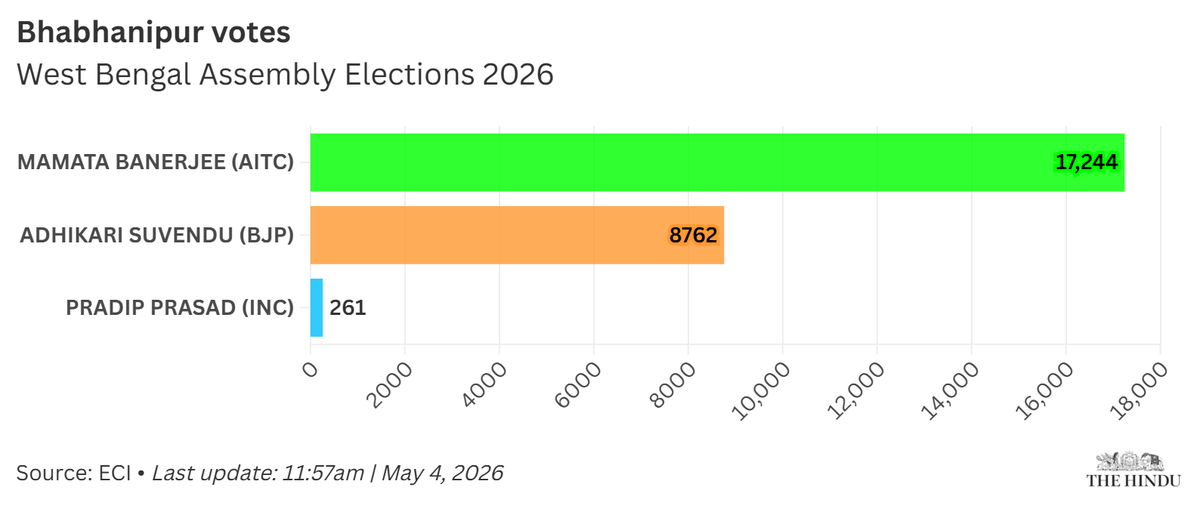
For the 2026 bypoll, the BJP fielded Hasirani Rath after Adhikari vacated Nandigram to retain Bhabanipur. The opposition field was complicated by changes in candidate arrangements and support among parties.
In Rejinagar, the contest involved the BJP, rival TMC factions, Congress, the Communist Party of India (Marxist) and the Aam Janata Unnayan Party (AJUP). The constituency’s political and demographic composition made it another important test of competing party support.
Early counting reports published on October 9 showed BJP candidates Hasirani Rath and Shankharavh Sarkar leading in Nandigram and Rejinagar. These trends suggested that the BJP was positioned to strengthen its foothold, but the final margins and official results remain essential to any definitive assessment. <Cite refs={[“turn969967view0″,”turn837407news24”]}/>
The contests also took place amid allegations of voter intimidation and polling irregularities. Opposition parties sought repolling, while the Election Commission described polling as largely peaceful. Such allegations should be assessed through the appropriate electoral procedures rather than treated as proven findings.
Tamil Nadu Bypolls: TVK’s Early Popularity Under Scrutiny
Tamil Nadu’s Madurantakam and Dharapuram by-elections were important because they tested the electoral position of TVK, the party led by actor-turned-politician C. Joseph Vijay.
The two seats became vacant after former AIADMK legislators joined TVK. The bypolls therefore gave the All India Anna Dravida Munnetra Kazhagam (AIADMK) an opportunity to challenge TVK and attempt to recover constituencies it had lost in the Assembly election.
Voter turnout was high in both constituencies, although it declined compared with the April Assembly polls. Madurantakam recorded 86.26% turnout, while Dharapuram recorded 80.30%, according to reports published before counting. <Cite refs={[“turn969967view2″,”turn837407news29”]}/>
The early counting picture was not uniform. TVK candidates initially led in both constituencies in some updates, while later reporting showed the AIADMK candidate ahead in Dharapuram. These changing trends illustrate why a lead during counting should not be confused with a declared victory.
Politically, the results matter because a newly elected government needs to maintain support beyond its initial electoral breakthrough. However, two constituency contests cannot establish whether TVK’s wider popularity is rising or falling across the entire state.
The final margins, local campaign issues and voting patterns will offer a more reliable basis for understanding the outcome.
Assam’s Nagaon Contest: BJP, Congress and AIUDF Compete
The Nagaon Lok Sabha by-election in Assam added a parliamentary dimension to the results. The contest featured BJP candidate Devasish Sharma, Congress nominee Sibamoni Bora and AIUDF chief Badruddin Ajmal.
The seat became vacant after Pradyut Bordoloi left Congress and subsequently won the Dispur Assembly constituency on a BJP ticket. The bypoll therefore tested the parties’ ability to build support in a constituency with a large electorate and competing political interests.
Nagaon recorded 76.19% voter turnout among approximately 19.05 lakh electors, according to the October 9 counting coverage. Early reports showed the BJP’s Devasish Sharma ahead of his rivals. <Cite refs={[“turn969967view0″,”turn837407news27”]}/>
A strong performance by the BJP would strengthen its position in the constituency, while a competitive showing by Congress or AIUDF would indicate that opposition parties retain a base of support.
The three-way nature of the contest is also important. When multiple parties compete for overlapping voter groups, the distribution of votes can matter as much as the overall popularity of any one candidate.
The final result and vote shares will help establish whether the BJP converted its early lead into a victory and how much support its rivals retained.
Puducherry: AINRC Retains Focus on Local Leadership
In Puducherry, the Thattanchavady Assembly by-election tested the political position of the AINRC-led government headed by Chief Minister N. Rangasamy.
The seat fell vacant after Rangasamy, who won two constituencies in the Assembly election, chose to retain Mangalam. AINRC candidate Ashok Anand contested the bypoll against opposition candidates.
Financial Express reported on October 9 that Ashok Anand had won Thattanchavady with a margin of more than 13,000 votes. <Cite refs={[“turn969967view0”]}/>
The result gave the ruling party a constituency-level win, but its broader implications should be interpreted carefully. A by-election shaped by local candidates, political networks and constituency-specific concerns is not necessarily a direct measure of statewide popularity.
For voters, the outcome also keeps attention on local governance, public services and the performance of elected representatives. These issues often influence bypolls alongside wider political loyalties.
What the October 2026 Results Mean for Regional Politics
The by-elections highlight three broader political themes. First, parties that have recently come to power face immediate tests of their ability to consolidate support. The BJP’s contests in West Bengal and TVK’s contests in Tamil Nadu illustrate this challenge.
Second, opposition unity and candidate selection can shape the competitiveness of local elections. In West Bengal, a fragmented opposition field complicated the contests, while the three-way race in Nagaon showed how different political organisations can compete for influence.
Third, turnout needs to be interpreted alongside results. High participation can indicate strong voter engagement, but it does not automatically favour the ruling party or the opposition. The candidate, constituency and issues at stake all matter.
The results are also a reminder that regional politics cannot be reduced to a single national trend. West Bengal, Tamil Nadu, Assam and Puducherry have different political histories, party structures and voter priorities.
For journalists and political observers, the most useful approach is to examine the declared winners, vote margins, turnout and constituency context together. The October bypolls provide valuable evidence, but larger conclusions about future elections require a wider set of results and more sustained political analysis.
Key Takeaways
- The October 2026 by-elections covered five Assembly seats and one Lok Sabha seat across West Bengal, Tamil Nadu, Assam and Puducherry.
- West Bengal’s Nandigram and Rejinagar contests tested the BJP after its recent rise to power and highlighted divisions among opposition parties.
- Tamil Nadu’s Madurantakam and Dharapuram bypolls provided an early electoral test for TVK and an opportunity for AIADMK to challenge the new ruling party.
- The results should be assessed using official final vote totals, margins and turnout figures rather than early counting leads alone.
Frequently Asked Questions
1. When were the 2026 by-election results declared?
Counting for the six constituencies took place on October 9, 2026. Final results should be confirmed through the Election Commission of India’s official constituency records.
2. Which states and regions held by-elections in October 2026?
The contests covered West Bengal, Tamil Nadu and Puducherry Assembly constituencies, along with the Nagaon Lok Sabha constituency in Assam.
3. Why were the Tamil Nadu bypolls important for TVK?
The Madurantakam and Dharapuram contests were an early test of TVK’s support after it came to power. They also gave AIADMK an opportunity to challenge TVK in constituencies previously held by its legislators.
4. Can by-election results predict the next Assembly election?
Not reliably on their own. Bypolls provide useful information about local political support, candidate performance and party organisation, but their outcomes can differ from statewide election results.














