






















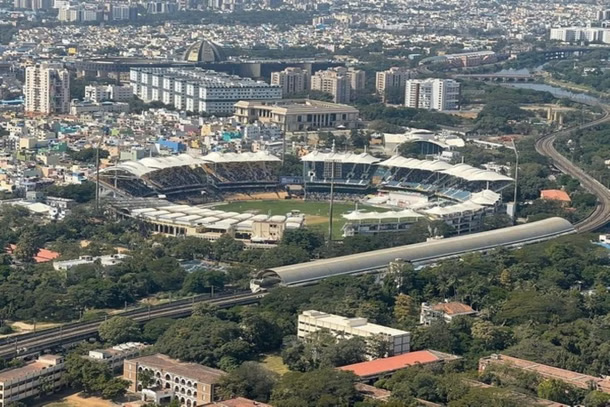
Chennai’s approach to urban development is drawing attention across India in 2026. The city has increasingly combined government initiatives with active citizen participation, creating improvements in public spaces, waste management, mobility, environmental conservation, and neighborhood development that many urban planners are studying closely.
Chennai’s Citizen-Led Urban Transformation Model Gains Momentum
The Chennai citizen-led urban transformation model has emerged as a notable example of how residents can actively contribute to city development alongside municipal authorities. As Indian cities continue to face challenges related to population growth, infrastructure pressure, waste management, traffic congestion, and climate risks, Chennai’s collaborative approach is being closely observed by policymakers and urban experts.
Unlike traditional top-down urban planning, many of Chennai’s recent improvements have involved resident welfare associations, volunteer groups, environmental organizations, and local communities working directly with civic authorities. This model has helped create practical solutions while increasing public ownership of city spaces.
The growing national interest reflects a broader search for sustainable urban development strategies that can be replicated across India’s rapidly expanding metropolitan areas.
Community Participation Reshaping Public Spaces
One of the key strengths of Chennai’s urban transformation journey has been community involvement in maintaining and improving public infrastructure.
Several neighborhoods have witnessed resident-led initiatives focused on park restoration, lake rejuvenation, waste segregation campaigns, tree plantation drives, and pedestrian-friendly public spaces. Citizen groups have also worked with local authorities to identify civic issues and propose practical solutions.
These efforts have helped improve not only physical infrastructure but also community engagement. Residents increasingly view themselves as stakeholders in the city’s future rather than passive recipients of government services.
Urban planners note that such participation often leads to better maintenance of public assets because communities remain actively invested after projects are completed.
Lake Restoration and Environmental Conservation Efforts
Environmental sustainability has become a central feature of Chennai’s transformation model. The city has faced recurring challenges related to flooding, water scarcity, and climate-related risks over the years.
Citizen groups have played an important role in restoring lakes, wetlands, and water bodies across various parts of the city. These restoration projects have focused on cleaning polluted water bodies, removing encroachments where possible, improving biodiversity, and increasing water storage capacity.
The protection of urban wetlands and water bodies has gained particular significance following severe flooding events experienced in previous years. Environmental experts believe that preserving natural ecosystems can help cities become more resilient to extreme weather conditions.
As climate adaptation becomes a national priority, Chennai’s experiences offer valuable lessons for other Indian cities facing similar environmental pressures.
Waste Management and Sustainable Living Practices
Another area where Chennai has received attention is community-driven waste management.
Many residential areas have promoted waste segregation at source, composting initiatives, recycling awareness programs, and reduced plastic consumption. Citizen volunteers have frequently partnered with municipal agencies to educate residents about sustainable waste practices.
While challenges remain, these localized efforts have contributed to improved awareness regarding environmental responsibility. Experts argue that successful waste management cannot depend solely on municipal systems and requires active citizen participation.
The Chennai model demonstrates how behavioral change at the household level can complement government-led sanitation and waste processing infrastructure.
Mobility, Walkability and Better Urban Planning
Improving urban mobility has become another important component of Chennai’s development efforts.
Citizen groups have increasingly advocated for safer footpaths, better public transport integration, cycling infrastructure, and improved road safety measures. These discussions have influenced broader conversations around creating more accessible and inclusive urban environments.
Across India, many cities continue to prioritize vehicle movement over pedestrian needs. Chennai’s growing focus on walkability and public space accessibility is being viewed as an important shift toward people-centered urban planning.
Urban experts suggest that future cities will need to balance economic growth with quality of life, making citizen feedback an essential part of planning decisions.
Why Other Indian Cities Are Paying Attention
The national attention surrounding Chennai’s citizen-led urban transformation model stems from its emphasis on collaboration rather than dependence on a single institution.
Cities such as Bengaluru, Pune, Hyderabad, Mumbai, and Delhi face similar challenges involving infrastructure, environmental sustainability, and public service delivery. Chennai’s experiences provide examples of how local communities can become partners in solving urban problems.
Experts caution that every city has unique social, economic, and geographic conditions. However, the broader principle of citizen participation remains widely applicable.
As India continues its urbanization journey, the ability to create partnerships between governments, residents, and civil society organizations may become increasingly important for sustainable city development.
Takeaways
• Chennai’s urban development model emphasizes active citizen participation alongside government efforts.
• Community-led projects have contributed to improvements in public spaces, environmental conservation, and waste management.
• Lake restoration and climate resilience initiatives have gained national attention.
• Other Indian cities are studying Chennai’s approach as a potential model for sustainable urban development.
FAQ
Q1. What is Chennai’s citizen-led urban transformation model?
It refers to development initiatives where residents, community groups, and civic authorities work together to improve infrastructure, public spaces, environmental sustainability, and urban services.
Q2. Why is Chennai receiving national attention in 2026?
Urban planners and policymakers are examining Chennai’s collaborative approach because it offers practical examples of citizen participation in city development.
Q3. What are some major areas of improvement under this model?
Key areas include lake restoration, waste management, public space improvement, environmental conservation, and mobility planning.
Q4. Can other Indian cities replicate Chennai’s model?
While every city has unique challenges, the principle of involving citizens in planning and implementation can be adapted across different urban regions.
(Keywords: Chennai citizen-led urban transformation model, Chennai urban development 2026, citizen participation in urban planning, Chennai sustainability initiatives, smart city development India, lake restoration Chennai, urban governance India, community-led city transformation)