



























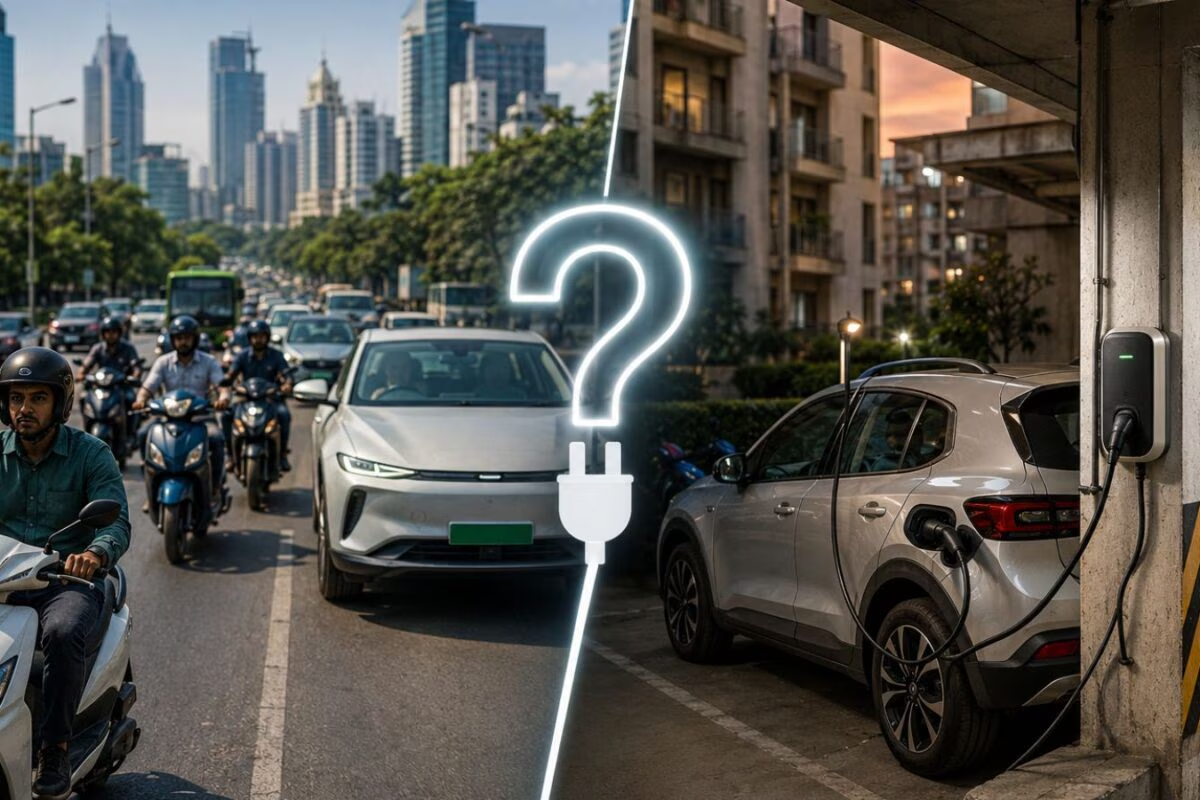
India’s EV battery-swapping ecosystem could make electric two-wheelers and three-wheelers more practical for delivery riders, gig workers and daily commuters. By allowing users to exchange a discharged battery for a charged one, the technology can reduce waiting time, although affordability, station availability and battery compatibility remain important challenges.
What Is EV Battery Swapping and How Does It Work?
EV battery swapping is a method of powering an electric vehicle by replacing its discharged battery with a charged one at a designated station. Instead of waiting for the vehicle’s battery to recharge, the rider exchanges it and continues the journey.
The process is particularly relevant to electric two-wheelers and three-wheelers, which often use smaller battery packs that can be designed for removal and replacement. Depending on the vehicle and station, swapping may take only a few minutes.
India’s Ministry of Power issued its Guidelines for Installation and Operation of Battery Swapping and Battery Charging Stations on January 10, 2025. The guidelines aim to encourage battery swapping, support battery-as-a-service models and develop the infrastructure needed for these services. https://www.powermin.gov.in/static/uploads/2025/08/5804f7f17e764f9ba1951183379b8e31.pdf
However, not every electric vehicle supports battery swapping. Vehicles with fixed battery packs generally need to be charged using compatible charging equipment. The technology’s benefits therefore depend on whether a suitable vehicle and a functioning swapping network are available.
Why Battery Swapping Matters for Delivery Riders
For delivery workers, time spent waiting for a battery to charge can affect how many orders they complete during a working day. This makes battery swapping especially relevant to riders who depend on their vehicles for income.
Consider a delivery rider working in a busy city. If the scooter’s battery runs low during a shift, the rider may need to return home, locate a charging point or wait at a charging facility. With a compatible swapping service nearby, the rider could exchange the battery and return to work sooner.
Research published by the International Council on Clean Transportation in collaboration with India’s NITI Aayog has examined the potential of battery swapping for electric two-wheelers. It identifies the value of reduced charging downtime, particularly for commercial vehicles that cover longer distances and are used intensively. https://theicct.org/publication/india-ev-battery-swapping-may22/
For gig workers, the practical benefit is not simply faster charging. It is the possibility of spending more time earning and less time managing vehicle energy requirements.
Actual savings, however, will depend on subscription charges, swapping fees, battery availability, travel distance and the rider’s daily workload.
Can Battery Swapping Make Electric Scooters More Affordable?
The upfront price of an electric scooter is an important consideration for first-time buyers. Battery swapping can offer an alternative purchasing model in which customers buy a compatible vehicle without purchasing the battery outright.
This arrangement is commonly known as Battery as a Service, or BaaS. Under this model, a battery provider owns or manages the battery and charges the vehicle owner or fleet operator for access to it.
Removing the battery’s cost from the initial vehicle purchase can reduce the amount a buyer needs to pay upfront. This could make electric mobility more accessible to delivery workers, small business owners and commuters who cannot afford a higher initial expense.
But a lower purchase price does not automatically mean a lower overall cost. Battery subscriptions, per-swap fees, service charges and contractual conditions can add up over time.
Buyers should compare the total cost of ownership, including electricity or swapping expenses, insurance, maintenance and financing. They should also check whether the battery service is available across their usual routes.
Government Guidelines and India’s Battery-Swapping Policy
India’s policy approach has developed through several stages. NITI Aayog released a draft Battery Swapping Policy for public consultation in April 2022, with a focus on light electric vehicles and the development of a battery-swapping ecosystem.
The draft addressed issues such as interoperability, battery safety, battery identification and the responsibilities of service providers. However, a draft policy should not be treated as a fully notified national policy.
In January 2025, the Ministry of Power issued separate operational guidelines covering battery-swapping and battery-charging stations. These guidelines seek to make infrastructure deployment easier and support the growth of battery-swapping services. https://www.powermin.gov.in/static/uploads/2025/08/5804f7f17e764f9ba1951183379b8e31.pdf
More recently, NITI Aayog’s India Electric Mobility Index material noted that Delhi notified a revised EV policy in June 2026, including electrification mandates for two-wheelers, three-wheelers and light commercial vehicles. This is a state-level development, not proof of a new nationwide battery-swapping mandate. https://www.niti.gov.in/node/2424
The distinction matters because infrastructure rules, state EV policies and a comprehensive national battery-swapping policy serve different purposes.
Battery Compatibility Remains a Major Challenge
One of the biggest obstacles to wider battery swapping is compatibility between vehicles and batteries.
Different manufacturers may use different battery dimensions, connectors, voltage levels, communication systems and safety requirements. A battery designed for one vehicle cannot automatically be used in another.
This can limit consumer choice. A rider may find a swapping station nearby but discover that it does not support the battery system used by their scooter.
Interoperability, which allows compatible equipment from different providers to work together, could make the system more convenient. However, standardisation must account for technical requirements, performance, safety and battery management.
Battery condition is another important consideration. Operators need systems to assess battery health, identify damaged units and monitor charging cycles. Clear procedures for handling faulty batteries can help protect riders, staff and the public.
Without dependable standards and compatible networks, swapping services may remain restricted to particular vehicle brands, fleets or geographical areas.
What Battery Swapping Could Mean for Tier-2 and Tier-3 Cities
The potential benefits extend beyond metropolitan areas. Cities such as Nagpur, Nashik, Indore, Jaipur and Lucknow have commuters, small businesses and delivery workers who could benefit from practical electric mobility options.
For these users, the success of battery swapping will depend on where stations are located and whether they fit everyday travel patterns. A station near a commercial market, delivery hub or major commuter route may be more useful than one far from regular destinations.
Local businesses could also explore battery-swapping facilities as a service opportunity, provided they can meet applicable technical, electrical and safety requirements.
However, expansion into smaller cities will require reliable demand, suitable premises, electricity connections and a steady supply of charged batteries. Operators must also account for periods of low demand and the cost of maintaining battery inventory.
For commuters, convenience will be determined by the distance to a station, waiting times, service reliability and the total cost of using the system. A well-designed network could make swapping useful, while an uneven network could discourage adoption.
Battery Swapping Versus Conventional EV Charging
Battery swapping and conventional charging address the same basic need but suit different users.
Conventional charging allows owners to recharge their own vehicle’s battery at home, work or a public charging station. It can be convenient for commuters who park for several hours overnight or during the working day.
Battery swapping is more attractive when a vehicle must return to service quickly. Delivery fleets, shared mobility operators and some commercial three-wheelers may benefit because their vehicles can spend long periods on the road.
Neither approach is universally better. Swapping requires compatible batteries, service networks and inventory management. Conventional charging requires sufficient charging access and time for the battery to recharge.
India is likely to need multiple charging and energy-service models because drivers have different travel requirements, budgets and parking arrangements.
What Needs to Happen Before Battery Swapping Becomes Mainstream?
Wider adoption will require more than the installation of swapping stations. Providers must make services reliable, transparent and financially practical for users.
First, station networks need to expand along routes used by delivery workers and commuters. Second, vehicle manufacturers and battery operators need to address compatibility within and across supported systems. Third, battery safety, testing, maintenance and end-of-life recycling must remain priorities.
Consumers also need clear information about subscription terms, replacement batteries, warranty coverage, service availability and responsibility for damaged batteries.
For delivery companies, fleet-level agreements could help make operating costs more predictable. Individual riders, meanwhile, should compare swapping charges with home charging and other available options before choosing a vehicle.
Battery swapping can address a genuine problem in electric mobility, but its success will depend on whether the service works reliably in everyday conditions. Lower upfront costs and shorter downtime are useful only when the complete system remains affordable and accessible.
Key Takeaways
- Battery swapping allows compatible electric vehicles to replace discharged batteries with charged ones, reducing the time spent waiting for charging.
- Delivery riders and high-use commercial fleets could benefit most when swapping stations are conveniently located.
- India’s Ministry of Power issued battery-swapping and charging-station guidelines in January 2025, while a comprehensive national policy is a separate matter.
- Battery compatibility, service fees, station coverage and safety standards will determine whether swapping becomes a practical option for ordinary commuters.
Frequently Asked Questions
1. What is EV battery swapping in India?
It is a service through which a compatible electric vehicle receives a charged battery in exchange for its discharged battery at a designated station.
2. Is battery swapping cheaper than charging an electric scooter?
Not necessarily. Swapping may reduce upfront vehicle costs under a battery-as-a-service arrangement, but subscriptions and per-swap charges can increase ongoing expenses. The total cost depends on usage and the provider’s terms.
3. Can any electric scooter use a battery-swapping station?
No. The vehicle and battery must be compatible with the station’s supported system. Buyers should verify compatibility and station coverage before purchasing a vehicle.
4. Has India introduced a national battery-swapping policy?
The government issued battery-swapping and charging-station guidelines in January 2025. NITI Aayog also published a draft Battery Swapping Policy in 2022. These are distinct from the formal notification of a comprehensive national policy.