




























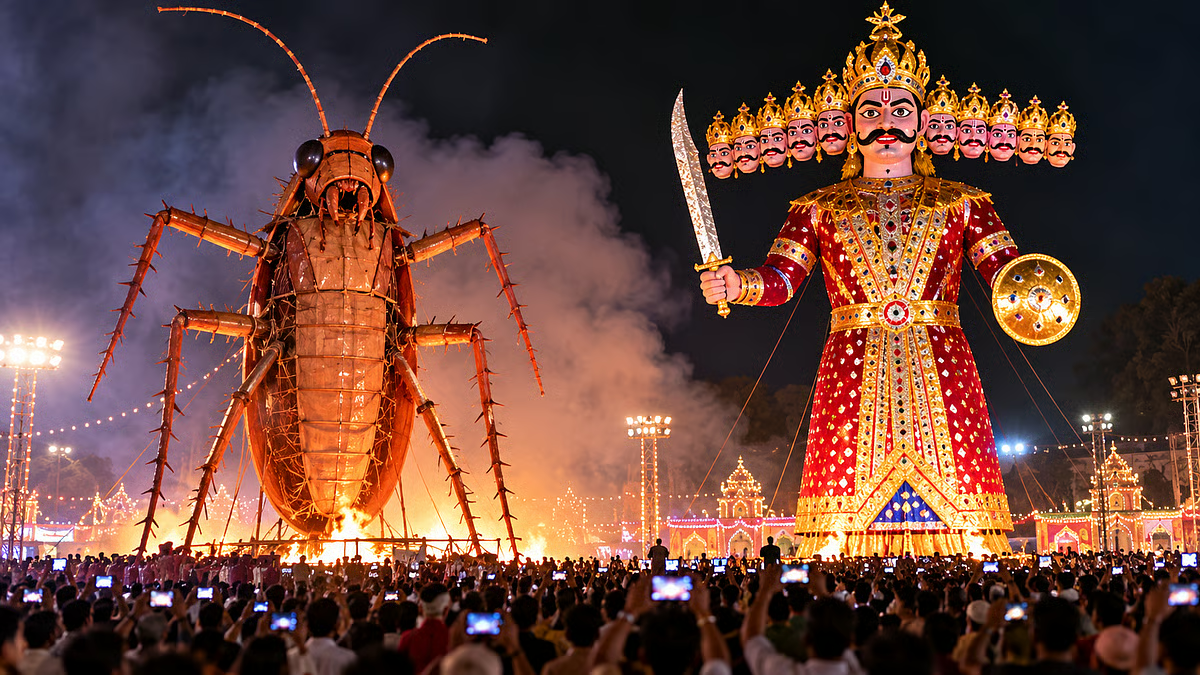
A 30-foot cockroach effigy burned alongside traditional figures during Dussehra celebrations in Delhi’s Pitampura has triggered political controversy and widespread social media reactions. Organisers described the unusual addition as a cleanliness message, while the Aam Aadmi Party (AAP) questioned its place in the religious celebration and demanded legal action.
What Happened at Delhi’s Ramlila Celebration?
The controversy centres on a Dussehra event organised by the Shri Keshav Ramlila Committee at Netaji Subhash Place in Pitampura, northwest Delhi. On October 20, 2026, a 30-foot cockroach effigy was burned alongside the traditional effigies of Ravana, Kumbhakarna and Meghnad.
The unusual spectacle quickly attracted public attention because the cockroach is not a traditional figure associated with Ravan Dahan. Videos and photographs of the effigy circulated online, prompting humorous comments, criticism and questions about the message behind the display.
The organising committee said the cockroach represented filth and dirt. According to its explanation, the initiative was intended to promote cleanliness and draw attention to the importance of maintaining hygienic surroundings.
However, the event became a political issue after opposition leaders challenged the decision to include the insect effigy in a religious celebration. The dispute subsequently expanded beyond the symbolism of the effigy to questions about cultural traditions, political messaging and public interpretation.
Why Did Organisers Burn a Cockroach Effigy?
Dussehra, also known as Vijayadashami, is widely celebrated to mark the victory of good over evil. In many parts of India, the occasion includes the burning of Ravana’s effigy, symbolising the defeat of wrongdoing and the triumph of righteousness.
The Shri Keshav Ramlila Committee introduced the cockroach effigy as an additional symbol. Organisers said it represented dirt and unhygienic conditions and connected the gesture with cleanliness campaigns such as Swachh Bharat and Swachh Delhi.
Committee president Ashok Goel, who is also a BJP MLA, maintained that the initiative was not politically motivated. The stated purpose was to use a familiar public celebration to communicate a message about cleanliness.
The choice nevertheless attracted attention because cockroaches are commonly associated with unsanitary environments and household pest problems. Their presence can also raise public-health concerns, particularly when pests contaminate food or spread allergens.
The distinction is important: the organisers presented the effigy as a symbolic cleanliness message, but that explanation did not prevent the display from becoming controversial.
AAP Objects to the Effigy and Demands Action
The incident drew criticism from the Aam Aadmi Party, which argued that the inclusion of the cockroach effigy was inappropriate in the context of a traditional religious celebration.
On October 20, Delhi AAP president Saurabh Bharadwaj submitted a complaint to the Delhi Police Commissioner and the Lieutenant Governor over the incident. Reports published on October 21 said the complaint sought action against those responsible for organising the display.
Bharadwaj alleged that the act hurt religious sentiments and called for a First Information Report (FIR). The party also criticised the use of a religious occasion for what it viewed as political messaging.
The allegations remain the complainant’s position and should not be treated as an established legal finding. Filing a complaint does not, by itself, establish that an offence has occurred.
As of October 21, the reported development was the submission of the complaint and the demand for police action. Any subsequent police decision, formal registration of an FIR or judicial finding would need to be verified independently before being reported as a confirmed outcome.
BJP Leaders and Organisers Defend the Decision
The organisers maintained that the cockroach effigy was intended to communicate a message about cleanliness rather than target a political party or individual.
Ashok Goel had previously said that the initiative was connected with the Swachh Bharat campaign. The committee’s explanation placed the emphasis on removing dirt and encouraging cleaner surroundings.
The controversy also involved Delhi minister Kapil Mishra, who was associated with the Dussehra event. Coverage of the incident reported criticism from AAP leaders and a wider political exchange between the parties.
The episode illustrates how public events can acquire competing interpretations. Organisers may describe a display as a symbolic social message, while political opponents may view the same action through the lens of religious sensitivities or partisan communication.
Neither interpretation should automatically be treated as the only possible explanation. A balanced account must distinguish between the organisers’ stated intention, the opposition’s allegations and any independently established facts.
Cockroach Janta Party’s Reaction Adds Another Twist
The incident attracted additional attention because the cockroach is also associated with the Cockroach Janta Party (CJP), a satirical political initiative founded by Abhijeet Dipke in May 2026.
The group has used the cockroach as a symbol in its political messaging and public commentary. Its activities have drawn attention to issues including unemployment and political dissatisfaction.
Following the circulation of the effigy video, Dipke reacted on social media with the remark, “Thank you for the free publicity,” according to a report published by The Indian Express on October 20.
His response added an ironic dimension to the controversy. While the Ramlila committee said its effigy was intended to represent filth, the image also reminded social media users of a political group using the same insect as its symbol.
The overlap created room for jokes, memes and competing interpretations. However, the existence of that association does not, on its own, establish that the committee intended to target the CJP. The organisers have denied that the initiative was politically motivated.
How Social Media Turned the Incident Into a Debate
The size and unusual appearance of the cockroach effigy made it well suited to circulation on social media. Images and videos from public events can spread rapidly when they combine a recognisable tradition with an unexpected visual element.
Reactions to the Delhi incident included humour, criticism and disagreement over whether the display was appropriate. Some users treated it as an unusual addition to the annual celebration, while others questioned its place alongside traditional mythological figures.
The incident also shows how viral content can become detached from its original context. A short video may attract attention without explaining the organisers’ stated purpose, the political reactions or the status of any legal complaint.
Artificial intelligence-generated and edited content can add another layer of confusion when fictional dialogue or exaggerated scenes are shared alongside footage of a real event. Readers should distinguish original recordings from parody videos and verify claims before forwarding them.
For news publishers, the responsible approach is to identify the source of a video, establish when and where it was recorded, and separate verified events from commentary or satire.
What the Controversy Means for Public Celebrations
The cockroach effigy controversy raises broader questions about how organisers introduce new symbols into traditional festivals. Public celebrations evolve over time, but additions can attract scrutiny when audiences interpret their cultural or political meaning differently.
In this case, the organisers presented the display as a cleanliness initiative, while AAP leaders argued that it was inappropriate in a religious setting. The CJP’s reaction further complicated the discussion because the insect already had a political association.
The episode does not establish that all attendees shared the same view. Nor does the filing of a complaint establish that the event violated the law.
The next developments depend on any response from the authorities and whether further evidence emerges about the complaint. Until then, the established facts should remain separate from allegations and political interpretations.
For readers, the central lesson is straightforward: a viral image can explain why a story attracts attention, but understanding the story requires its context, the statements of the people involved and careful verification of what has actually happened.
Key Takeaways
- A 30-foot cockroach effigy was burned alongside the traditional effigies of Ravana, Kumbhakarna and Meghnad during a Dussehra event in Pitampura, Delhi, on October 20, 2026.
- The Shri Keshav Ramlila Committee said the cockroach represented filth and that the display was intended to promote cleanliness.
- AAP Delhi president Saurabh Bharadwaj filed a complaint seeking action over the incident, alleging that it hurt religious sentiments.
- Cockroach Janta Party founder Abhijeet Dipke responded to the viral video with a remark about receiving free publicity. The organisers denied that the effigy was politically motivated.
Frequently Asked Questions
1. Why was a cockroach effigy burned at Delhi’s Ramlila?
The Shri Keshav Ramlila Committee said the 30-foot effigy represented filth and dirt. Organisers described it as a symbolic effort to promote cleanliness alongside the traditional Dussehra effigies.
2. Where did the cockroach effigy incident take place?
The event took place at the Shri Keshav Ramlila Committee’s Dussehra celebration at Netaji Subhash Place in Pitampura, northwest Delhi.
3. Why did AAP object to the cockroach effigy?
AAP Delhi president Saurabh Bharadwaj alleged that the display hurt religious sentiments and submitted a complaint to the Delhi Police Commissioner and the Lieutenant Governor seeking action.
4. Was the cockroach effigy officially linked to the Cockroach Janta Party?
The insect is associated with the satirical Cockroach Janta Party, founded by Abhijeet Dipke. However, the Ramlila committee said its decision was not politically motivated and denied that the effigy was connected to the party.