





























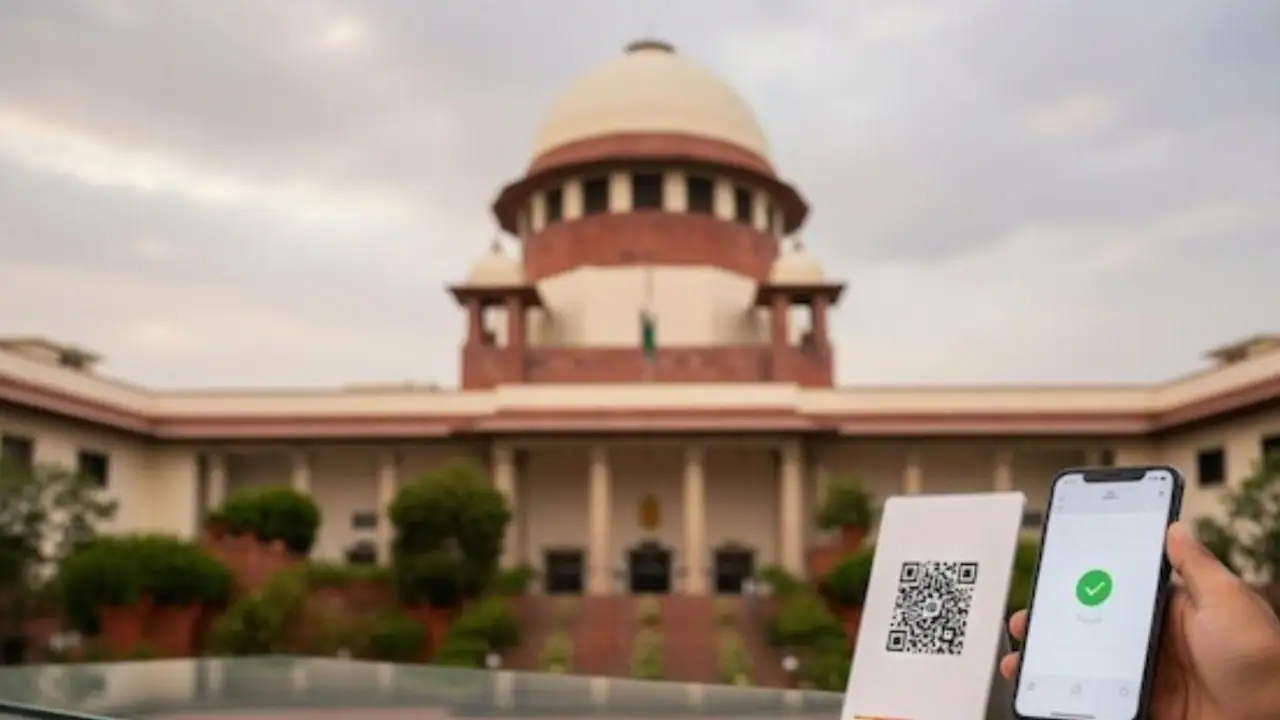
The Supreme Court’s UPI MDR hearing has brought renewed attention to India’s digital payment system. The court on September 28 declined to stay the proposed Merchant Discount Rate on specified UPI merchant payments above Rs 2,000, while seeking responses from the Centre, RBI and NPCI.
Supreme Court Declines Interim Stay on UPI MDR
The Supreme Court has refused to put an interim stay on the new UPI Merchant Discount Rate framework. The matter concerns a 0.4% MDR that is scheduled to apply from October 15, 2026, to specified person-to-merchant, or P2M, UPI transactions above Rs 2,000.
A three-judge bench led by Chief Justice Surya Kant is examining a petition challenging the framework. The court has sought responses from the Centre, Reserve Bank of India and National Payments Corporation of India, among other respondents.
The refusal to grant an interim stay does not mean the court has given a final ruling on the legality of the MDR framework. The case will continue after the authorities respond to the issues raised in the petition.
What Is UPI MDR and Why Is It Being Introduced?
Merchant Discount Rate, commonly called MDR, is a charge associated with processing a digital payment received by a merchant. Under the new framework, eligible P2M UPI transactions above Rs 2,000 will attract an MDR of 0.4%.
The charge is a merchant-side cost rather than a direct fee imposed on the person making the payment. The government and NPCI have said consumers should continue to use UPI without being charged the MDR directly.
The new framework is significant because UPI has operated without an MDR for several years. The revised structure is intended to create a revenue mechanism around selected higher-value merchant transactions while keeping low-value payments and person-to-person transfers outside the charge.
Who Will Pay the New UPI Charge?
The key distinction is between customers and merchants.
Under the announced framework, eligible merchants receiving P2M UPI payments above Rs 2,000 will be subject to the 0.4% MDR. Person-to-person transactions remain outside the framework, while P2M transactions up to Rs 2,000 will also remain free of MDR.
Small merchants classified under the P2PM category also receive protection under the framework. NPCI has stated that small merchants receiving up to Rs 1 lakh per month through UPI are covered by mandatory zero MDR provisions.
This distinction matters for everyday users in Tier-2 and Tier-3 cities, where UPI is widely used for small purchases at local shops, service providers, restaurants and street businesses.
How Much Will Merchants Pay on Larger Transactions?
The MDR is set at 0.4% for eligible P2M transactions above Rs 2,000, with a maximum charge of Rs 300 per transaction. The cap applies once the transaction reaches Rs 75,000.
For example, a merchant receiving Rs 3,000 through an eligible UPI transaction would face an MDR of Rs 12. A Rs 10,000 transaction would result in an MDR of Rs 40.
For a transaction of Rs 1 lakh, the 0.4% calculation would normally produce Rs 400, but the applicable MDR would be capped at Rs 300.
The structure therefore affects merchants more directly than ordinary UPI users. However, the practical impact could vary depending on how businesses adjust their pricing, payment preferences and operating costs.
Will Customers Have to Pay for UPI?
The announced framework does not introduce a direct UPI payment charge for consumers. The MDR is designed as a merchant-side charge, and authorities have said merchants and payment intermediaries should not pass the charge on to customers.
This means a customer paying Rs 5,000 to an eligible merchant through UPI is not supposed to see an additional 0.4% fee added to the payment.
However, the effect on customers will also depend on how merchants respond to the new cost. Some trader groups have raised concerns that businesses operating on thin margins could encourage cash or alternative payment methods for larger purchases.
That is a potential market response, not a rule under the new framework.
Why the Supreme Court Hearing Matters
The legal challenge raises questions about the basis and implementation of the MDR framework. The Supreme Court has therefore asked the concerned authorities to respond before the case proceeds further.
The immediate significance of the September 28 order is that the October 15 implementation has not been blocked by an interim court order.
For digital payment users, this means the current position remains that eligible merchant transactions will be covered by the new framework from October 15 unless there is a subsequent change through the court, government or payment-system authorities.
The hearing also places the economics of UPI under greater public scrutiny. UPI has become a major part of India’s payment infrastructure, and any change to its cost structure can affect banks, payment apps, merchants and consumers.
What Could Change for Small Businesses?
For large retailers and businesses handling high-value digital transactions, the financial impact will depend on transaction volumes and average payment sizes.
For smaller businesses, the framework provides exemptions intended to protect low-value transactions and qualifying small merchants. This is particularly relevant outside India’s biggest cities, where neighbourhood shops and small service businesses often rely heavily on QR-code payments.
At the same time, merchants whose transactions regularly cross the Rs 2,000 threshold will need to understand how the MDR is calculated and reflected in their payment settlement.
The issue could become particularly relevant in sectors such as electronics, mobile retail, education services, healthcare, travel and other businesses where individual bills can frequently exceed Rs 2,000.
UPI’s Next Phase Could Depend on the MDR Debate
The Supreme Court hearing comes at a time when UPI has become deeply integrated into India’s daily economy. Official data cited by India Today showed that UPI processed 2,366 crore transactions worth Rs 29.9 lakh crore in July 2026 alone.
That scale explains why even a relatively small change in the payment ecosystem has wider implications.
The MDR framework is not a direct charge on every UPI transaction. Most everyday low-value payments remain outside the levy, and person-to-person payments continue to remain free.
What happens next will depend partly on the Supreme Court proceedings and partly on how merchants, banks, payment platforms and customers respond after the framework takes effect.
For now, the key date to watch is October 15, 2026, when the new MDR framework is scheduled to begin.
Key Takeaways
- The Supreme Court has declined an interim stay on the new UPI MDR framework.
- A 0.4% MDR is scheduled from October 15 on specified P2M UPI transactions above Rs 2,000.
- The MDR is payable by eligible merchants, while consumers are not supposed to be charged directly.
- The Supreme Court has sought responses from the Centre, RBI and NPCI, so the legal challenge remains ongoing.
FAQ
What is the new UPI MDR charge?
The new framework introduces a 0.4% Merchant Discount Rate on specified person-to-merchant UPI transactions above Rs 2,000, subject to a maximum MDR of Rs 300 per transaction.
Will customers have to pay the UPI MDR?
The MDR is structured as a merchant-side charge. The government has stated that the cost should not be passed on to customers.
When will the new UPI MDR start?
The revised MDR framework is scheduled to take effect on October 15, 2026.
Does the Supreme Court decision mean the MDR is permanently approved?
No. The Supreme Court only declined an interim stay at this stage and has sought responses from the Centre, RBI and NPCI. The legal challenge remains pending.