





























Mumbai’s data centre boom is expanding across the Metropolitan Region, but a proposed hyperscale facility in Thane has triggered protests over water, electricity, noise and its location near residential neighbourhoods. The debate highlights the infrastructure challenges behind India’s growing AI and cloud economy.
Why Thane residents are protesting the data centre
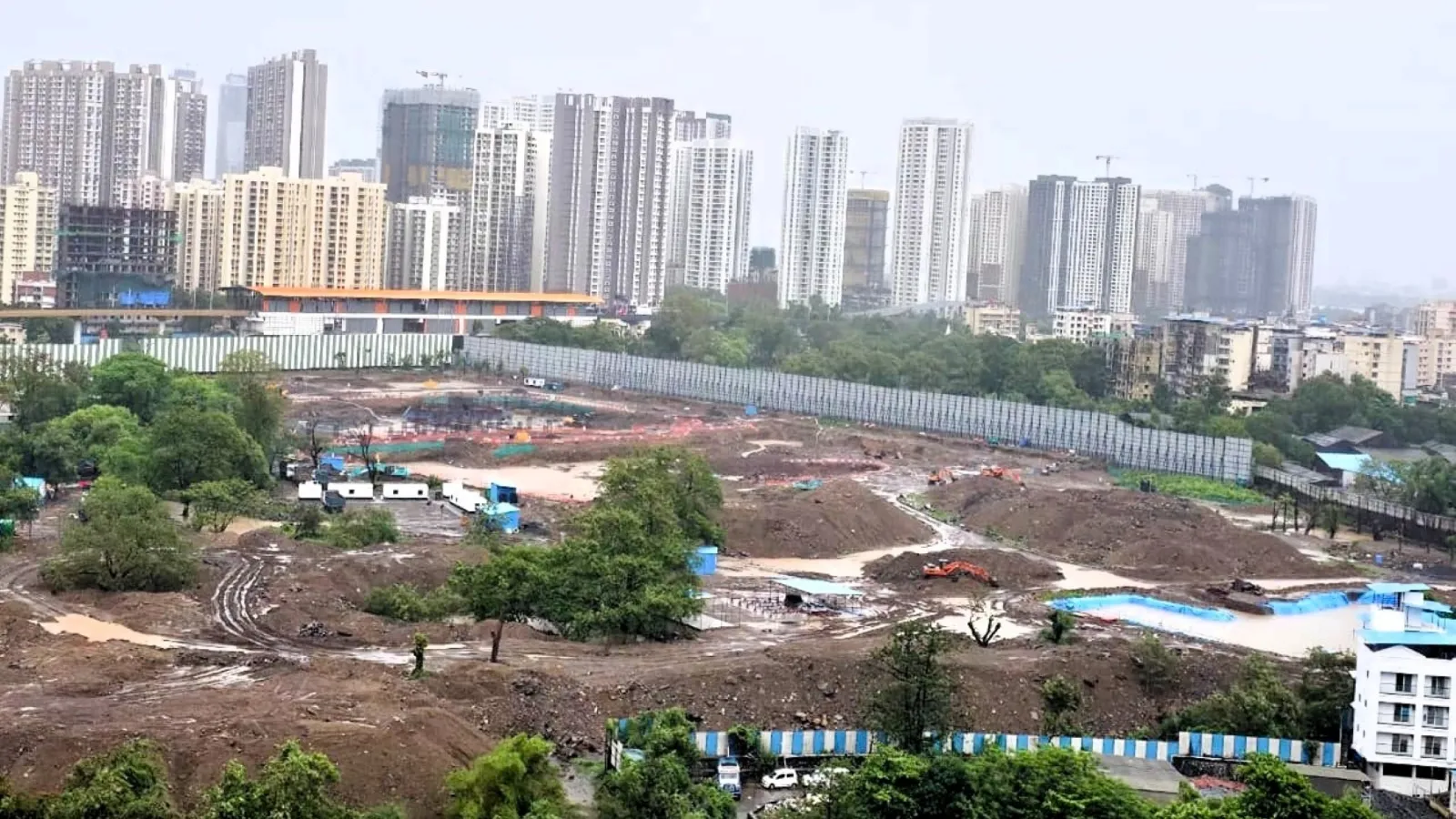
The latest debate around Mumbai’s data centre expansion centres on a proposed 53-acre Amazon Web Services facility in Balkum, Thane. Residents in Balkum, Majiwada and Dhokali initially welcomed news of an Amazon facility, expecting it could create employment and economic opportunities. The site had earlier been associated with a chemical company, and some locals saw redevelopment as a potential source of jobs.
Concerns grew after residents learned that the proposed project would be a hyperscale data centre rather than a conventional commercial facility. According to details reported by The Indian Express, the project is expected to consume 422 MW of power, use 125 kilolitres of treated water a day and have 193 diesel generator sets as backup.
Hundreds of residents have since protested against the project. A human chain was organised on July 18, while the local #WakeupThanekar movement has focused on the location of the facility and its potential impact on an already densely populated part of Thane.
Mumbai data centre boom is accelerating
The Thane dispute comes at a time when Maharashtra is actively encouraging data centre investments. The state has said it has attracted more than $300 billion in investment interest in the sector and is targeting 5.7 GW of data centre capacity by 2032. Maharashtra currently accounts for about 66 per cent of India’s data centre capacity, according to Economic Times Datacenters.
The Mumbai Metropolitan Region is particularly important to this expansion. A July 2026 report cited by The Indian Express said the MMR accounts for 49 per cent of India’s operational data centre capacity. The region has more than 14 international submarine cable landings, extensive fibre connectivity and established business infrastructure, all of which make it attractive for operators.
Mumbai’s data centre development has also continued to increase during 2026. An Economic Times Datacenters report citing Cushman & Wakefield said Mumbai’s data centre development capacity grew 31 per cent to 1.7 GW in the first half of 2026.
Why Thane’s location is creating a different concern
Data centres are not new to the Mumbai region. Navi Mumbai, particularly the Dighe, Airoli, Ghansoli and Mahape belt, has emerged as a major cluster. Mumbai also has data centre facilities around areas such as Chandivali and Powai.
The concern in Thane is largely about where the proposed facility is being developed.
The Indian Express reported that the proposed AWS facility in Balkum is surrounded by high-rise buildings, smaller settlements, schools and hospitals. A regional bureaucrat cited by the publication said the Thane project differs from several facilities in Mumbai and Navi Mumbai because many existing data centres in those areas are located inside established industrial complexes and are less surrounded by residential accommodation.
That distinction matters for residents. A large industrial or technology facility in an established industrial zone can have a very different relationship with surrounding communities than one located beside thousands of homes.
Residents associated with the protest have stressed that they are not necessarily opposed to data centres or AI infrastructure. Their main objection is the proposed location in a heavily populated residential belt.
Water demand becomes a major issue
Water is one of the biggest points of debate surrounding the Thane data centre.
Thane already faces pressure on its water supply. The Indian Express reported that the city has a daily shortage of 31 million litres of potable water and that the Thane Municipal Corporation has approached the Brihanmumbai Municipal Corporation for additional supply.
According to information reported by the publication, the proposed facility is expected to use 125 kilolitres of treated water per day. Thane civic officials said the data centre is proposed to receive treated water from sewage treatment plants at Kolshet and Majiwada rather than potable water.
Amazon has also said the facility will use closed-loop cooling technology and will not use water for cooling. The company told The Indian Express that treated water would be used for landscaping and irrigation, while the cooling system would recirculate coolant through sealed pipes.
This distinction is important because public discussions about data centres can easily make their total water requirements sound equivalent to direct drinking-water consumption. In this case, the proposed water arrangement is specifically described as treated water, while Amazon says its cooling system itself will not consume water.
Electricity demand is another major concern
The proposed facility’s electricity requirement is perhaps the most striking number in the debate.
Its environmental impact assessment reportedly estimates a combined power consumption of 422 MW once operational. The facility is also expected to have 193 diesel generator sets for backup power.
Residents have raised concerns that such a large electricity requirement could put additional pressure on the local power system, particularly during periods when demand is already high.
Amazon, however, has said the facility will not draw power from the local distribution network serving homes, shops and businesses. According to the company’s statement reported by The Indian Express, it will connect to the high-voltage transmission grid through a dedicated industrial substation.
That means the question is not simply whether the data centre will consume electricity. The larger issue is how the required generation and transmission capacity will be planned and whether the infrastructure serving the facility can operate without reducing reliability for existing consumers.
Noise and diesel generators worry nearby residents
Residents living close to the proposed site have also raised concerns about noise, heat and air pollution.
A data centre operates continuously because cloud services, online platforms and digital systems cannot simply be switched off at night. Servers generate heat, which means the facility requires cooling systems and supporting equipment to operate around the clock.
The proposed Thane project is expected to have 193 diesel generator sets as backup. Residents have questioned what the noise and emissions could mean for nearby homes if a large number of generators have to operate during a power disruption.
Amazon has said the facility will comply with legal noise limits under the Noise Pollution (Regulation and Control) Rules, 2000. Whether residents are satisfied with those safeguards will depend on how the facility is ultimately built, operated and monitored.
Why India needs more data centres
The controversy also needs to be viewed against the growing demand for digital infrastructure.
Everyday services such as online banking, digital payments, streaming, e-commerce, cloud applications and artificial intelligence rely on large computing facilities. As more businesses move their operations online and AI workloads increase, companies need more computing capacity closer to the users and networks they serve.
Mumbai has several advantages in this regard. Its position as a major business centre, its connectivity to international submarine cables and its established telecommunications infrastructure make the region an important location for data centres.
An Economic Times report in August said Mumbai’s development pipeline had reached 1.7 GW after growing 31 per cent. That expansion reflects demand from cloud providers, hyperscalers and AI platforms.
So the question facing Thane is not whether India needs digital infrastructure. It is how that infrastructure should be planned in cities where land, water, electricity and residential space are already under pressure.
What the Thane debate means for future projects
The Thane controversy could become an important test for how Indian cities manage the next phase of the data centre boom.
Officials and experts cited by The Indian Express have argued that data centres cannot simply be excluded from urban areas because digital infrastructure needs to be located close to networks and users. At the same time, they have stressed the importance of separating industrial and residential uses and introducing appropriate safeguards.
This creates a difficult planning challenge. Data centres require large amounts of electricity, reliable connectivity, cooling systems and land. Residential communities need dependable water supplies, safe roads, acceptable noise levels and a healthy environment.
For Maharashtra, which is targeting a substantial increase in data centre capacity by 2032, these questions are likely to become more important as additional projects are proposed. The Thane dispute shows that attracting investment is only one part of the equation. Cities also have to determine where these facilities should be located and how their resource requirements will be met.
The bigger question behind Mumbai’s digital expansion
The Thane protests are ultimately about more than one proposed data centre.
Maharashtra is betting heavily on digital infrastructure, AI and cloud computing as part of its wider economic strategy. The investment can support jobs, construction, technology services and long-term digital capacity. But data centres also have physical requirements that are easy to overlook because their primary output is digital.
They occupy land, require electricity, need cooling and depend on reliable infrastructure.
For residents, the debate is therefore straightforward: what does a digital economy mean for the physical resources of the neighbourhood where it is being built?
The answer will depend on planning, transparency, environmental safeguards and how effectively authorities balance new infrastructure with existing civic needs.
Takeaways
- A proposed 53-acre AWS hyperscale data centre in Thane has triggered protests from nearby residents.
- The facility is expected to require 422 MW of power and 125 kilolitres of treated water daily, with 193 diesel generators planned as backup.
- Amazon says the project will use closed-loop cooling, treated water for landscaping and irrigation, and a dedicated high-voltage power connection.
- The dispute comes as Maharashtra targets 5.7 GW of data centre capacity by 2032 and continues to attract major investment interest.
FAQ
Why are Thane residents protesting the data centre?
Residents are mainly concerned about the proposed facility’s location near residential areas, as well as its electricity demand, water requirements, noise, backup generators and possible environmental impact. Protesters have said they are not opposed to data centres in principle but object to this particular location.
How much electricity will the proposed Thane data centre use?
The environmental impact assessment cited by The Indian Express estimates that the facility will consume 422 MW of power when operational. Amazon has said it will connect to the high-voltage transmission grid through a dedicated industrial substation rather than the local distribution network serving homes and businesses.
Will the Thane data centre use drinking water?
According to Thane civic officials cited by The Indian Express, the proposed facility would receive treated water from sewage treatment plants at Kolshet and Majiwada. Amazon has also said its cooling system will use closed-loop technology and will not consume water for cooling.
Why is Maharashtra encouraging more data centres?
Data centres support cloud computing, digital services and growing AI workloads. Maharashtra has strong telecommunications infrastructure and connectivity, including international submarine cable landings. The state is targeting 5.7 GW of data centre capacity by 2032 as part of its broader digital infrastructure and economic growth plans.
(Mumbai data centre boom, Thane data centre protest, Amazon data centre Thane, Maharashtra data centres, Mumbai digital infrastructure, data centre power consumption India, data centre water consumption, Thane news, Mumbai technology news, AI infrastructure India)