




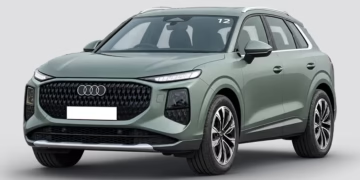

















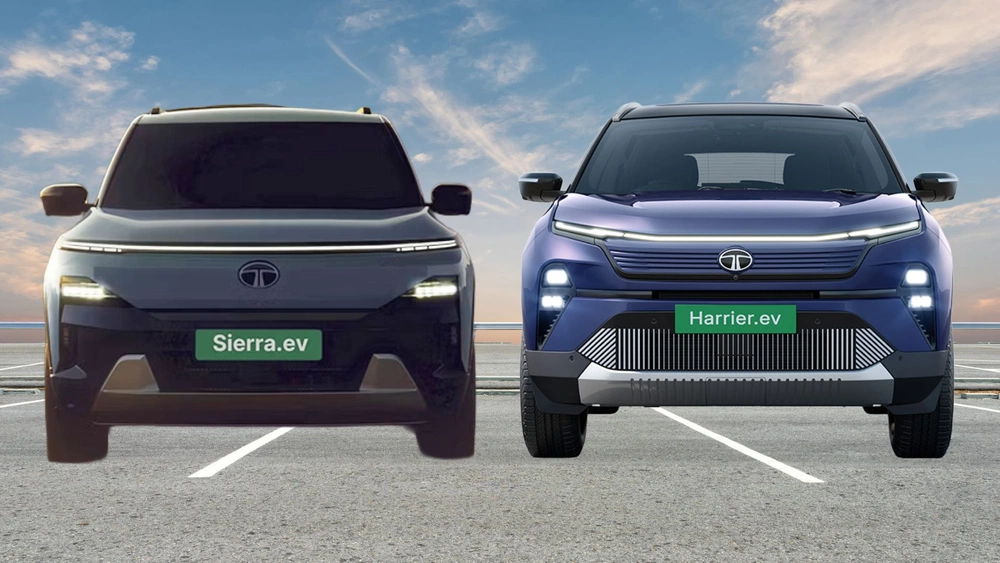
The Tata Harrier EV and Tata Sierra EV are now two of Tata Motors’ most important electric SUVs. While the Harrier EV offers a larger body and stronger road presence, the Sierra EV starts at a lower price and claims a higher maximum range.
Tata Harrier EV vs Sierra EV: Where they stand
The Tata Harrier EV and Tata Sierra EV target buyers looking for a premium electric SUV, but they approach the segment differently. The Harrier EV is the larger and wider vehicle, positioned above the Sierra EV in Tata’s electric SUV line-up. The Sierra EV, launched in June 2026, sits between the Curvv EV and Harrier EV in the company’s range.
As of August 27, 2026, the Sierra EV has a starting ex-showroom price of ₹18.79 lakh, while the Harrier EV starts at about ₹21.69 lakh according to current comparison data. That gives the Sierra an entry-price advantage of roughly ₹2.90 lakh.
However, price is only one part of this comparison. The two SUVs differ considerably in dimensions, boot space, battery options, range, drivetrain choices and driving character.
For buyers in Tier-2 and Tier-3 cities, the decision may also come down to road width, parking space, highway usage and the need for a practical family cabin.
Price comparison: Sierra EV has the lower entry point
The Tata Sierra EV has a significant advantage on starting price. Its range currently begins at ₹18.79 lakh ex-showroom for the Pure 63 RWD variant. The top-end Sierra EV Empowered A 75 AWD is priced at ₹25.99 lakh ex-showroom.
The Harrier EV starts higher, with the base price listed at ₹21.69 lakh in current comparison data. Its larger battery and higher variants push the price considerably higher, with the 75kWh AWD versions sitting toward the top of the range.
This means a buyer with a budget around ₹20 lakh has a clearer path into the Sierra EV.
The comparison becomes more interesting at higher budgets because there is considerable price overlap between the two SUVs. A buyer should therefore compare specific variants rather than assuming that the Sierra is always cheaper or the Harrier always offers more equipment.
Range comparison: Sierra EV has the headline advantage
Range is one of the biggest reasons to consider the Sierra EV. It gets 63kWh and 75kWh battery options, with the 75kWh RWD version claiming up to 665km of range. The 63kWh version has a claimed range of around 566km, according to current specifications.
The Harrier EV is available with 65kWh and 75kWh battery packs. Tata claims 538km for the 65kWh version and up to 627km for the 75kWh version, depending on configuration. The 75kWh AWD version has a claimed 622km range.
So, purely on claimed maximum range, the Sierra EV 75 RWD has the edge.
But buyers should not treat these figures as guaranteed real-world driving distances. Range changes with speed, traffic, weather, air-conditioning use, driving style, tyre pressure and road conditions.
For frequent highway travel between cities, the larger battery versions of either SUV make more sense.
Battery and performance: Harrier EV focuses more on power
Both SUVs offer large battery packs and all-wheel-drive options, but the Harrier EV has a particularly strong performance proposition.
The Harrier EV’s 75kWh AWD setup uses two motors and produces up to 313hp and 504Nm. Autocar India’s testing recorded 0 to 100kph in 6.74 seconds for the 75kWh AWD version.
The Sierra EV also offers a dual-motor setup on the larger battery. Its top AWD version produces around 306hp and 504Nm, with a claimed 0 to 100kph time of 5.8 seconds in current specifications.
The Sierra therefore should not be dismissed as a less capable SUV simply because it is smaller.
The Harrier’s advantage is more about its larger dimensions and heavier, more substantial character. The Sierra’s smaller footprint can be useful on narrower urban roads and crowded city streets.
Space comparison: Sierra surprises with its boot
This is one area where the smaller Sierra EV has an unexpected advantage.
The Harrier EV measures 4,607mm in length and 1,922mm in width, making it substantially larger than the Sierra EV. It has a 2,741mm wheelbase and a 502-litre boot, along with additional frunk storage.
The Sierra EV is 4,340mm long and 1,841mm wide, with a 2,730mm wheelbase. Despite being 267mm shorter than the Harrier, it offers a claimed 622-litre boot measured to the roof. It also has a frunk with capacity varying by drivetrain.
That makes the Sierra particularly attractive for families carrying luggage, shopping bags or weekend-trip equipment.
The rear cabin is also a strong point. Reviews note that the Sierra retains generous rear-seat space and even offers some backrest recline.
Harrier EV is wider and feels more substantial
The dimensions tell an important story.
The Harrier EV is 267mm longer and 81mm wider than the Sierra EV. Its wheelbase is only 11mm longer, which means the difference in exterior size does not translate into a proportionally larger cabin.
The Harrier’s extra width can be useful for three passengers sitting across the rear bench. It also contributes to the SUV’s broader road presence.
But that same width can become a disadvantage in narrow lanes, older residential areas and tight parking spaces.
For buyers in smaller cities and towns, this is worth considering. A vehicle that looks impressive on a wide highway may be less convenient if daily driving involves narrow roads or crowded markets.
The Sierra’s more compact dimensions make it easier to position in tighter spaces while still offering a substantial cabin.
Features: Both SUVs offer premium technology
Both electric SUVs come with extensive technology, but their interiors have different personalities.
The Harrier EV gets a large 14.53-inch Samsung Neo QLED display, a digital instrument cluster, JBL audio, ventilated seats, panoramic sunroof, multiple cameras, digital rear-view mirror and advanced parking functions on higher variants.
The Sierra EV has taken a more dramatic approach with its three-screen dashboard on higher variants. It also offers features such as a head-up display, powered seats, panoramic sunroof, connected-car technology and JBL audio with Dolby Atmos.
The Sierra’s feature list is particularly strong considering its starting price.
However, equipment varies significantly between variants. Buyers should compare the exact trim they intend to purchase rather than comparing only the base price of one vehicle with the top-spec features of the other.
Charging and long-distance usability
Both vehicles support DC fast charging, making them more practical for highway use than an EV that depends mainly on slower AC charging.
The Harrier EV can charge from 20% to 80% in about 25 minutes using a 120kW DC charger, according to current specifications.
The Sierra EV also offers DC fast charging, with current specifications listing 120kW charging capability on applicable variants.
For long-distance buyers, charging infrastructure remains just as important as battery capacity.
A buyer travelling regularly between major cities should check the availability of reliable DC chargers along frequently used routes. In Tier-2 and Tier-3 locations, home charging can become especially important because public fast-charging coverage may not be as dense as in major metros.
Which electric SUV offers better practicality?
The answer depends on what practical means for the buyer.
If boot capacity and a spacious family cabin are priorities, the Sierra EV makes a strong case. Its 622-litre boot is substantially larger than the Harrier EV’s 502-litre luggage capacity.
If road presence, width and highway-oriented driving matter more, the Harrier EV has the advantage.
The Harrier also offers 600mm water-wading capacity on the AWD version, which may appeal to buyers who regularly encounter difficult monsoon conditions or rough roads.
The Sierra EV counters with 205mm ground clearance and available quad-wheel drive, along with terrain modes and off-road assistance on higher variants.
Neither SUV should be treated as a dedicated off-roader, but both offer more capability than a typical urban EV crossover.
Tata Harrier EV vs Sierra EV: Which one should you buy?
For most buyers looking for value, the Sierra EV makes the stronger overall argument.
It starts nearly ₹3 lakh below the Harrier EV, offers up to 665km of claimed range, has a 622-litre boot and provides a spacious cabin in a more compact body.
The Harrier EV makes more sense if you want a larger SUV with a wider body, strong road presence and a more substantial highway-driving character. Its 75kWh AWD version also delivers 313hp and 504Nm, making it the more performance-focused choice on paper.
For a family that mostly drives in cities and occasionally takes highway trips, the Sierra EV is arguably the more sensible purchase.
For someone who frequently travels long distances, wants a larger SUV footprint and values performance and AWD capability, the Harrier EV deserves the extra consideration.
The best choice ultimately depends on the variant, not just the model name.
Key Takeaways
- Tata Sierra EV starts at ₹18.79 lakh, while the Harrier EV starts at about ₹21.69 lakh ex-showroom.
- Sierra EV offers a higher claimed maximum range of up to 665km, compared with up to 627km for the Harrier EV.
- Sierra EV has a larger claimed boot capacity of 622 litres, while Harrier EV offers 502 litres.
- Harrier EV is the better choice for buyers prioritising larger dimensions and strong performance, while Sierra EV offers stronger value and practicality.
FAQs
Which is cheaper, Tata Sierra EV or Harrier EV?
The Tata Sierra EV is cheaper at the entry level. Its starting price is ₹18.79 lakh ex-showroom, compared with about ₹21.69 lakh for the base Harrier EV in current comparison data.
Which has better range, Harrier EV or Sierra EV?
The Sierra EV has the higher claimed maximum range. Its 75kWh RWD version is rated at up to 665km, while the Harrier EV’s maximum claimed range is 627km for its 75kWh configuration.
Which has more boot space?
The Sierra EV has the larger boot. It offers 622 litres measured to the roof, while the Harrier EV offers 502 litres.
Should I buy the Sierra EV or Harrier EV?
The Sierra EV makes more sense for buyers prioritising price, range, family practicality and easier urban usability. The Harrier EV is better suited to buyers who want a larger, wider SUV with strong road presence and performance-focused AWD capability.