




























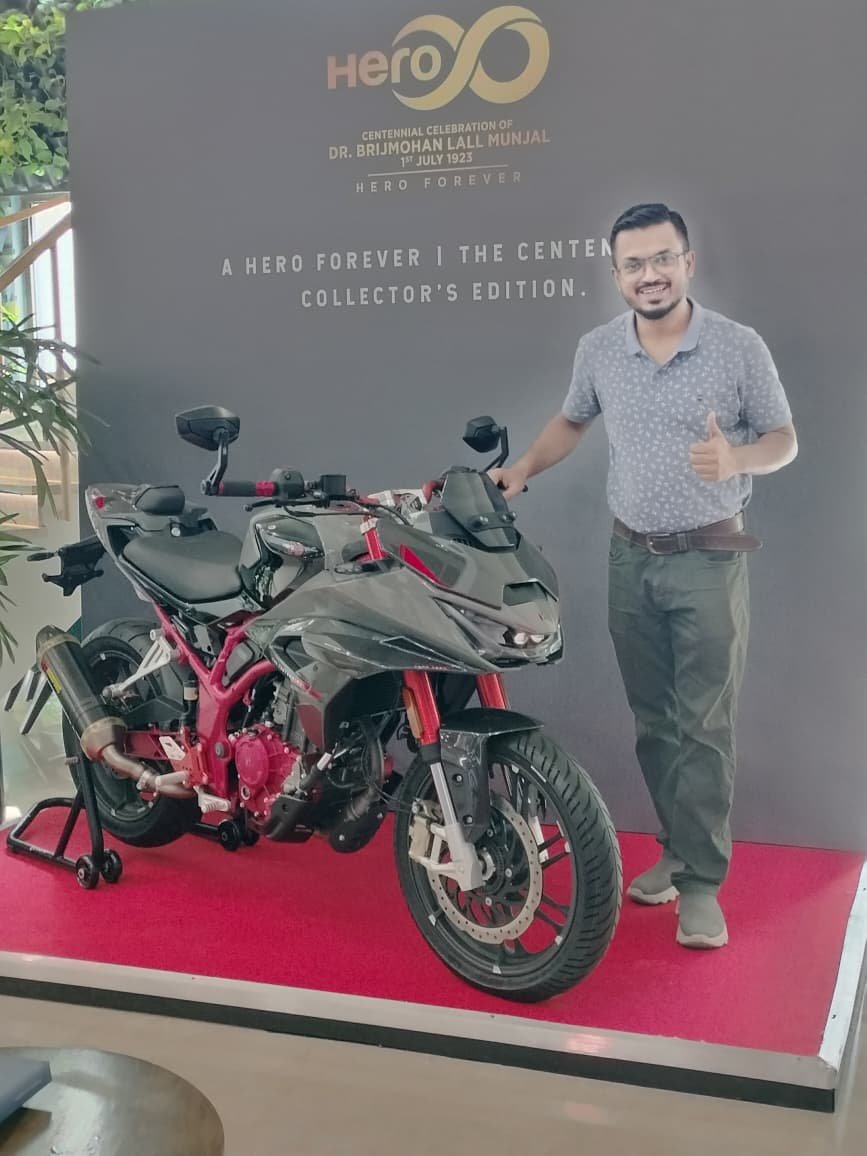
Managing Director & Chairman — D S Motors, Teliamura, Tripura, India
Looking a decade ahead, Shoumyadeep Ghosh wants to become a more strategic, patient and institution-oriented entrepreneur. Early in any journey, the founder has to be involved in everything — sales, operations, finance, every decision. But as an organisation matures, that role has to evolve from “I have to solve everything” to “I have to build people and systems capable of solving things.” He wants to sharpen his strategic thinking, delegation, technology adoption and organisational psychology, and to grow more comfortable with patience — accepting that not every investment, employee or strategy delivers results immediately. For him, the next decade is about building depth rather than chasing size, distributing leadership and institutionalising knowledge so responsibility doesn’t rest on one person alone.
Asked what scares him more, failure or stagnation, Ghosh doesn’t hesitate: stagnation. Failure at least forces useful questions — what went wrong, what should change. Stagnation is quieter and more dangerous, because a business can keep earning and appear normal while the market quietly moves ahead of it. He’d rather fail while trying to improve than stay comfortable while slowly becoming irrelevant, and he believes every organisation should periodically ask itself what it would do differently if it were starting today.
If he had to sum up his next chapter in one word, it would be transformation — not simply growing bigger, but becoming better, across personal, organisational, digital, people-related and strategic dimensions. His guiding rule: keep the values, upgrade the methods.
On people, listening and credibility
The most important thing Ghosh has learned about people is that they want to feel valued — customers, employees and partners alike. Even excellent products and technology mean little without trust, which is why he considers emotional intelligence a core leadership skill; business, at its core, is a human activity. He names listening as the most underrated business skill in leadership, arguing that the most important information rarely shows up in a formal report — it surfaces in conversations with frontline staff, technicians and customers who often spot problems before management does.
Credibility, in his view, is an entrepreneur’s most valuable asset — more durable than financial or technological advantage, and something that takes years to build but can be damaged quickly. He calls it the invisible infrastructure of a successful organisation: you won’t find it on a balance sheet, but you’ll see its consequences everywhere. That same thinking shapes his definition of powerful leadership — not volume or control, but the ability to create clarity, confidence, accountability, ownership, and ultimately, more leaders. An organisation that weakens whenever the founder is absent, he says, hasn’t truly institutionalised its leadership.
On legacy, consistency and society
If Ghosh’s journey could leave society one message, it would be not to underestimate consistent effort — in an age of instant visibility, real businesses still take years to build, and young entrepreneurs shouldn’t be discouraged just because progress isn’t immediately visible. He defines legacy not as personal recognition but as what continues to create value after he’s no longer personally involved — employees who grew, customers who kept trusting the business, an organisation that keeps generating opportunity. He hopes employees eventually say they learned something valuable from their time at D S Motors, and hopes customers remember, above all, that they could depend on the company — a sentence he considers worth more than any advertising slogan.
The next chapter, he says, is about institutional maturity: stronger systems, leadership development, digitalisation and a shift from a business that depends on individual intervention to one built on capable people and processes. He wants to be remembered not for revenue or titles, but for patience, trust, consistency and the people and institution he helped build — and he names integrity as the one thing he’ll never compromise, on the belief that trading long-term reputation for short-term advantage rarely pays off.
On principle, technology and India’s opportunity
One principle he never wants his organisation to forget: the customer isn’t an interruption to the business — the customer is the reason it exists. He also stresses that people remember experiences more than information, and that consistent behaviour, more than communication, is what actually builds culture and brand. On technology, he doesn’t see it competing with traditional business strengths like relationships and judgement; he sees it as an accelerator, with the real advantage belonging to organisations that combine human empathy with technological capability.
Ghosh sees India’s biggest entrepreneurial opportunity in the combination of young people, technology and regional markets — digital connectivity is steadily erasing the old advantage that metropolitan cities held, giving small-town entrepreneurs access to the same knowledge and tools. His message to them: don’t let geography become a psychological limit — think globally, understand locally, execute consistently.
Asked to sum up his philosophy in a sentence, he offers: keep learning, keep improving, keep building, and never let temporary circumstances define permanent potential. In five words, he calls his journey resilience, responsibility, learning, evolution and legacy — and when asked what’s still unfinished, he answers, with evident optimism, “almost everything.” Since D S Motors began in 2007, he doesn’t see its history as a conclusion but as a foundation — because the real goal was never simply to stay in business, but to stay valuable, useful and relevant.