




























The BMW i7 50 xDrive is the latest version of BMW’s flagship electric sedan in India, combining a 112.5kWh-class battery, dual-motor all-wheel drive, luxury-focused rear seating and extensive technology. The 2026 update also brings revised styling, a new cabin layout and a claimed WLTP range of up to 728km.
BMW i7 50 xDrive Gets a Major 2026 Update
The BMW i7 50 xDrive has received a substantial update for 2026, with changes covering its exterior design, cabin technology, battery and charging capability. The version tested by Autocar India is locally assembled and priced at Rs 1.95 crore, ex-showroom.
The i7 remains positioned as BMW’s flagship electric sedan, sitting alongside the petrol-powered 7 Series in the company’s luxury sedan range. The latest model is intended to combine the quietness of an electric powertrain with the space, equipment and comfort expected from a 7 Series.
BMW’s India website lists the new i7 50 xDrive with a claimed WLTP range of up to 728km, a 0 to 100kmph time of 5.5 seconds and a 111.5kWh battery. BMW also says the car can add up to 252km of WLTP range after 10 minutes of high-power charging under suitable conditions.
The headline numbers are impressive, but a luxury EV is ultimately judged by more than acceleration or claimed range. The important questions for everyday Indian use are how comfortable it is, how easily it can be driven in cities and how practical its charging and luggage arrangements are.
Exterior Design and Road Presence
BMW has revised the i7’s exterior without changing its basic large luxury-sedan proportions.
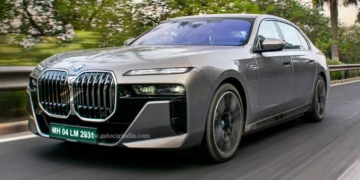
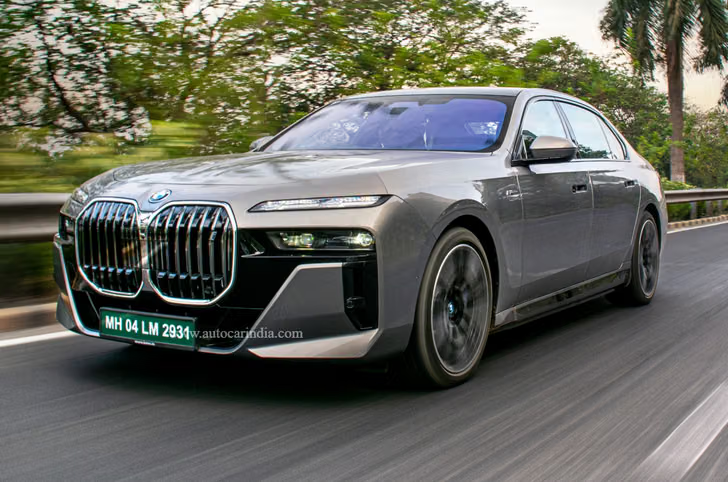
The 2026 version gets slimmer daytime running lights with a crystalline appearance, revised headlamps, a redesigned illuminated kidney grille and cleaner bumper treatment. The rear also receives revised tail-lamps, a new diffuser and a neater bumper design. Autocar India’s road test found the updated styling more cohesive than the outgoing design.
The car’s size remains substantial. That gives the i7 considerable road presence, but it also means drivers have to pay attention when negotiating narrow roads, crowded parking areas and tight urban lanes.
BMW addresses some of that challenge with Integral Active Steering. The rear wheels can turn by up to 3.5 degrees, helping reduce the turning circle at lower speeds and improving stability at higher speeds. BMW says the system makes manoeuvring in tight parking areas easier.
The test car also used 20-inch wheels with relatively high-profile tyres. While they may look less aggressive than larger wheels, the extra tyre sidewall contributes to the i7’s comfort-focused character.
Interior Comfort Is the Main Attraction
The cabin is where the BMW i7 50 xDrive makes its strongest case as a luxury sedan.
The 2026 model receives a redesigned dashboard with BMW’s new panoramic display concept. Instead of relying on a conventional instrument cluster, the car uses a wide panoramic head-up display positioned close to the base of the windscreen. It can show information including speed, navigation, charge status and other driving data.
There is also a new 17.9-inch central touchscreen, accompanied by a separate passenger display. The interface provides access to a large number of vehicle functions, although the sheer number of menus can make the system feel complicated.
The rear seats remain the real focus. All four seats offer heating, ventilation and massage functions according to Autocar India’s test. The rear-left seat can also be placed into a relaxation position, with the front passenger seat moving forward and an ottoman extending for the rear occupant.
For buyers who use the car with a chauffeur, this rear-seat experience is likely to matter more than outright performance.
Rear Seat Technology and Theatre Experience
The i7 is designed to function as a mobile luxury lounge as much as a car.
One of its most prominent features is the 31.3-inch 8K BMW Theatre Screen that folds down from the roof for rear passengers. The system is intended to provide a large-screen entertainment experience during longer journeys. BMW has also offered Amazon Fire TV integration on the i7 range in India.
The car also offers powered doors and extensive ambient lighting. The Bowers & Wilkins Diamond Surround Sound system is another major highlight. Autocar India’s 2026 test car had a 35-speaker setup with Dolby Atmos and BMW’s 4D audio functionality.
These features are not essential for commuting, but they explain the i7’s positioning. It is not simply an electric sedan with a large battery. It is intended to deliver an experience for passengers who may spend considerable time in the rear seat.
That focus becomes especially relevant in cities such as Mumbai, Delhi and Bengaluru, where luxury sedans are frequently used for chauffeur-driven travel.
BMW i7 50 xDrive Performance and Driving Experience
The i7 50 xDrive uses two electric motors and all-wheel drive. The latest Indian-specification car produces around 483hp and 660Nm according to Autocar India’s September 2026 road test, with a claimed 0 to 100kmph time of 5.5 seconds.
The important characteristic is not simply the acceleration figure. Electric motors deliver torque immediately, allowing the i7 to move with very little effort.
In normal driving, the power delivery is smooth and progressive. There is little reason to use the more aggressive driving modes during routine city travel because the car has considerable performance available even in its efficiency-focused settings.
Press the accelerator harder and the i7 responds quickly despite its roughly 2.8-tonne mass. Autocar India recorded a claimed 0 to 100kmph time of 5.5 seconds and noted that the car can reach 200kmph in under 19 seconds.
Regenerative braking can be adjusted through several settings, including Adaptive, High, Medium and Low. The Adaptive setting is particularly useful for everyday driving because it varies regeneration according to traffic and road conditions.
Ride Comfort on Indian Roads
For an Indian luxury sedan, ride quality is arguably more important than outright speed, and this is one area where the i7 50 xDrive performs strongly.
The car uses adaptive two-axle air suspension, and BMW says the system automatically adjusts damping according to road conditions. The rear-wheel-steering system also helps make the large sedan easier to manoeuvre.
Autocar India’s test found the ride exceptionally comfortable, including over broken road surfaces. The higher-profile tyres and air suspension help absorb potholes and rough patches while maintaining body control.
Ground clearance remains something drivers need to watch. The standard ride height is relatively low at 136mm, although the suspension can be raised by 20mm when required. This is useful for negotiating speed breakers and steeper ramps.
For Indian buyers, that lift function is more than a novelty. It can make a difference on poorly designed speed breakers, basement ramps and uneven urban roads.
Range and Charging for Everyday Use
The BMW i7 50 xDrive gets a larger battery than the earlier model. BMW’s current technical information lists a 111.5kWh battery and a maximum WLTP range of 728km. The car supports DC charging at up to 250kW, while AC charging is supported at up to 22kW.
BMW says a 10 to 80 percent DC fast charge can take as little as 28 minutes under suitable conditions. A 10-minute high-power charging session can add up to 252km of WLTP range, although actual results depend on the charger, battery temperature, state of charge and other conditions.
The claimed 728km should not be interpreted as a guaranteed real-world distance. WLTP testing is a standardised measurement, while actual range changes with driving style, traffic, speed, weather, air-conditioning use and road conditions.
That distinction matters in India, particularly for owners travelling between cities. The i7’s large battery provides a substantial buffer, but long-distance planning still depends on the availability and reliability of compatible fast chargers along the route.
Everyday Usability and Boot Space
The i7 is easy to drive for its size once the driver becomes familiar with its dimensions and steering system.
The light steering, rear-wheel steering and parking assistance features help in urban environments. BMW also offers Parking Assistant Professional and camera-based parking technology on the i7 range.
However, luggage space is one of the compromises.
Autocar India’s test noted that the spare wheel remains mounted on the boot floor, reducing usable luggage capacity. This is an unusual limitation for an electric flagship sedan, especially considering the amount of space available elsewhere in the vehicle.
This may not matter much for a daily office commute, but it becomes more relevant for airport transfers or long-distance trips involving several large suitcases.
The car’s overall dimensions can also be challenging in older city areas and tight parking structures. Its technology helps, but the i7 remains a large luxury sedan rather than a compact urban EV.
Features and Safety Technology
The BMW i7 50 xDrive is packed with equipment, ranging from comfort features to driver assistance systems.
BMW’s i7 range includes Driving Assistant Professional, which provides assistance with functions such as maintaining distance and lane position. Parking Assistant Professional adds additional camera and automated parking functions.
The cabin also gets multiple screens, advanced audio, powered doors, ambient lighting, heated and ventilated seats and rear-seat entertainment.
The challenge is that having many functions does not automatically make them simple to operate. Autocar India found the infotainment interface more complicated than ideal because several functions are located within multiple menus.
This is a recurring issue with highly digitised luxury cars. Physical buttons are reduced while touchscreen controls increase, giving manufacturers more flexibility but sometimes making simple adjustments less immediate.
For a car that may be driven by both owners and chauffeurs, ease of use remains an important part of everyday usability.
BMW i7 50 xDrive Price in India
The locally assembled BMW i7 50 xDrive is priced at Rs 1.95 crore, ex-showroom, according to the latest September 2026 road test and BMW India information. The higher-performance i7 M70 xDrive is positioned above it and is imported as a completely built unit.
At this price, the i7 competes in India’s flagship luxury sedan segment rather than the mainstream EV market.
The value proposition therefore depends on what the buyer wants from the vehicle. Range, performance and charging speed are important, but the strongest reasons to consider the i7 are its rear-seat comfort, quiet cabin, technology and ability to cover long distances without frequent charging when conditions are favourable.
The biggest compromises are its large size, complicated infotainment controls and reduced luggage practicality because of the spare wheel placement.
BMW i7 50 xDrive Verdict for Indian Buyers
The BMW i7 50 xDrive is designed around luxury first and electric propulsion second.
Its 2026 update improves the exterior design, adds a more advanced cabin and increases the battery capacity and claimed range. The 728km WLTP figure gives the car a substantial theoretical range, while 250kW DC charging can reduce charging stops when compatible infrastructure is available.
For passengers, the combination of air suspension, ventilated and massaging seats, rear relaxation functions, the 31.3-inch theatre screen and high-end audio creates a cabin designed for long journeys.
For the driver, the dual-motor powertrain provides effortless acceleration, while rear-wheel steering makes the large sedan easier to manoeuvre than its dimensions suggest.
The i7 50 xDrive is therefore best understood as a luxury chauffeur-friendly EV with strong everyday range and exceptional comfort. Its limitations are practical rather than fundamental: boot space is compromised, the infotainment system takes time to learn, and the car’s size remains a consideration on crowded Indian roads.
Takeaways
- The BMW i7 50 xDrive is priced at Rs 1.95 crore ex-showroom in India.
- Its 111.5kWh battery has a claimed WLTP range of up to 728km.
- The dual-motor all-wheel-drive setup delivers strong acceleration while maintaining a comfort-focused character.
- Rear-seat comfort, air suspension and extensive technology are major strengths, while boot practicality and infotainment complexity remain notable compromises.
FAQ
What is the BMW i7 50 xDrive range in India?
BMW lists a maximum WLTP range of up to 728km for the latest i7 50 xDrive. Real-world range will vary according to driving style, traffic, weather, road conditions, air-conditioning use and other factors.
How fast can the BMW i7 50 xDrive charge?
The i7 50 xDrive supports DC charging at up to 250kW. BMW lists a minimum 10 to 80 percent charging time of around 28 minutes under suitable high-power charging conditions. It also supports AC charging at up to 22kW.
Is the BMW i7 comfortable for Indian roads?
Yes, comfort is one of the car’s key characteristics. Its adaptive two-axle air suspension and higher-profile tyres help absorb rough surfaces, while the suspension can also be raised to provide additional clearance over difficult speed breakers.
Is the BMW i7 practical for everyday use?
The i7 can work well as an everyday luxury sedan, particularly for chauffeur-driven use. Its large dimensions require care in tight spaces, while the boot’s spare-wheel arrangement reduces usable luggage capacity. Parking assistance and rear-wheel steering help offset some of the car’s size.