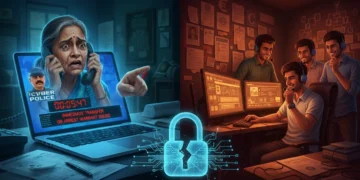



























Mumbai Cyber Police have arrested six people in an alleged digital arrest scam involving ₹1.12 crore taken from a 68-year-old retired businessman from Dahisar. Police say the accused impersonated telecom and police officials, used fake documents and kept the victim under video surveillance for nearly two weeks.
Mumbai digital arrest scam targeted a 68-year-old
The Mumbai digital arrest scam came to light after a 68-year-old retired businessman from Dahisar was allegedly forced to transfer ₹1.12 crore to accounts controlled by a group of fraudsters.
According to Mumbai Cyber Police, the alleged fraud took place between July 30 and August 12. The victim was contacted by people claiming to represent the Department of Telecommunications and was allegedly told that his Aadhaar details had been misused in a money laundering case.
The callers then connected him to people posing as police officers. Investigators said the fraudsters told the victim that a criminal case had been registered against him in Delhi and used threats of arrest to keep him under their control.
Police said the victim was kept under what the fraudsters called a digital arrest through WhatsApp video calls. The investigation eventually led to six arrests.
How the alleged digital arrest scam unfolded
The fraud reportedly began with a call from a person posing as a telecom official. The caller allegedly claimed that the victim’s Aadhaar details had been connected to an illegal SIM card or financial activity.
The call was then transferred to another person who claimed to be a police officer. According to investigators, the impersonator used the name Vijay Khanna and told the victim that his identity documents had been found during an investigation into money laundering.
The alleged fraudsters reportedly escalated the pressure by claiming that the victim was connected to a much larger money laundering case involving transactions worth ₹238 crore.
Police said the accused also showed the victim a fake Supreme Court notice and other documents carrying government and law enforcement references. The use of official-looking documents was allegedly intended to make the fabricated case appear genuine.
The victim was then subjected to repeated video calls and instructed to remain available to the callers.
Victim allegedly kept under video surveillance
Investigators said the 68-year-old was kept under the alleged digital arrest for nearly two weeks.
During this period, the fraudsters reportedly threatened him with arrest and allegedly told him that his family members could also face legal action. The victim was allegedly required to report his location regularly while remaining connected through video calls.
Police said the pressure eventually led the victim to liquidate fixed deposits and transfer a total of ₹1.12 crore into bank accounts controlled by the alleged network.
The fraud was discovered after the victim’s daughter became aware of what had happened and approached the cyber police.
This form of cyber fraud relies less on technical hacking and more on impersonation, fear and psychological pressure. The victim is made to believe that a serious criminal investigation is taking place and that transferring money is necessary to prove innocence or avoid arrest.
Six people arrested in Mumbai cybercrime case
Mumbai Cyber Police arrested six people in connection with the case.
The accused have been identified in police reports as Gaurav Mahesh Goyal, Shikhar Mukesh Tyagi, Rajesh Kumar Mohanlal Jain, Mohammad Tariq Anwar Momin, Ajay Kumar Kaliprasad Sharma and Chintankumar Sureshbhai Desai.
Police allege that the individuals had different roles in the financial and operational network used to move the fraud proceeds.
One of the accused, Goyal, is described by investigators as an IIT Delhi graduate and web developer. Police also said he had previously been booked in a separate cheating case in 2021.
Another accused, Tyagi, works as an operations manager at a private bank, according to investigators.
The arrests do not by themselves establish guilt. The allegations will be subject to the legal process as the investigation and proceedings continue.
Police trace money through bank accounts and SIM cards
Investigators followed the money trail after the ₹1.12 crore was transferred.
According to police, the first account that received the money was linked to a gold trading firm. Investigators then allegedly identified a wider network involving mule bank accounts, SIM cards and devices used to receive one-time passwords.
Police said SIM cards connected to the bank account were handled by one accused, while other members allegedly helped provide access to handsets used for OTPs.
Investigators also said one of the accused travelled from Mumbai to Delhi and then to Bijnor in Uttar Pradesh in connection with the movement or collection of the funds.
The investigation resulted in the seizure of 20 mobile phones, two laptops, 25 bank accounts, ATM cards, passbooks and Aadhaar cards, according to the Indian Express.
What makes digital arrest scams dangerous
Digital arrest scams exploit a basic weakness in online communication: it can be difficult for a victim to immediately verify who is on the other side of a phone or video call.
Fraudsters often use government names, police uniforms, official-looking documents and legal terminology to create a sense of authority. Once the victim becomes frightened, the scammers can keep increasing the pressure.
The Mumbai case allegedly followed this pattern. The victim was reportedly told that his identity documents were connected to a serious financial crime. Fake legal documents and impersonated officials were then used to reinforce the story.
The term digital arrest can itself be misleading. A person cannot be legally arrested simply through a WhatsApp video call. Government agencies and police do not conduct criminal arrests by placing someone under an online video-call confinement arrangement and demanding money to establish their innocence.
The key warning sign is a demand to transfer money because of an alleged police, court or government investigation conducted entirely through a phone or video call.
Why senior citizens remain vulnerable targets
Senior citizens can be particularly vulnerable to impersonation-based cyber fraud when criminals create a situation involving an apparent government or police investigation.
The Mumbai case demonstrates how quickly an ordinary communication can be turned into a prolonged fraud operation. The alleged scammers did not simply ask for money during a single call. They reportedly maintained contact with the victim over nearly two weeks.
The repeated interaction may have helped reinforce the false impression that the investigation was genuine.
Fraudsters can also use fear of arrest, damage to reputation and threats involving family members to prevent victims from discussing the matter with relatives. This isolation can give criminals more time to persuade the victim to make financial transfers.
Families can reduce this risk by discussing common cyber fraud methods with older relatives and encouraging them to independently verify unexpected calls involving police cases, financial crimes, Aadhaar details or court notices.
What people should do after receiving such calls
Anyone receiving a call claiming to be from the police, Department of Telecommunications, Enforcement Directorate, CBI, RBI or another government authority should avoid transferring money during the call.
The caller’s identity should be independently verified using official contact details rather than numbers or links supplied by the caller.
People should also avoid sharing OTPs, banking credentials, debit card information, passwords or remote-access permissions with unknown callers.
If money has already been transferred, reporting the incident quickly can help investigators trace transactions and potentially freeze funds that have not yet moved through the financial network.
In India, cybercrime complaints can be reported through the government’s National Cyber Crime Reporting Portal, while financial cyber fraud can also be reported through the 1930 cybercrime helpline.
Mumbai case highlights importance of quick reporting
The Mumbai investigation shows why early reporting can be important in financial cybercrime cases.
Police were able to trace the movement of the alleged fraud proceeds through bank accounts and identify people connected to the financial trail. Investigators also recovered electronic devices and banking materials during the probe.
The case remains under investigation, and police are examining the roles of the six arrested individuals and the wider financial network allegedly connected to the fraud.
For the public, the case offers a clear warning about one of the most common features of digital arrest scams: criminals create a fake legal emergency and then use fear to push victims into transferring money.
A genuine investigation should not require a person to pay money simply to avoid arrest through a video call. When a caller demands immediate payment while claiming to represent a law enforcement or government agency, independently verifying the claim is critical.
Takeaways
- Mumbai Cyber Police arrested six people in an alleged ₹1.12 crore digital arrest scam.
- A 68-year-old retired businessman from Dahisar was allegedly kept under video surveillance for nearly two weeks.
- Police say the accused impersonated telecom and police officials and used fake legal documents to frighten the victim.
- The investigation reportedly uncovered multiple bank accounts, SIM cards and electronic devices allegedly linked to the movement of the money.
FAQ
What is a digital arrest scam?
A digital arrest scam is a type of cyber fraud in which criminals impersonate police, government officials or other authorities and falsely tell victims that they are involved in a criminal case. The fraudsters then use threats and prolonged video or phone calls to pressure victims into transferring money.
How much money was lost in the Mumbai digital arrest case?
Mumbai Cyber Police said a 68-year-old Dahisar resident was allegedly defrauded of ₹1.12 crore. Police said the victim transferred the money into accounts controlled by the alleged fraud network.
How did the Mumbai digital arrest scam allegedly work?
Police said the fraudsters initially posed as telecom officials before impersonating police personnel. They allegedly claimed the victim was linked to a money laundering case, showed fake documents and used WhatsApp video calls to maintain control over him.
What should you do if someone claims you are under digital arrest?
Do not transfer money or share OTPs and banking information. End the call, independently verify the claim with the concerned agency and report suspected cyber fraud immediately. If money has already been transferred, contact the cybercrime helpline at 1930 as quickly as possible.
(Internal keyword suggestions: Mumbai digital arrest scam, digital arrest scam Mumbai, ₹1.12 crore cyber fraud, Mumbai cyber crime, senior citizen cyber fraud, digital arrest India, WhatsApp scam India, cyber fraud warning, digital arrest scam modus operandi, Mumbai cyber police)